


PM Modi dedicates Kochi Metro to the nation

Agencies
June 17, 2017

Thiruvananthapuram, Jun 17: Kerala shifted tracks to a new phase in urban transport infrastructure on Saturday, with Prime Minister Narendra Modi dedicating the first phase of Kochi Metro to the nation.
viewimage

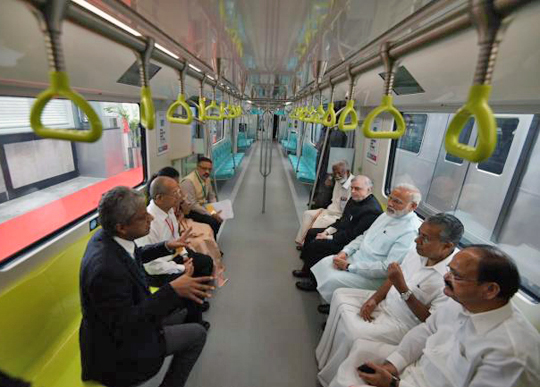
Before the formal opening of the 13.26-km first phase, between Palarivattom and Aluva, the Prime Minister took a ride on one of the trains. Addressing a gathering at the inaugural event’s venue in Kaloor, Modi highlighted features of Kerala’s first metro rail network which made it unique.

Kochi Metro is the first metro project commissioned with Communication-Based Train Controlling Signalling System. The Kochi Metro Rail Limited (KMRL) has provided jobs for about 1,000 women and 23 trans-genders. “The project is also an example of environment-friendly development. It plans to meet nearly 25% of the entire energy requirements from renewable sources, particularly solar energy. The long-term plan is to become a zero-carbon emitting urban transit system,” the Prime Minister said.

Modi said 50 cities in the country were ready to implement metro rail projects and foreign investment had been invited to the urban public transport sector. He said the National Transit Oriented Development Policy, issued in April, aimed to create “compact walkable communities” and bring public transport closer to transit.

Chief Minister Pinarayi Vijayan acknowledged contributions of migrant labourers in the construction of the Metro and requested KMRL to facilitate a Metro ride for them. Lauding the project coordinators for finishing work on the Metro on schedule, the Chief Minister said Kochi Metro sent out a message to potential investors that development projects could be completed in a time-bound manner in Kerala.

He sought assistance from the Centre to further the state-Centre association to pursue the development agenda while acknowledging the Centre’s “positive” approach to development. In a veiled reference to earlier uncertainties over the Prime Minister’s presence at the event, Vijayan said people who created the controversy were left “disappointed”. Kochi Metro will begin commercial operations on Monday.

Insets

On track

** Construction completed in four years
** Total project cost of Rs 5,181.79 crore
** Rs 2032.91 crore released by GoI
** Total 25.612 km, fully elevated, from Aluva to Petta
** 22 stations; 11 in phase 1
** 13.26 km in phase 1, in 20 minutes
** A train every 10 minutes, fares start at Rs 10
** First-in-India open-loop smart card for buses, taxi-cabs, autos
** 25% of energy requirements from renewable sources
** Covered vertical garden on every sixth pillar
** Water Metro as feeder service planned with 38 jetties

Cheers to Metro man

At the inaugural event attended by senior politicians and bureaucrats, the loudest cheers from the 3,000-odd crowd were reserved for ‘Metro Man’ and Chief Adviser for Kochi Metro, E Sreedharan. The applause, every time his name was mentioned on the dais, was significant after an earlier controversy over his exclusion from the dais. The veteran engineer, however, was characteristically self-effacing in his response. “(the cheers were) Probably because I’m a local,” he told reporters.

Fracas over a "free ride"

The presence of BJP state president Kummanam Rajasekharan during the Prime Minister’s inaugural Metro journey has come in for some criticism. Rajasekharan was not in the original list of passengers scheduled to travel with Modi, from Palarivattom to Pathadippalam.

The PM was accompanied by Governor P Sathasivam, Union Urban Development Minister Venkaiah Naidu, Pinarayi Vijayan, Chief Secretary Nalini Netto, Urban Development Secretary Rajiv Gauba, E Sreedharan and KMRL Managing Director Elias George. Rajasekharan’s presence was criticised on social media, also because elected representatives were not invited for the ride.

Comments

Shankar
 - 
Sunday, 18 Jun 2017

BJP is trying really hard to make a mark in Kerala. They are using all the PR tricks known to them.

Add new comment

  • Coastaldigest.com reserves the right to delete or block any comments.
  • Coastaldigset.com is not responsible for its readers’ comments.
  • Comments that are abusive, incendiary or irrelevant are strictly prohibited.
  • Please use a genuine email ID and provide your name to avoid reject.
Ram Puniyani
January 14,2020

In the beginning of January 2020 two very disturbing events were reported from Pakistan. One was the attack on Nankana Sahib, the holy shrine where Sant Guru Nanak was born. While one report said that the place has been desecrated, the other stated that it was a fight between two Muslim groups. Prime Minister of Pakistan Imran Khan condemned the incident and the main accused Imran Chisti was arrested. The matter related to abduction and conversion of a Sikh girl Jagjit Kaur, daughter of Pathi (One who reads Holy Guru Granth Sahib in Gurudwara) of the Gurudwara. In another incident one Sikh youth Ravinder Singh, who was out on shopping for his marriage, was shot dead in Peshawar.

While these condemnable attacks took place on the Sikh minority in Pakistan, BJP was quick enough to jump to state that it is events like this which justify the Citizenship Amendment Act (CAA). Incidentally CAA is the Act which is discriminatory and relates to citizenship with Religion, which is not as per the norms of Indian constitution. There are constant debates and propaganda that population of Hindus has come down drastically in Pakistan and Bangla Desh. Amit Shah, the Home minister stated that in Pakistan the population of Hindus has come down from 23% at the time of partition to 3.7% at present. And in Bangla Desh it has come down from 22% to present 8%.

While not denying the fact that the religious minorities are getting a rough deal in both these countries, the figures which are presented are totally off the mark. These figures don’t take into consideration the painful migrations, which took place at the time of partition and formation of Bangla Desh later. Pakistan census figures tell a different tale. Their first census was held in 1951. As per this census the overall percentage of Non Muslim in Pakistan (East and West together) was 14.2%, of this in West Pakistan (Now Pakistan) it was 3.44 and in Eat Pakistan it was 23.2. In the census held in Pakistan 1998 it became 3.72%. As far as Bangla Desh is concerned the share of Non Muslims has gone down from 23.2 (1951) to 9.6% in 2011.

The largest minority of Pakistan is Ahmadis, (https://minorityrights.org/country/pakistan/) who are close to 4 Million and are not recognised as Muslims in Pakistan. In Bangla Desh the major migrations of Hindus from Bangla Desh took place in the backdrop of Pakistan army’s atrocities in the then East Pakistan.

As far as UN data on refugees in India it went up by 17% between 2016-2019 and largest numbers were from Tibet and Sri Lanka.  (https://www.un.org/en/development/desa/population/migration/publication…)

The state of minorities is in a way the index of strength of democracy. Most South Asian Countries have not been able to sustain democratic values properly. In Pakistan, the Republic began with Jinnah’s classic speech where secularism was to be central credo of Pakistan. This 11th August speech was in a way what the state policy should be, as per which people of all faiths are free to practice their religion. Soon enough the logic of ‘Two Nation theory” and formation of Pakistan, a separate state for Muslim took over. Army stepped in and dictatorship was to reign there intermittently. Democratic elements were suppressed and the worst came when Zia Ul Haq Islamized the state in collusion with Maulanas. The army was already a strong presence in Pakistan. The popular formulation for Pakistan was that it is ruled by three A’s, Army, America and Allah (Mullah).

Bangla Desh had a different trajectory. Its very formation was a nail in the coffin of ‘two nation theory’; that religion can be the basis of a state. Bangla Desh did begin as a secular republic but communal forces and secular forces kept struggling for their dominance and in 1988 it also became Islamic republic. At another level Myanmar, in the grip of military dictatorship, with democratic elements trying to retain their presence is also seeing a hard battle. Democracy or not, the army and Sanghas (Buddhist Sang has) are strong, in Myanmar as well. The most visible result is persecution of Rohingya Muslims.

Similar phenomenon is dominating in Sri Lanka also where Budhhist Sanghas and army have strong say in the political affairs, irrespective of which Government is ruling. Muslim and Christian minorities are a big victim there, while Tamils (Hindus, Christians etc.) suffered the biggest damage as ethnic and religious minorities. India had the best prospect of democracy, pluralism and secularism flourishing here. The secular constitution, the outcome of India’s freedom struggle, the leadership of Gandhi and Nehru did ensure the rooting of democracy and secularism in a strong way.

India so far had best democratic credentials amongst all the south Asian countries. Despite that though the population of minorities rose mainly due to poverty and illiteracy, their overall marginalisation was order of the day, it went on worsening with the rise of communal forces, with communal forces resorting to identity issues, and indulging in propaganda against minorities.

While other South Asian countries should had followed India to focus more on infrastructure and political culture of liberalism, today India is following the footsteps of Pakistan. The retrograde march of India is most visible in the issues which have dominated the political space during last few years. Issues like Ram Temple, Ghar Wapasi, Love Jihad, Beef-Cow are now finding their peak in CAA.

India’s reversal towards a polity with religion’s identity dominating the political scene was nicely presented by the late Pakistani poetess Fahmida Riaz in her poem, Tum bhi Hum Jaise Nikle (You also turned out to be like us). While trying to resist communal forces has been an arduous task, it is becoming more difficult by the day. This phenomenon has been variously called, Fundamentalism, Communalism or religious nationalism among others. Surely it has nothing to do with the religion as practiced by the great Saint and Sufi traditions of India; it resorts mainly to political mobilization by using religion as a tool.

Comments

Ashi
 - 
Tuesday, 14 Jan 2020

If Malaysia implement similar NRC/CAA, India and China are the loser.

Add new comment

  • Coastaldigest.com reserves the right to delete or block any comments.
  • Coastaldigset.com is not responsible for its readers’ comments.
  • Comments that are abusive, incendiary or irrelevant are strictly prohibited.
  • Please use a genuine email ID and provide your name to avoid reject.
News Network
January 24,2020

Mangaluru, Jan 24: The third annual nocturnal Mangaluru Kambala, also known as the Rama Lakshmana Kambala, will be held on the night of January 25 at Goldfinch City in Bangra Kuluru, Mangaluru Kambala Samithi president Brijesh Chowta announced on Friday.

The all-night Kambala will have six categories - Naegilu Kiriya, Hagga Kiriya, Naegilu Hiriya, Hagga Hiriya, Kane Halage and Adda Halage.

The event will be inaugurated at 0930 hrs on January 25 and another programme will be held at 1800 hrs.

Comments

Add new comment

  • Coastaldigest.com reserves the right to delete or block any comments.
  • Coastaldigset.com is not responsible for its readers’ comments.
  • Comments that are abusive, incendiary or irrelevant are strictly prohibited.
  • Please use a genuine email ID and provide your name to avoid reject.
News Network
July 19,2020

Bengaluru, Jul 19: Karnataka Chief Minister B S Yediyurappa convened a meeting with Private Medical College Hospitals on Saturday to assess COVID-19 management and directed them to provide 50 per cent of the beds, as promised, with effect from Sunday.

The chief minister said that private medical college hospitals need to cooperate as there is a sharp rise in COVID-10 cases in the city. He further said that it has come to the notice of the government that some institutes are denying treatment of COVID-19 as well as non-COVID patients.

The chief minister expressed his concerns over media reports stating several people died as they didn't get timely treatment due to denial from the hospitals. He said that Bengaluru should continue to lead the country as a role model in COVID-19 management.

During previous meetings, private medical colleges had agreed upon providing around 4,500 beds, which would make the total beds available in government and private medical colleges 6,500.

The chief minister expressed dismay over some colleges not providing the number of beds as promised and also about certain lacunae which were noticed by ministers during their visit.
During this emergency situation, we should show humanity. COVID and non-COVID patients shall not be denied treatment and the balance in healthcare system shall be maintained, he advised.

He assured them of all support, including providing doctors and nurses if need be.
The private medical colleges had assured to provide 50 per cent of beds and some colleges offered 80 per cent of the beds for COVID treatment.

Nodal officers have already been appointed to monitor the availability of beds in these medical colleges.

It was decided to issue a notice to Vaidehi Medical College for their absence in the meeting.

Comments

Add new comment

  • Coastaldigest.com reserves the right to delete or block any comments.
  • Coastaldigset.com is not responsible for its readers’ comments.
  • Comments that are abusive, incendiary or irrelevant are strictly prohibited.
  • Please use a genuine email ID and provide your name to avoid reject.