



President, Sonia express concern over lynching incidents

Agencies
July 2, 2017

New Delhi, Jul 2: President Pranab Mukherjee joined Congress president Sonia Gandhi in expressing serious concern over growing number of mob lynching cases in India, wondering whether the society is vigilant enough to save the basic tenets of the country.
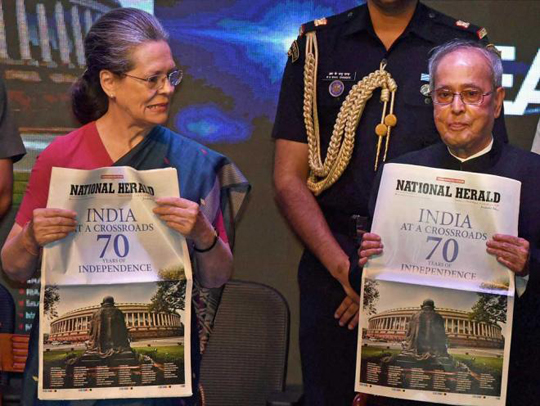
sonia

“When mob lynching becomes so high and uncontrollable, we have to pause and reflect, are we vigilant enough?,” Mukherjee said at the release of commemorative publication of relaunched National Herald here.

Sonia Gandhi, who spoke at the function, said, "It is being encouraged by a culture of vigilante violence, actively supported by those who are supposed to enforce the law."

Later, Priyanka Gandhi Vadra, daughter of the Congress president, told reporters that "It (incident of lynching) makes my blood boil. It should make blood of every Indian boil."

Mukherjee's comment and Sonia Gandhi's criticism came in the wake of reports about the spiralling violence over beef.

Mukherjee, who retires later this month, said, "When mob frenzy becomes so high, irrational and uncontrollable, we have to pause and reflect. I am not talking of vigilantism, I am talking of are we vigilant enough, proactively to save the basic tenets of our country.”

He said, "I do believe that citizens' and media vigilance can act as the biggest deterrent to forces of darkness and backwardness."

Congress president Sonia Gandhi said India is being marked by increasing threats of 'authoritarianism.'

She said, "Today the tried and tested idea of India has been thrown fundamentally into question by rising intolerance, by malevolent forces. It is being encouraged by a culture of vigilantive violence, actively supported by those who are supposed to enforce the law."

Gandhi further said that National Herald newspaper, which has been revived, is a testament to unity and justice and "not the division and hate that the present times are witnessing.

She said, "We are in a war of ideas, we have reached this war to preserve our ideas, which have built India as a model of democracy diversity and coexistence.if we don't raise our voices, if we do not speak up, our voices will be taken as consent."

A day after nationwide protests against lynchings spilt onto the streets, Modi had on Thursday broke his silence at Sabarmati Ashram in Gujarat and said killing people in the name of gau bhakti (devotion to the cow) is not acceptable.

The PM also said Mahatma Gandhi would not have approved of it and that no person in the country has the right to take the law into his own hands.

However, Modi's warning seemed to have had a little effect as just hours after his speech, Alimuddin, a meat trader, was lynched in Jharkhand’s Ramgarh.

Many cities witnessed protests across various locations under the tagline “Not in My Name” to protest against the lynching of 15-year-old Junaid Khan in a Mathura-bound train last week.

Comments

AK
 - 
Thursday, 6 Jul 2017

Thats VERY VERY GOOD .. Many families will give blessing to siddaramaiah...

Only Drunkards will not be happy with the closer.

Abdullah
 - 
Sunday, 2 Jul 2017

Worst President and opposition party ever faced in India.

Add new comment

  • Coastaldigest.com reserves the right to delete or block any comments.
  • Coastaldigset.com is not responsible for its readers’ comments.
  • Comments that are abusive, incendiary or irrelevant are strictly prohibited.
  • Please use a genuine email ID and provide your name to avoid reject.
News Network
January 13,2020

Jan 13: India lost more than $1.33 billion to internet restrictions in 2019 as Prime Minister Narendra Modi’s government pushed ahead with his party’s Hindu nationalist agenda, raising tensions and sparking nationwide protests.

The worst shutdown has been in Kashmir, where after intermittent closures in the first half of the year, the internet has been cut off since Aug. 5 following the government’s decision to revoke the special autonomous status of the country’s only Muslim-majority state, a study said. The prologued closure was criticized by India’s highest court, which ruled Friday that the “limitless” internet shutdown enforced by the government for the last five months was illegal and asked that it be reviewed.

India imposed more internet restrictions than any other large democracy, according to the Cost of Internet Shutdowns 2019 report released by Top10VPN, a U.K.-based digital privacy and security research group. The South Asian nation recorded the third-highest losses after Iraq and Sudan, which lost $2.31 billion and $1.86 billion respectively to disruptions. Worldwide internet restrictions caused losses worth $8.05 billion, the report said.

The cost of internet blackouts was calculated using indicators from groups including the World Bank, International Telecommunication Union, and the Delhi-based Software Freedom Law Center. It includes social media shutdowns in its calculations.

India’s ministry of information and technology didn’t respond to an email seeking a response to the report’s findings.

‘Conservative Estimates’

Through 2019, India shut access to the internet for over 4,000 hours. The report added shutdowns in India were often narrowly targeted, down to the level of blocking city districts for a few hours to allow security forces to restore order. Many of these incidents were not included in the report.

“These are conservative estimates,” said Simon Migliano, head of research at U.K.-based Top10VPN. “Internet shutdowns are increasing and it shows a damaging trend.”

India’s other major internet disruptions coincided with two moves by the government that affect India’s Muslim minority. The first disruption took place in November in the states of Uttar Pradesh and Rajasthan after the Supreme Court handed a victory to Hindu groups over Muslim petitioners in a long-simmering dispute over a plot of land.

There were further disruptions in December when protests erupted against the introduction of a religion-based law that allows undocumented migrants of all faiths except Islam from neighbouring countries to seek Indian citizenship. The government enforced shutdowns across Uttar Pradesh and some Northeastern states in order to quell the protests, the report said.

Comments

Add new comment

  • Coastaldigest.com reserves the right to delete or block any comments.
  • Coastaldigset.com is not responsible for its readers’ comments.
  • Comments that are abusive, incendiary or irrelevant are strictly prohibited.
  • Please use a genuine email ID and provide your name to avoid reject.
News Network
January 31,2020

New Delhi, Jan 31: Substantial competition and low tariff rates by telecom operators since 2016 have led to a financial stress in the sector, the Economic Survey said on Friday.

The data price in the country came down by over 99 per cent during 2016-2019, making it among the lowest tariff in the world, according to the survey.

"Since 2016, the sector has witnessed substantial competition and price cutting by the telecom service providers (TSPs), creating financial stress in the sector. As a result, the sector is experiencing consolidation. While some operators have filed for bankruptcy, others have merged, in their quest to improve viability," the survey report said.

In April-June 2019, the price of data was Rs 7.7 per gigabyte (GB) as compared to Rs 200 per GB in June 2016, it added.

"The Average Revenue Per User (ARPU) for GSM based mobile services has also gone down substantially from Rs 126 in June 2016 to Rs 74.30 in June 2019," the survey said.

The tariff war started in the market with entry of new telecom operator Reliance Jio in September 2016.

"BSNL and MTNL are also affected by the tariff war that has impacted their cash flow resulting in mounting losses," the survey said.

The financial health of the public sector telecom firms plummeted to a level where they have been finding hard to pay employees salaries in time.

The government has drawn up a plan to revive these PSUs which is still in works.

The revival plan consists of several measures, including reduction of staff cost through voluntary retirement scheme, allotment of spectrum for 4G services, monetisation of land and building, tower and fibre assets of BSNL and MTNL, debt restructuring through sovereign guarantee bonds and ''in-principle'' approval for merger of BSNL and MTNL.

The survey said that the wireless telephony now constitutes 98.27 per cent of all subscriptions whereas share of landline telephones now stands at only 1.73 per cent where market share is dominated by private sector players.

"The overall tele-density in India stands at 90.45 per cent, the rural tele-density being 57.35 per cent and urban teledensity being 160.71 per cent at the end of September 2019. The private sector dominates with a share of 88.81 per cent (106.06 crore connections) at the end of September, 2019 while the share of public sector was 11.19 per cent (13.36 crore connections)," the survey said.

The lower price of data has also lead in surge of broadband connections and average consumption of the internet.

Total broadband connections increased by about ten times, from 6.1 crore in 2014 to 59.46 crore in June 2019, the survey said.

The number of internet subscribers (both broadband and narrowband put together) stood at 66.53 crore at the end of June 2019 as compared to 25.16 crore in 2014.

The number of mobile internet subscribers was 64.36 lakh at the end of June 2019 while the number of wireline internet subscribers was 2.17 crore.

"India is now the global leader in monthly data consumption, with average consumption per subscriber per month increasing 157 times from 62 MB in 2014 to 9.8 GB in June 2019. The cost of data has also reduced substantially, enabling affordable internet access for millions of citizens," the survey said.

Comments

Add new comment

  • Coastaldigest.com reserves the right to delete or block any comments.
  • Coastaldigset.com is not responsible for its readers’ comments.
  • Comments that are abusive, incendiary or irrelevant are strictly prohibited.
  • Please use a genuine email ID and provide your name to avoid reject.
News Network
July 24,2020

New Delhi, Jul 24: The Delhi High Court on Friday asked the ICMR to come out with a clarification that mobile number, government-issued identity card, photographs or even a residential proof ought not to be insisted upon for Covid-19 test of mentally ill homeless persons.

According to an Indian Council of Medical Research (ICMR) advisory of June 19, every person who was to be tested for Covid-19 has to provide a government-issued identity proof and should have a valid phone number for tracing and tracking the individual and his/her contacts.

A bench of Chief Justice D N Patel and Justice Prateek Jalan said that ICMR should issue a clarification by way of a circular or an official order that the identity proof, address proof and mobile number are not required for testing mentally ill homeless persons.

The high court said a camp can be organised for testing such persons as is being done across Delhi for others.

"Guidelines have to be given by you (ICMR). You put it in black and white for the states'' benefit. You only need to clarify in two-three lines that mobile number, address proof and identity cards are not required for testing mentally ill homeless persons," it said.

"Use your powers for the public at large. Once you do so (issue the clarification), all states will comply," the bench added.

Additional Solicitor General Chetan Sharma, appearing for ICMR, sought time to take instructions from the government regarding the observations made by the bench.

The high court, thereafter, listed the matter for further hearing on August 7.

The bench was hearing a PIL moved by advocate Gaurav Kumar Bansal seeking directions to ICMR and Delhi government to issue guidelines for Covid-19 testing of mentally ill homeless persons in the national capital.

Coronavirus India update: State-wise total number of confirmed cases, deaths on July 24

The high court on July 9 had asked the ICMR to consider the plight of the mentally ill homeless persons and see whether they can be tested without insisting upon a mobile number, government issue identity card and residential address proof.

The bench had said to ICMR that many homeless mentally ill persons are institutionalised or in shelter homes and therefore, traceable, so there was no need for their identity proof or phone numbers to test them for Covid-19.

In response to the court''s query, ICMR has filed an affidavit stating that the purpose behind the submission of government identity card and telephone number was to ensure proper tracking and treatment of positive cases and their contacts as ''Test/Track/Treat'' is the best strategy for control of Covid-19 pandemic. 

It further said that since health was a state subject, the concerned state health authority may consider adopting a suitable protocol to ensure that the strategy of ''Test/Track/Treat'' is followed and the grievance raised in the PIL is also addressed.

ICMR, in its affidavit, has said that it has only advised facilitating contact tracing as well as tracking of the Covid-19 infected patients.

"The modalities regarding the contact tracing as well as tracking of the Covid-19 infected patients completely falls under the domain of IDSP. NCDC and state health authorities. 

"ICMR is a research organization and the contact tracing, as well as tracking of the Covid-19 infected patients, is not under the domain of ICMR," it has said in its affidavit.

Bansal has claimed in his petition that the Delhi government has not taken seriously the lack of guidelines with respect to Covid-19 testing of mentally ill homeless persons.

Coronavirus Worldometer | 15 countries with the highest number of cases, deaths due to the Covid-19 pandemic

He has said the high court had on June 9 directed it to address the grievances raised by him in another PIL with regard to mentally ill homeless persons in accordance with law, rules, regulations and government policy.

He said that on June 13 he also sent a representation to the Chief Secretary of Delhi government for providing treatment to mentally ill homeless persons in the national capital who have no residence proof. 

However, nothing was done by the Delhi government, he had told the court.

Comments

Add new comment

  • Coastaldigest.com reserves the right to delete or block any comments.
  • Coastaldigset.com is not responsible for its readers’ comments.
  • Comments that are abusive, incendiary or irrelevant are strictly prohibited.
  • Please use a genuine email ID and provide your name to avoid reject.