


Protests intensify after Karnataka releases Cauvery water to Tamil Nadu

September 7, 2016

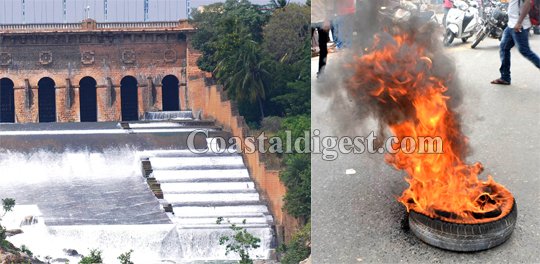
Bengaluru, Sep 7: Amid protests, Karnataka has started releasing Cauvery water to Tamil Nadu complying with the Supreme Court directive asking it to release 15,000 cusecs per day to the neighbouring state for ten days.
cavPInt

"Karnataka has started releasing Cauvery water to Tamil Nadu to obey the Supreme Court directive asking the state government to release 15,000 cusecs of water per day to Tamil Nadu for ten days," a state water resources ministry official said here.

He said the state started releasing water from midnight yesterday. Meanwhile, protesters have intensified their agitation in Mandya and other parts of the state blocking several roads and forcing schools and colleges to shut down. Complying with the Supreme Court direction, the state government yesterday decided to release water despite "severe hardships."

The court order directed an immediated backlash with agitated farmers and activists belonging to pro-Kannada outfits blocking the Bengaluru-Mysuru Highway.

Mandya district, the nucleus of Cauvery politics, saw a bandh yesterday with protesters holding road blockades and dharnas at several places, as hundreds of security personnel -- including central forces -- were deployed in the Cauvery belt to maintain law and order.

"Despite severe hardships faced by the government of Karnataka, the state will release water as directed by the Supreme Court," Chief Minister Siddaramaiah had told reporters after nearly a three-hour long all-party meeting convened by him here, yesterday.

Siddaramaiah had also said government would approach the Supreme Court with a modification petition, explaining its difficulties in implementing its order.

Noting that the 'samba' crops in Tamil Nadu would be adversely affected, an apex court bench comprising Justices Dipak Misra and U U Lalit directed Karnataka to ensure supply of water to Tamil Nadu.

Comments

fathima
 - 
Thursday, 8 Sep 2016

Stop blaming you people. Its not 'you',its 'us'. They are our people. Just like how yettinahole is crucial for mangaloreans,same goes with mandyans.As far as i know Tamilians are more proud being Tamilian than being Indian.They should see alternative ways for their problem.Always depending on Cauvery will make two states to fall in drought in coming days

Rikaz
 - 
Wednesday, 7 Sep 2016

Give them water, dont be selfish....

Priyanka
 - 
Wednesday, 7 Sep 2016

u people are protesting like anything when it comes to u, u cant give your water to anybody then how can u ask mangalore's water wasnt u ashamed of it. yethinahole always be ours.

Add new comment

  • Coastaldigest.com reserves the right to delete or block any comments.
  • Coastaldigset.com is not responsible for its readers’ comments.
  • Comments that are abusive, incendiary or irrelevant are strictly prohibited.
  • Please use a genuine email ID and provide your name to avoid reject.
Agencies
January 1,2020

Kanpur, Jan 1: In a seemingly bizarre development, the IIT in Kanpur has set up a panel to decide whether the poem "Hum dekhenge lazim hai ki hum bhi dekhenge", penned by Faiz Ahmad Faiz, is anti-Hindu.

The panel has been set up in response to complaints filed by a faculty member who claimed that the students, during a protest, sang this poem which was anti-Hindu.

The poem reads thus -- "Lazim hai ke hum bhi dekhenge. Jab arz-e-Khuda ke kaabe se. Sab bhut uthwaye jayenge, Hum ahl-e-safa mardood-e-harm. Masnad pe bithaye jayenge. Sab taaj uchale jaenge. Sab takht giraye jayenge. Bas naam rahega Allah ka. Hum dekhenge."

It was the last line that has turned into a bone of contention. Translated into English, it means, 'When thrones will vanish, only Allah's name will remain' -- implying the misleading translation by the professor.

The poem had been written by Faiz in reference to military dictator Zia-ul-Haq in 1979 and was against the military rule in Pakistan. Faiz had left leanings and was an atheist. He was known for his revolutionary writings that kept him in jail for several years.

It may be recalled that the IIT-Kanpur students had taken out a peaceful march on the campus on December 17 in support of the students of Jamia Millia Islamia and during the march, the students sang the Faiz poem.

According to IIT Deputy director Manindra Agarwal: "In the video, the students are seen reciting the Faiz poem which can also be perceived as being anti-Hindu.

The IIT faculty member, in his complaint, has alleged that the students made anti-India and communal statements during their demonstration in solidarity with the Jamia students.

The complaint was based on two lines of the poem, which have obviously been misinterpreted -- "When all idols will be removed, only Allah's name will remain."

The faculty member has stated that "organisers and masterminds must be identified and expelled immediately."

Fifteen other students have also signed the complaint filed by the professor against the protesting students.

Meanwhile, IIT students have said that the faculty member who lodged the complaint has been banned on a social networking site for posting communal content.

In an article published on the IIT-Kanpur student media portal, the students clarified what exactly happened on the day of protest and how their chant was given a 'communal and misleading' turn. They stated that they had recited a few lines of the Faiz poem in reference to the police crackdown on the Jamia students.

Comments

Add new comment

  • Coastaldigest.com reserves the right to delete or block any comments.
  • Coastaldigset.com is not responsible for its readers’ comments.
  • Comments that are abusive, incendiary or irrelevant are strictly prohibited.
  • Please use a genuine email ID and provide your name to avoid reject.
coastaldigest.com news network
February 23,2020

Mangalore University has been participating in the campus bird count a sub-event of ‘Great backyard bird count’ (GBBC) organized by Bird Count India for the past 5 years. This year, CBC was held from 14th to 17th February of 2020 across various campuses in India.

This year the four days event was successfully ended up with the sightings of 103 species of birds from various locations across the campus spread on 300 acres. In this Black Drongo, Black Kite, Brahminy Kite, Common Iora, Green Wabler, Purple-rumed Sunbird, Red-whiskered Bulbul, White-cheeked Barbet, Jungle Babbler and Plum headed parakeets were the common birds, and also observed House Crow with nest and nestlings, Indian Robin nest with eggs, Bronzed Drongo constructing the nest and Shikra mating and carrying nesting materials.  Whereas Yellow-billed Babbler is rare in the campus, Ashy Drongo, Barn Swallow, Booted Eagle, Grey Wagtail, Indian Pitta etc. were migratory birds, Grey-headed Bulbul (Near Threatened bird), Rufous Babbler and Grey-headed Bulbul were Western Ghats Endemics  and Brown Wood Owl, Barn Owl, Spotted Owlet, Nightjars (Savanna, Indian and Jerdon’s) and Sri Lanka Frogmouth were nocturnal birds. Blue-eared Kingfisher Grey-bellied Cuckoo which was very rare and new additions to avian list of the campus.

In the first year (2016) of Mangalore University’s CBC recorded 77 species, in 2017 recorded 95 species, in 2018 recorded 110 species and in 2019 recorded 107 species of birds. However some of the common species like Rose ringed parakeets, Blue tailed bee-eater, Nilgiri Flowerpecker and Indian roller etc., sighted last year were not seen this year. But with 2 new additions from this CBC, the checklist of Mangalore University Campus has been updated with a total of 141 species.

This event was coordinated by Vivek Hasyagar from the Department of Applied Zoology and Maxim Rodrigues from the Department of Marine Geology. Survey trails were led by more than 60 students and research scholars from various Departments of Mangalore University includes Applied Zoology, Biosciences, Microbiology, Botany, Physics, Chemistry and Material Science.  In addition, some enthusiastic participants from St. Aloysius College had involved in identifying the birds around the campus.

Quote:

Wild/planned fire affects negatively on the existing ecologically sensitive areas in and around the campus especially in lateritic grasslands. Because many insectivorous birds are dependent on these lateritic grassland habitats for their food and breeding grounds for many ground dwelling birds like Yellow wattled lapwing, Red wattled lapwing, Indian Robin and Barred buttonquails. Conserving these habitats will be helpful in protecting these birds.

Quotes from the participants: “The Campus Bird Count 2020 at Mangalore University was an experience of its own kind. Observing birds in their natural habitat gave me new perspective of viewing them not only as another living being, but as equals, or even of higher intelligence. The Campus Bird Count is an important step towards documenting bird life year after year, and creating awareness amongst youngsters, so that proper conservation steps can be taken to protect them from human interference”.

-Jyotsna Dessai ( 1 M.Sc Zoology)

Comments

Add new comment

  • Coastaldigest.com reserves the right to delete or block any comments.
  • Coastaldigset.com is not responsible for its readers’ comments.
  • Comments that are abusive, incendiary or irrelevant are strictly prohibited.
  • Please use a genuine email ID and provide your name to avoid reject.
News Network
March 25,2020

Mangaluru, Mar 25: Fishing boats returned to the old Port in Mangaluru after the government prohibited deep-sea fishing till further orders on Wednesday to prevent the assembly of a large gathering here in the wake of the novel coronavirus pandemic. 

According to officials, deep-sea fishing activities result in the gathering of a large number of people and is much against the government's direction on maintaining social distancing. 

According to the Department, the 42-Km coastline in Dakshina Kannada hass 57 purse seine boats, 1,270 trawl boats, 1,483 gillnet boats, 549 other mechanised boats.

Comments

Add new comment

  • Coastaldigest.com reserves the right to delete or block any comments.
  • Coastaldigset.com is not responsible for its readers’ comments.
  • Comments that are abusive, incendiary or irrelevant are strictly prohibited.
  • Please use a genuine email ID and provide your name to avoid reject.