


Rahul, Left leaders back JNU students' protest

February 14, 2016

New Delhi, Feb 14: The protest against the arrest of Jawaharlal Nehru University (JNU) Students’ Union president Kanhaiya Kumar on charges of sedition turned into a political battle on Saturday.
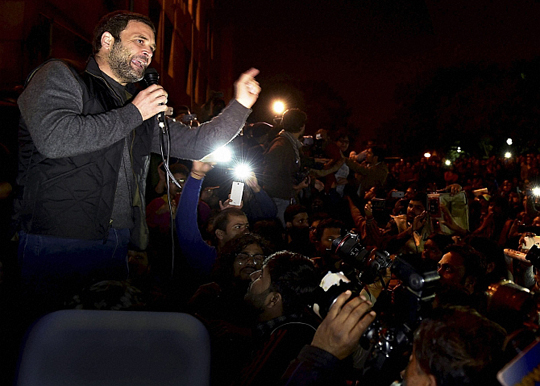
rahul

Congress vice-president Rahul Gandhi’s visit to the campus in the evening along with some party colleagues, including Deputy Leader of the Opposition in the Rajya Sabha Anand Sharma, charged the already tense atmosphere in the campus.

Rahul was welcomed by some “members and supporters” of Akhil Bharatiya Vidyarthi Parishad (ABVP) with black flags.

Left party leaders, including CPM general-secretary Sitaram Yechury and CPI leader D Raja, were also present which triggered counter protests by ABVP members.

Delhi Chief Minister Arvind Kejriwal chose to highlight allegations that ABVP was behind the anti-India slogans against hanging of 2001 Parliament attack convict Afzal Guru. The chief minister has ordered a magisterial enquiry.

Earlier, seven students were taken into preventive custody. They were taken to Parliament Street police station and were released later in the evening.

Though the protest, held outside Indira Gandhi National Centre for the Arts, was thwarted, there were other protests during the day on the university campus.After Kumar’s arrest, students and some teachers have been holding protests demanding to know why students are being treated like “terrorists” and were being arrested from the campus.
Upset by the arrest and heavy police presence on the campus, the professors have also expressed concern over the “threat to democratic ethos”.

“JNU has always been a university where there has been a vibrant culture. Excessive police action is uncalled for and has worsened the situation,” the professors said in a statement.

The police, too, wrote a letter to vice-chancellor Jagadesh Kumar asking the University to produce five students who were involved in “anti-national” activities and told the varsity authorities to alert them if such activities take place in future.

Some former Army officers have also threatened to return their JNU degrees saying that they find it difficult to be associated with a university which has become a hub of anti-national activities.

Comments

Abu Muhammad
 - 
Sunday, 14 Feb 2016

Anti-Indian slogan should be condemned and punished. At the same time hoisting Pakistani flag by Sanghparivar, celebrating Gandhiji's murder, installing killers Godse statue & worship, disrespect to constitution, Arms training to Sanghparivar goons, waging war against secular India by openly declaring it as Hindu Rashtra, honouring assassins of Indira Gandhi, Sanghparivars open support and allegiance to British during Freedom struggle - ARE ALL THESE -ACTS OF PATRIOTISM? or 100% ANTI-NATIONAL?

NationalismBef…
 - 
Sunday, 14 Feb 2016

Exposes true face of Rahul G and Left leaders, shame on them for supporting students raising anti-India slogans.

Add new comment

  • Coastaldigest.com reserves the right to delete or block any comments.
  • Coastaldigset.com is not responsible for its readers’ comments.
  • Comments that are abusive, incendiary or irrelevant are strictly prohibited.
  • Please use a genuine email ID and provide your name to avoid reject.
Agencies
February 10,2020

New Delhi, Feb 10: The government is set to privatise Central Electronics Ltd, a CPSE under the Department of Science and Technology, by selling its 100% stake with management control and has invited the Expression of Interest for the same by March 16.

The selected bidder will be required to lock in its shares for a period of three years during which it cannot undertake the sale of its stake in CEL, the PIM (Preliminary Information Memorandum) said.

"The government of India has 'in-principle' decided to disinvest 100 per cent of its equity shareholding in CEL (which is equivalent to 100 per cent of the total paid up equity share capital of CEL) through Strategic Disinvestment with transfer of management control (Strategic Disinvestment or Transaction)," DIPAM, the Disinvestment Department, said.

The process for the transaction has been divided into two stages, namely, Stage I and Stage II.

After BPCL and Air India, this is yet another CPSE which government is slated to privatise if it gets offers from bidders.

The government has set a challenging target of Rs 2.1 lakh crore disinvestment proceeds from CPSE sell-offs and IPOs, OFSs (Offer for sale) in the next fiscal and it going out all guns blazing to meet that target after revising this fiscal target of Rs 1.05 lakh crore to Rs 65,000 crore.

The Interested Bidders (which can also include employees of CEL) must have a minimum net worth of Rs 50 crore as on March 2019. DIPAM has released complete invitation Preliminary Information Memorandum (PIM) of CEL. Resurgent India Limited is the advisor to the Transaction.

CEL is a pioneer in the country in the field of Solar Photovoltaic (SPV) with the distinction of having developed India's first Solar cell in 1977 and first Solar panel in 1978 as well as commissioning India's first solar plant in 1992.

More recently, it has developed and manufactured the first crystalline flexible solar panel especially for use on the passenger train roofs in 2015.

Its solar products have been qualified to International Standards IEC 61215/61730. CEL is further working on development of a range of new and upgraded products for signaling and telecommunication in the railway sector.

In the SWOT analysis of the CPSE, DIPAM has stated under weakness that "the company has weak financial loss due to past losses, high manufacturing cost and non payment of dues by state nodal agencies affecting the financial position of the company".

The CPSE has adequate land for expansion, the SWOT analysis said adding "the CPSE faces threat of dumping of solar cells at very low rates which makes solar PV manufacturing industry unviable".

Entry of new players in the market for solar products and railway signalling systems also is cited as a threat.

Comments

Add new comment

  • Coastaldigest.com reserves the right to delete or block any comments.
  • Coastaldigset.com is not responsible for its readers’ comments.
  • Comments that are abusive, incendiary or irrelevant are strictly prohibited.
  • Please use a genuine email ID and provide your name to avoid reject.
News Network
January 9,2020

New Delhi, Jan 9: JNU students who tried to march towards the Rashtrapati Bhavan on Thursday protesting the violence on the university campus were stopped by police and later detained.

The police also resorted to baton charge to control the mob who tried to block the traffic at Janpath. Using loudspeakers, the police also appealed to the crowd to maintain peace.

Before the students tried to proceed towards the Rashtrapati Bhavan, a delegation of JNU Students' Union and JNU Teachers' Association also met Human Resource Development (HRD) Ministry officials and demanded the removal of Vice-Chancellor M Jagadesh Kumar from his post.

Comments

Add new comment

  • Coastaldigest.com reserves the right to delete or block any comments.
  • Coastaldigset.com is not responsible for its readers’ comments.
  • Comments that are abusive, incendiary or irrelevant are strictly prohibited.
  • Please use a genuine email ID and provide your name to avoid reject.
News Network
January 10,2020

Mumbai, Jan 10: India’s oil demand growth is set to overtake China by mid-2020s, priming the country for more refinery investment but making it more vulnerable to supply disruption in the Middle East, the International Energy Agency (IEA) said on Friday.

India’s oil demand is expected to reach 6 million barrels per day (bpd) by 2024 from 4.4 million bpd in 2017, but its domestic production is expected to rise only marginally, making the country more reliant on crude imports and more vulnerable to supply disruption in the Middle East, the agency said.

China’s demand growth is likely to be slightly lower than that of India by the mid-2020s, as per IEA’s China estimates given in November, but the gap would slowly become bigger thereafter.

“Indian economy is and will become even more exposed to risks of supply disruptions, geopolitical uncertainties and the volatility of oil prices,” the IEA said in a report on India’s energy policies.

Brent crude prices topped USD 70 a barrel on rising geopolitical tensions in the Middle East, putting pressure on emerging markets such as India. Like the rest of Asia, India is highly dependent on Middle East oil supplies with Iraq being its largest crude supplier.

India, which ranks No 3 in terms of global oil consumption after China and the United States, ships in over 80 per cent of its oil needs, of which 65 per cent is from the Middle East through the Strait of Hormuz, the IEA said.

The IEA, which coordinates release of strategic petroleum reserves (SPR) among developed countries in times of emergency, said it is important for India to expand its reserves.

REFINERY INVESTMENTS

India is the world’s fourth largest oil refiner and a net exporter of refined fuel, mainly gasoline and diesel.

India has drawn plans to lift its refining capacity to about 8 million bpd by 2025 from the current about 5 million bpd.

The IEA, however, forecasts India’s refining capacity to rise to 5.7 million bpd by 2024.

This would make “India a very attractive market for refinery investment,” IEA said.

Drawn to India’s higher fuel demand potential, global oil majors like Saudi Aramco, BP, Abu Dhabi National Oil Co and Total are looking at investing in India’s oil sector.

Saudi Aramco and ADNOC aim to own a 50 per cent stake in a planned 1.2-million bpd refinery in western Maharashtra state, for which land is yet to be acquired.

Comments

Add new comment

  • Coastaldigest.com reserves the right to delete or block any comments.
  • Coastaldigset.com is not responsible for its readers’ comments.
  • Comments that are abusive, incendiary or irrelevant are strictly prohibited.
  • Please use a genuine email ID and provide your name to avoid reject.