


Rise in kidney ailments overload dialysis units

December 16, 2015

Bengalur, Dec 16: The rising number of kidney ailments, due to the increasing cases of non-communicable diseases, has posed a serious challenge to the government. The limited dialysis facilities are witnessing an overload.
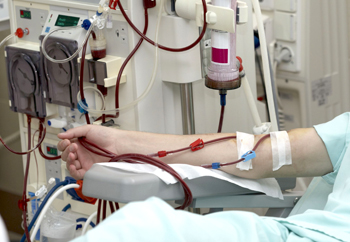
kidneyAt least two lakh people undergo dialysis in the State. Speaking to media persons, Dr Keshavamurthy R, director, Institute of Nephro Urology, said that with non-communicable diseases such as diabetes on the rise, those with kidney ailments are seen in good numbers.

The Institute sees a patient overload most of the time. With 25 units in place, 60 to 65 people undergo dialysis every day, while a good number are asked to await their turn. “No matter how many units are started, they are occupied because patients are seen in growing numbers,” he said.

This Institute sees patients from West Bengal and Odisha as well. “The diagnosis is done and we put them on dialysis.

Later, they are sent back to their respective places unless their condition is serious as a very small number can be treated completely or can undergo a transplant. The rest have to be on dialysis for life,” he said.

Institute expansion

The autonomous institute will undergo expansion soon. A proposal has been sent to the government for construction of a four-storey building on a plot behind the present premises. With this, 45 more beds will be added. If approved, the construction will begin in the next six months.

PPP model

If infrastructure is one challenge, inadequate manpower is another. For a dialysis centre to be functional, at least one nephrologist, a technician and nurses trained in dialysis are a must.

However, with not enough specialists on hand, the department of health and family welfare and that of medical education have resorted to training general physicians to carry out the procedure. One doctor from each taluk is undergoing training by turns at the Institute of Nephro Urology to be able to go back and run dialysis units.

Meanwhile, Dr G Vamadev, director, department of health and family welfare, said that they had sought a report from all districts on the number of dialysis units available and the want of manpower.

“There is a proposal to start dialysis units on a public-private partnership model. The government will provide the infrastructure necessary, while the other party will run the centre with manpower and consumables,” he said.

Comments

Add new comment

  • Coastaldigest.com reserves the right to delete or block any comments.
  • Coastaldigset.com is not responsible for its readers’ comments.
  • Comments that are abusive, incendiary or irrelevant are strictly prohibited.
  • Please use a genuine email ID and provide your name to avoid reject.
coastaldigest.com news network
January 12,2020

Mangaluru, Jan 12: Sudarshan Moodbidri and Robin Devaiah were today unanimous elected presidents of Dakshina Kannada and Kodagu district units of Bharatiya Janata Party.

Karnataka BJP vice-president Nirmal Kumar Surana oversaw the election process of the two district units at the BJP’s party office here.

While Sanjeeva Matandoor, Puttur MLA and incumbent president of DK unit of the party welcomed his successor Sudarshan, it was the turn of BB Bharatheesh, president of Kodagu unit to welcome Robin.

K Uday Kumar Shetty, DK district election officer and Ravi Kalappa, Kodagu district assistant election officer conducted the election under the supervision of Surana in the presence of MLAs of the party from respective districts.

Sudarshan started out his career as taluk and then district convener of Bajrang Dal before taking up responsibility as seva pramukh of Vishwa Hindu Parishad.

He formally joined the BJP as general secretary of Mulki-Moodbidri assembly unit of the party, moved on as convener of training cell of the party and was the general secretary of the district unit of the party before his elevation. A B.Com student of Dhavala College, Moodbidri, he is 44.

Robin, 50, who started out as a RSS volunteer as a student, too is incumbent general secretary of the Kodagu unit. Having been a member of ABVP for 8-years, he joined BJP formally in 1996 through Yuva Morcha and was its district treasurer, national executive member and state general secretary.

A product of Field Marshal K M Cariappa College, Kodagu, he served two terms as general secretary of the district unit prior to his elevation.

Comments

Add new comment

  • Coastaldigest.com reserves the right to delete or block any comments.
  • Coastaldigset.com is not responsible for its readers’ comments.
  • Comments that are abusive, incendiary or irrelevant are strictly prohibited.
  • Please use a genuine email ID and provide your name to avoid reject.
News Network
January 25,2020

New Delhi, Jan 25: The latest edition of the Oxford Advanced Learner's Dictionary features 26 new Indian English words, including Aadhaar, chawl, dabba, hartal and shaadi.

The 10th edition of the dictionary, which was launched on Friday, has 384 Indian English words and incorporates over 1,000 new words such as chatbot, fake news and microplastic.

The dictionary focuses on language change and its evolution through the years, and has ensured that the language and examples used in the new edition are relevant and up to date with the times, Oxford University Press (OUP) said.

The new edition comes with interactive online support through the Oxford Learner's Dictionaries website and an app. The website includes advanced features such as audio-video tutorials, video walkthroughs, self-study activities and enhanced iWriter and iSpeaker tools.

"This edition has 26 new Indian English words of which 22 figure in the printed dictionary. The other four are in the digital version," said Fathima Dada, Managing Director (Education Division) at OUP.

Some of other new Indian words in the dictionary are auntie (while aunty already figures in the English dictionary, auntie is an Indianism), bus stand, deemed university, FIR, non-veg, redressal, tempo, tube light, veg and videograph.

The four new Indian English words in the online version of the dictionary are current (for electricity), looter, looting and upazila (one of the areas that a district is divided into for administration purposes).

According to OUP, the new edition provides better, more accurate and understandable definitions with examples, usage notes and additional resources to help the learner use the right word in the right context.

"Prevalence and common usage are the main criteria for enlisting new words. We scan the globe for words which are often used by people while speaking English. Then these words go through a rigorous testing process," Dada said.

"As OUP is the custodian of English language globally, these words have to go through its processes," she told PTI.

The Oxford Advanced Learner's Dictionary, she said, has been reinventing itself for nearly eight decades, anticipating the growing learning requirements of learners.

"The 10th edition also is equipped with a strong digital support system, including an app," she said.

It is equipped with several digital tools. With iSpeaker, learners can get help preparing for speaking exams and presentations. With iWriter, learners can plan, write and review their written work. Text Checker allows the teacher to check any text against the Oxford 3000, 5000, and OPAL (Oxford Phrasal Academic Lexicon) written word list.

Resources accessible through online premium access include lesson plans, worksheets, video walkthroughs, and classroom and self-study activities. With the OALD app one can find 86,000 words, 95,000 phrases, 112,000 meanings and 237,000 examples.

The dictionary, which spans 77 years, was originally published in Japan in 1942 and was first brought out by OUP in 1948. The learner's dictionary is based on the original values of its creator, Albert Sydney Hornby, whose aim was to help language learners worldwide understand the meaning of English words.

Comments

Add new comment

  • Coastaldigest.com reserves the right to delete or block any comments.
  • Coastaldigset.com is not responsible for its readers’ comments.
  • Comments that are abusive, incendiary or irrelevant are strictly prohibited.
  • Please use a genuine email ID and provide your name to avoid reject.
News Network
February 5,2020

Tightening control over companies misleading advertisements of medicines and products, the Indian government could soon slap a fine of up to Rs10 lakh and up to two years' imprisonment. While repeat offender could be fined up to Rs50 and imprisonment up to five years.

The Ministry of Health and Family Welfare's new draft of the Drugs and Magic Remedies (Objectionable Advertisements) (Amendment) Bill, 2020, provides extremely stringent penalties compared to the current law.

Under the new Act, companies advertising medicines and products falsely claiming to make a person fairer, improve height and memory or cure issues like hair loss or greying and premature ageing, among several others, may attract more stringent fines and jail time.

The current Act, 1954, leaves scope for companies to create deceptive advertisements as first time offender can be jailed for six months while repeat offender can be up to one year in prison, reported The Indian Express.

Under the Bill, deceptive advertisements will cover digital advertising, notice, circular, label, wrapper, invoice, banner and poster, among others. The government also plans to expand the scope of the law under the proposed amendments to cover 24 more deceptive claims not included in the current law, like medicines that can cure AIDS, change the sex of a foetus, among others, reported Livemint.

Comments

Add new comment

  • Coastaldigest.com reserves the right to delete or block any comments.
  • Coastaldigset.com is not responsible for its readers’ comments.
  • Comments that are abusive, incendiary or irrelevant are strictly prohibited.
  • Please use a genuine email ID and provide your name to avoid reject.