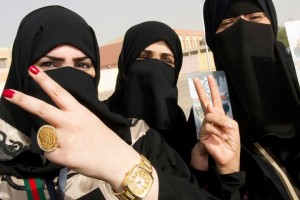
Saudi women sign first-ever petition to end male guardianship

September 28, 2016

Riyadh, Sep 28: Thousands of Saudis have signed a petition urging an end to the guardianship system giving men control over the work, study, marriage and travel of female relatives, activists said Tuesday. The petition calls for the kingdom’s women to be treated “as a full citizen, and decide an age where she will be an adult and will be responsible for her own acts”, said campaigner Aziza Al- Yousef of Riyadh.

petitionThe retired university professor told AFP that she tried unsuccessfully to deliver the petition with 14,700 names to the Royal Court on Monday. The activists will now send it by mail as requested. Saudi Arabia has some of the world’s tightest restrictions on women, and is the only country where they are not allowed to drive.

Under the guardianship system a male family member, normally the father, husband or brother, must grant permission for a woman’s study, travel and other activities. Activists say that even female prisoners have to be received by the guardian upon their release, meaning that some have to languish in jail beyond their sentences if the man does not want to accept them.

“We are suffering from this guardianship system,” said Nassima al-Sadah, an activist in Eastern Province. The campaign is an outgrowth of a Twitter hashtag in Arabic that started more than two months ago calling for an end to guardianship.

“This momentum got very high after the hashtag was created” and following a report by the New York-based Human Rights Watch, Yousef said. “Saudi Arabia’s male guardianship system remains the most significant impediment to women’s rights in the country despite limited reforms over the last decade,” the watchdog said.

Comments

Ahmrd
 - 
Wednesday, 28 Sep 2016

They are against the Shariath. The Shariath haa made such rules/laws only to Protect them.These ladies are Fools under the influence of West and Israeil.

Add new comment

  • Coastaldigest.com reserves the right to delete or block any comments.
  • Coastaldigset.com is not responsible for its readers’ comments.
  • Comments that are abusive, incendiary or irrelevant are strictly prohibited.
  • Please use a genuine email ID and provide your name to avoid reject.
News Network
May 22,2020

Rajan Kurian with wife Berly Rajan Kurian, son Brian, daughter Bella and mother Valsa

Dubai, May 22: A 43-year-old Indian businessman won USD one million (approximately Rs 7.59 crore) in the Dubai Duty Free draw.

Rajan Kurian, who owns a construction business in Kerala, had bought the ticket online.

Mr Kurian said he was grateful for the win, considering the gloomy circumstances prevailing in the world due to the coronavirus pandemic.

"I will set aside a good part of my win to help the needy. I feel grateful with the win but I need to share it with people who need it," he said. 

Mr Kurian said some of the money will go into growing his business.

"The last few months have been tough with the COVID-19 situation. My business has come to a standstill. This money will be put to good use," he said.

An Indian expat also won a BMW motorbike in the lucky draw held on Wednesday.

A longtime resident of Dubai for 30 years now, 57-year-old Syed Hydrose Abdulla, who works as a public relations officer in a beverages company, had also bought the ticket online.

Comments

Debasisdhara
 - 
Saturday, 18 Jul 2020

Lucky prize money send me please

Add new comment

  • Coastaldigest.com reserves the right to delete or block any comments.
  • Coastaldigset.com is not responsible for its readers’ comments.
  • Comments that are abusive, incendiary or irrelevant are strictly prohibited.
  • Please use a genuine email ID and provide your name to avoid reject.
Agencies
August 2,2020

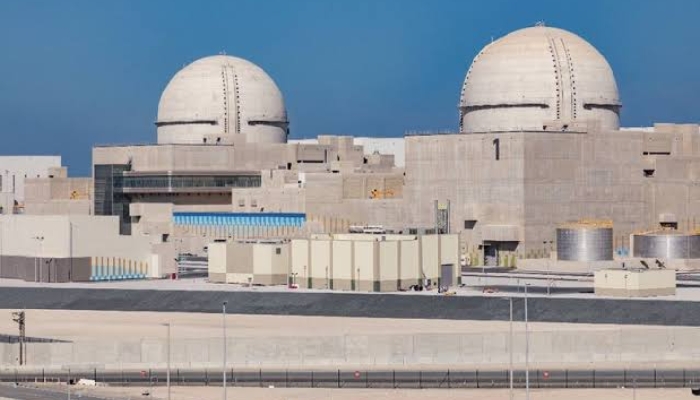
Dubai, Aug 2: The United Arab Emirates (UAE) announced on Saturday that it has started operations in the first of four reactors at the Barakah nuclear power station - the first nuclear power plant in the Arab world.

Emirates Nuclear Energy Corporation (ENEC), which is building and operating the plant with Korea Electric Power Corporation (KEPCO) said in a press release that its subsidiary Nawah Energy Company "has successfully started up Unit 1 of the Barakah Nuclear Energy Plant, located in the Al Dhafrah Region of Abu Dhabi".

That signals that Unit 1, which had fuel rods loaded in March, has achieved "criticality" - a sustained fission chain reaction.

"The start-up of Unit 1 marks the first time that the reactor safely produces heat, which is used to create steam, turning a turbine to generate electricity," said ENEC.

Barakah, which was originally scheduled to open in 2017, has been dogged by delays and is billions of dollars over budget. It has also raised myriad concerns among nuclear energy veterans who are concerned about the potential risks Barakah could visit upon the Arabian Peninsula, from an environmental catastrophe to a nuclear arms race.

Paul Dorfman, an honorary senior research fellow at the Energy Institute, University College London and founder and chair of the Nuclear Consulting Group, has criticised the Barakah reactors' "cheap and cheerful" design that he says cuts corners on safety.

Dorfman authored a report (PDF) last year detailing key safety features Barakah's reactors lack, such as a "core catcher" to literally stop the core of a reactor from breaching the containment building in the event of a meltdown. The reactors are also missing so-called Generation III Defence-In-Depth reinforcements to the containment building to shield against a radiological release resulting from a missile or fighter jet attack.

Both of these engineering features are standard on new reactors built in Europe, says Dorfman.

There have been at least 13 aerial attacks on nuclear facilities in the Middle East - more than any other region on earth.

The vulnerability of critical infrastructure in the Arabian Peninsula was further laid bare last year after Saudi Arabia's oil facilities at Abqaiq and Khurais were attacked by 18 drones and seven cruise missiles - an assault that temporarily knocked out more than half of the kingdom's oil production.

On Saturday, Dorfman reiterated his concern that there is no regional protocol in place to determine liability should an accident or incident at Barakah result in radioactive contamination spreading from the UAE to its neighbours. 

"Given Barakah has started up, because of all the well-rehearsed nuclear safety and security problems, it may be critically important that the Gulf states collectively evolve a Nuclear Accident Liability Convention, so that if anything does go wrong, victim states may have some sort of redress," Dorfman told Al Jazeera. 

The UAE has substantial oil and gas reserves, but it has made huge investments in developing alternative energy sources, including nuclear and solar.

Experts though have questioned why the UAE - which is bathed in sunlight and wind - has pushed ahead with nuclear energy - a far more expensive and riskier option than renewable energy sources.

When the UAE first announced Barakah in 2009, nuclear power was cheaper than solar and wind. But by 2012 - when the Emirates started breaking ground to build the reactors - solar and wind costs had plummeted dramatically.

Between 2009 and 2019, utility-scale average solar photovoltaic costs fell 89 percent and wind fell 43 percent, while nuclear jumped 26 percent, according to an analysis by the financial advisory and asset manager Lazard.

There are also concerns about the potential for Barakah to foment nuclear proliferation in the Middle East - a region rife with geopolitical fault lines and well-documented history of nuclear secrecy.

The UAE has sought to distance itself from the region's bad behaviour by agreeing not to enrich its own uranium or reprocess spent fuel. It has also signed up to the United Nation's nuclear watchdog's Additional Protocol, significantly enhancing inspection capabilities, and secured a 123 Agreement with the United States that allows bilateral civilian nuclear cooperation.


Comments

Add new comment

  • Coastaldigest.com reserves the right to delete or block any comments.
  • Coastaldigset.com is not responsible for its readers’ comments.
  • Comments that are abusive, incendiary or irrelevant are strictly prohibited.
  • Please use a genuine email ID and provide your name to avoid reject.
Saudi Gazette
May 27,2020

Riyadh, May 27: Following the announcement of easing of lockdown measures, which includes reopening of all mosques for daily congressional as well as Friday prayers across the Kingdom except the holy city of Makkah, the Ministry of Islamic Affairs, Call and Guidance has set mandatory guidelines.

In a circular issued to mosque staff, Minister of Islamic Affairs, Call and Guidance Sheikh Abdullatif Al-Asheikh has instructed that all mosques must comply with the following precautionary measures and instructions:

1. Open mosques 15 minutes before the Adhan and close them 10 minutes after prayer

2. Reduce the waiting period between the Adhan and Iqamah to 10 minutes

3. Open windows and doors from entering time to the end of the prayer

4. Remove copies of Holy Qur’an and other books temporarily from mosques

5. Ensure attendees keep a distance of two meters between each other

6. Ensure one space is left between each row

7. Close all water coolers and refrigerators

8. Do not allow distribution of water or food in mosques

9. Close toilets and places of ablution

Precautionary measures on Friday prayers are as follows:

1. Open mosques 20 minutes before Friday prayer and closing them 20 minutes after prayer.

2. Friday sermon with prayer should not exceed 15 minutes.

The circular also stipulates to keep the suspension of the religious courses, programs and lectures, as well as the memorizing Holy Qur'an sessions in the mosques and to continue education and lectures remotely until further notice.

The circular pointed out that the imams of mosques should urge the worshipers to take the following precautionary measures:

1. Wear a face mask

2. Bring their own prayer rugs and not leave them after the prayer

3. Prevent accompanying children under 15 years of age from entering mosques

4. Perform ablution at home

5. Avoid crowding when entering or exiting mosques

Meanwhile, the spokesman of the Ministry of Interior clarified later in the day that people are allowed to perform congressional prayers in their locality during the time of curfew.

Comments

Add new comment

  • Coastaldigest.com reserves the right to delete or block any comments.
  • Coastaldigset.com is not responsible for its readers’ comments.
  • Comments that are abusive, incendiary or irrelevant are strictly prohibited.
  • Please use a genuine email ID and provide your name to avoid reject.