In the beginning of January 2020 two very disturbing events were reported from Pakistan. One was the attack on Nankana Sahib, the holy shrine where Sant Guru Nanak was born. While one report said that the place has been desecrated, the other stated that it was a fight between two Muslim groups. Prime Minister of Pakistan Imran Khan condemned the incident and the main accused Imran Chisti was arrested. The matter related to abduction and conversion of a Sikh girl Jagjit Kaur, daughter of Pathi (One who reads Holy Guru Granth Sahib in Gurudwara) of the Gurudwara. In another incident one Sikh youth Ravinder Singh, who was out on shopping for his marriage, was shot dead in Peshawar.
While these condemnable attacks took place on the Sikh minority in Pakistan, BJP was quick enough to jump to state that it is events like this which justify the Citizenship Amendment Act (CAA). Incidentally CAA is the Act which is discriminatory and relates to citizenship with Religion, which is not as per the norms of Indian constitution. There are constant debates and propaganda that population of Hindus has come down drastically in Pakistan and Bangla Desh. Amit Shah, the Home minister stated that in Pakistan the population of Hindus has come down from 23% at the time of partition to 3.7% at present. And in Bangla Desh it has come down from 22% to present 8%.
While not denying the fact that the religious minorities are getting a rough deal in both these countries, the figures which are presented are totally off the mark. These figures don’t take into consideration the painful migrations, which took place at the time of partition and formation of Bangla Desh later. Pakistan census figures tell a different tale. Their first census was held in 1951. As per this census the overall percentage of Non Muslim in Pakistan (East and West together) was 14.2%, of this in West Pakistan (Now Pakistan) it was 3.44 and in Eat Pakistan it was 23.2. In the census held in Pakistan 1998 it became 3.72%. As far as Bangla Desh is concerned the share of Non Muslims has gone down from 23.2 (1951) to 9.6% in 2011.
The largest minority of Pakistan is Ahmadis, (https://minorityrights.org/country/pakistan/) who are close to 4 Million and are not recognised as Muslims in Pakistan. In Bangla Desh the major migrations of Hindus from Bangla Desh took place in the backdrop of Pakistan army’s atrocities in the then East Pakistan.
As far as UN data on refugees in India it went up by 17% between 2016-2019 and largest numbers were from Tibet and Sri Lanka. (https://www.un.org/en/development/desa/population/migration/publication…)
The state of minorities is in a way the index of strength of democracy. Most South Asian Countries have not been able to sustain democratic values properly. In Pakistan, the Republic began with Jinnah’s classic speech where secularism was to be central credo of Pakistan. This 11th August speech was in a way what the state policy should be, as per which people of all faiths are free to practice their religion. Soon enough the logic of ‘Two Nation theory” and formation of Pakistan, a separate state for Muslim took over. Army stepped in and dictatorship was to reign there intermittently. Democratic elements were suppressed and the worst came when Zia Ul Haq Islamized the state in collusion with Maulanas. The army was already a strong presence in Pakistan. The popular formulation for Pakistan was that it is ruled by three A’s, Army, America and Allah (Mullah).
Bangla Desh had a different trajectory. Its very formation was a nail in the coffin of ‘two nation theory’; that religion can be the basis of a state. Bangla Desh did begin as a secular republic but communal forces and secular forces kept struggling for their dominance and in 1988 it also became Islamic republic. At another level Myanmar, in the grip of military dictatorship, with democratic elements trying to retain their presence is also seeing a hard battle. Democracy or not, the army and Sanghas (Buddhist Sang has) are strong, in Myanmar as well. The most visible result is persecution of Rohingya Muslims.
Similar phenomenon is dominating in Sri Lanka also where Budhhist Sanghas and army have strong say in the political affairs, irrespective of which Government is ruling. Muslim and Christian minorities are a big victim there, while Tamils (Hindus, Christians etc.) suffered the biggest damage as ethnic and religious minorities. India had the best prospect of democracy, pluralism and secularism flourishing here. The secular constitution, the outcome of India’s freedom struggle, the leadership of Gandhi and Nehru did ensure the rooting of democracy and secularism in a strong way.
India so far had best democratic credentials amongst all the south Asian countries. Despite that though the population of minorities rose mainly due to poverty and illiteracy, their overall marginalisation was order of the day, it went on worsening with the rise of communal forces, with communal forces resorting to identity issues, and indulging in propaganda against minorities.
While other South Asian countries should had followed India to focus more on infrastructure and political culture of liberalism, today India is following the footsteps of Pakistan. The retrograde march of India is most visible in the issues which have dominated the political space during last few years. Issues like Ram Temple, Ghar Wapasi, Love Jihad, Beef-Cow are now finding their peak in CAA.
India’s reversal towards a polity with religion’s identity dominating the political scene was nicely presented by the late Pakistani poetess Fahmida Riaz in her poem, Tum bhi Hum Jaise Nikle (You also turned out to be like us). While trying to resist communal forces has been an arduous task, it is becoming more difficult by the day. This phenomenon has been variously called, Fundamentalism, Communalism or religious nationalism among others. Surely it has nothing to do with the religion as practiced by the great Saint and Sufi traditions of India; it resorts mainly to political mobilization by using religion as a tool.



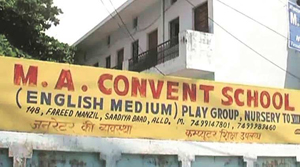 Zia-ul Haq, manager of MA Convent School in Baghara locality, was booked under the Prevention of Insults to National Honour Act and arrested, officials said.
Comments
The Law of ALLAH is should be first preference... Why ! cos he created all that exists and we are his properties... Some people may ignorantly blame as anti national.. But the manager doesnt want to bow to anything except ALLAH...
Why should he bow down to bharth... does it give anything? it doesnt mean i dont love my country.. ofcourse prophet Muhammad pbuh said love your Place.
But many cheddis alwz complain of others when they themselves doing everything against the LaW of the country as well as Law of the CREATOR ...
A time will come where judgment will be given with JUSTICE by the best JUDGE ... that day CRIMINALS will never escape of their dirty POLITICS and DECEPTION>
Worship your CREATOR not his CREATION.
What has been done by the Manger is very wrong not acceptable.
But Don't forget that even RSS don't sing National Anthem even they had not accepted Tri_Colour Indian Flag.
Authorities have to book the manger, Sealing the school is not the solution, let students attend the classes and Teachers do their duties...
All my dear Hindu commentators.
It is very appreciating you expressed your concerns. While commenting, please try to find out what is the reason which indeed prevents them not singing the Jana gana...
There is one main reason, all Muslims and Non-Muslims should understand about a Fundamental point of Islamic teaching.
If there is any teaching which has the most important that is only 1 point. This point has been preached in 1/3 rd of Hold Quran. And the same teaching is in Hadees the book of prophets message.
What is that main message. Perhaps even many Muslims don't know it well.
Please note it is called attributing any qualities or anything to God's quality. That is called against Oneness of God.
Again rewriting the above statement in other way, wholeheartedly accepting, proclaiming that
'There is only 1 God and no other God, nor anything has the quality of God. ' There is only 1 God, no other God, no any power that equates to that 1 and only God.
In contrary if anybody does worship other than that God, or think anything is there having the power OR quality of that God, then that person is committing a grave and UNFORGIVABLE SIN.
This is the biggest and unforgivable sin. This sin can ruin all good deeds of their life for this easy and grave mistake.
Therefore every Muslim should be careful of committing this mistake.
Now coming to our National anthem, the author has escalated the some portion of the anthem, Bharatha to the quality of God.
The intention of Thagorji might have written in good intention. However Muslims are definitely not against him, but the meaning does not allow them to proclaim that sentence.
The same type has been written in VANDE MATARAM SONG.
My dear all Non-Muslims brothers and sisters this is for your clarification and for your knowledge.
Your true well wisher and patriot Indian Muslim.
I don't think this guy had to take it so serious....at least national anthem ko gaane detha...the word vidhata can be kept silent....but don't take it so extreme and defame all together..
Add new comment