


SDPI accuses police of anti-Muslim bias; DK MP says Hindus are victims

CD Network | Sumedha V
June 18, 2017

Mangaluru, Jun 18: Accusing Dakshina Kannada district police of being communally biased against Muslims, Social Democratic Party of India has said that several innocent Muslims have been targeted by the cops in the wake of recent communal disturbances in Kalladka town of Bantwal taluk.
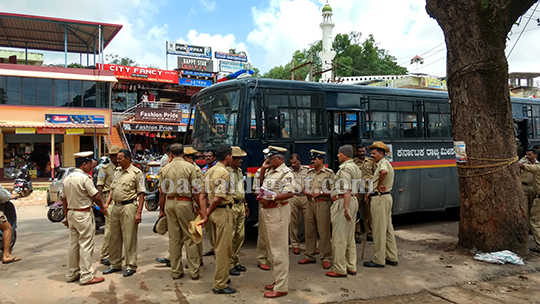
clashcommunal

Addressing a press conference at BC Road, near here, Ashraf Manchi, district secretary of SDPI, said the cases booked against the accused belonging to Muslim and Hindu communities in the aftermath of June 13 clash exposed the communal mindset of the police.

“Police have registered 10 cases in connection with Kalladka clash. However, they have registered complaints against 82 persons from Muslim community and only against 19 persons from Hindu community,” he said.

He said that though police have arrested nine persons each from Hindu and Muslim communities, Muslims have been slapped with cases under IPC Section 307 (attempt to murder), while most of the arrested Hindus have been slapped minor cases under weaker Sections like 324. “32 Muslims have been booked under Section 304, while only 4 members of the Sangh Parivar, which is mainly responsible for the incident have been booked under the same Section,” he lamented.

He said that activists of the Sangh Parivar had pelted stones on the Masjid and Madrasa from atop a building owned by Kalladka Prabhakar Bhat. “The president of the Masjid, Abubakar Haji, has informed the police regarding the damage caused. However, they have not registered case against any of the accused in the incident. Ironically, complaint has been registered against 30 Muslims on charge of pelting stones at a Sri Rama temple,” he said.

Mr Manchi also accused the police of committing atrocities against Muslims. “Bantwal Circle Inspector B K Manjayya and Bantwal town police station SI Rakshit A K, along with a team with no women police entered the houses of innocent Muslims late at night and committed atrocities against family members irrespective of women, elderly people and sick. The police also damaged the doors and windows of the Muslim houses during midnight raids. The shocked women have been admitted to a hospital in Mangaluru, but the police are not ready to take the statements of the victims,” he complained.

“In fact stones were pelted at SI A K Rakshit when he was trying to disperse the violent crowd near the Sri Rama Vidyakendra after dispersing crowd in front of the mosque. In this case police have named 23 accused. Ironically all of them are Muslims and they were also booked under Section 307,” said Munish Ali, a local SDPI leader and member of Bantwal Town Municipal Council.

Calling Kalladka clash as a pre-planned conspiracy of Sangh Parivar, he said that the government had completely failed in thwarting the plot of the communal outfits. “Their intention was to create a major communal riot. Had the district administration and police department taken enough precautionary measures after two innocent Muslim youths were stabbed on May 26 by Sangh Parivar activists, this wouldn’t have happed,” he said accusing both Congress and BJP of resorting to vote bank politics.

Police targeting innocent Hindus, says MP

Meanwhile Dakshina Kannada MP Nalin Kumar Kateel has accused the police of arresting innocent Hindus due to political pressure. “Both police department and communal mafia trying to suppress Hindu power and Hindu sentiments,” he told media persons in Puttur.

He said that the police department has become a mere puppet in the hands of the politicians in Congress ruled Karnataka. “The hands of able and efficient police officers have been tied. Even though miscreants of other communities are harassing Hindus, police are arresting innocent Hindus for the sake of head count,” he lamented.

He went on to claim that the police invoked the Goonda Act against innocent Hindu youths in order to create fear among Hindu society, while the real culprits are roaming free.

He said that BJP will extend full support to the protest scheduled to be organized by Hindu Jaagarana Vedike on June 24 at Kalladka. He said that BJP state president B S Yeddyurappa will also take part in the protest.

Comments

Abdullah
 - 
Monday, 19 Jun 2017

Wake up Mr. Khader, Bawa and Siddharamayya....
Else give your seat to others in next election.

abdul
 - 
Monday, 19 Jun 2017

Mr.MP we remember very well your statement on Karthik Raj murder case , and that proved you are unfit for this post and when real culprit got caught you disappeared with shobakaaaa ( one more unfit )

Add new comment

  • Coastaldigest.com reserves the right to delete or block any comments.
  • Coastaldigset.com is not responsible for its readers’ comments.
  • Comments that are abusive, incendiary or irrelevant are strictly prohibited.
  • Please use a genuine email ID and provide your name to avoid reject.
News Network
January 19,2020

Mysuru, Jan 19: Karnataka Rural Development and Panchyat Raj Minister K S Eshwarappa on Sunday claimed that Popular Front of India and Social Democratic Party of India have been indulging in anti-national activities.

Talking to media persons here, he said the government is mulling to ban and take action against PFI and its political arm SDPI.

It was recommended even during the previous government, but it was not taken seriously, he added.

He said that the BJP will ensure that all the MLAs who were instrumental in the party coming to power (the then-disqualified MLAs who joined BJP from Congress and JDS recently and won the bypoll subsequently) will not be let down and be given suitable posts in the government.

Comments

Sharief
 - 
Sunday, 19 Jan 2020

RSS will be banned and wipedout from the planet.

Now USA declared RSS as the worst terrorists. So Indian government is terrorist.


This is the limit of their brain.


Add new comment

  • Coastaldigest.com reserves the right to delete or block any comments.
  • Coastaldigset.com is not responsible for its readers’ comments.
  • Comments that are abusive, incendiary or irrelevant are strictly prohibited.
  • Please use a genuine email ID and provide your name to avoid reject.
News Network
July 28,2020

Hounde, Jul 28: Coronavirus and its restrictions are pushing already hungry communities over the edge, killing an estimated 10,000 more young children a month as meager farms are cut off from markets and villages are isolated from food and medical aid, the United Nations warned Monday.

In the call to action shared with The Associated Press ahead of publication, four UN agencies warned that growing malnutrition would have long-term consequences, transforming individual tragedies into a generational catastrophe.

Hunger is already stalking Haboue Solange Boue, an infant from Burkina Faso who lost half her former body weight of 5.5 pounds (2.5 kilograms) in just a month. Coronavirus restrictions closed the markets, and her family sold fewer vegetables. Her mother was too malnourished to nurse.

“My child,” Danssanin Lanizou whispered, choking back tears as she unwrapped a blanket to reveal her baby's protruding ribs.

More than 550,000 additional children each month are being struck by what is called wasting, according to the UN — malnutrition that manifests in spindly limbs and distended bellies. Over a year, that's up 6.7 million from last year's total of 47 million. Wasting and stunting can permanently damage children physically and mentally.

“The food security effects of the COVID crisis are going to reflect many years from now,” said Dr. Francesco Branca, the WHO head of nutrition. “There is going to be a societal effect.”

From Latin America to South Asia to sub-Saharan Africa, more poor families than ever are staring down a future without enough food.

In April, World Food Program head David Beasley warned that the coronavirus economy would cause global famines “of biblical proportions” this year. There are different stages of what is known as food insecurity; famine is officially declared when, along with other measures, 30% of the population suffers from wasting.

The World Food Program estimated in February that one Venezuelan in three was already going hungry, as inflation rendered salaries nearly worthless and forced millions to flee abroad. Then the virus arrived.

“Every day we receive a malnourished child,” said Dr. Francisco Nieto, who works in a hospital in the border state of Tachira.

In May, Nieto recalled, after two months of quarantine, 18-month-old twins arrived with bodies bloated from malnutrition. The children's mother was jobless and living with her own mother. She told the doctor she fed them only a simple drink made with boiled bananas.

“Not even a cracker? Some chicken?” he asked.

“Nothing,” the children's grandmother responded. By the time the doctor saw them, it was too late: One boy died eight days later.

The leaders of four international agencies — the World Health Organization, UNICEF, the World Food Program and the Food and Agriculture Organization — have called for at least dollar 2.4 billion immediately to address global hunger.

But even more than lack of money, restrictions on movement have prevented families from seeking treatment, said Victor Aguayo, the head of UNICEF's nutrition program.

“By having schools closed, by having primary health care services disrupted, by having nutritional programs dysfunctional, we are also creating harm,” Aguayo said. He cited as an example the near-global suspension of Vitamin A supplements, which are a crucial way to bolster developing immune systems.

In Afghanistan, movement restrictions prevent families from bringing their malnourished children to hospitals for food and aid just when they need it most. The Indira Gandhi hospital in the capital, Kabul, has seen only three or four malnourished children, said specialist Nematullah Amiri. Last year, there were 10 times as many.

Because the children don't come in, there's no way to know for certain the scale of the problem, but a recent study by Johns Hopkins University indicated an additional 13,000 Afghans younger than 5 could die.

Afghanistan is now in a red zone of hunger, with severe childhood malnutrition spiking from 690,000 in January to 780,000 — a 13% increase, according to UNICEF.

In Yemen, restrictions on movement have blocked aid distribution, along with the stalling of salaries and price hikes. The Arab world's poorest country is suffering further from a fall in remittances and a drop in funding from humanitarian agencies.

Yemen is now on the brink of famine, according to the Famine Early Warning Systems Network, which uses surveys, satellite data and weather mapping to pinpoint places most in need.

Some of the worst hunger still occurs in sub-Saharan Africa. In Sudan, 9.6 million people live from one meal to the next — a 65% increase from the same time last year.

Lockdowns across Sudanese provinces, as around the world, have dried up work and incomes for millions. With inflation hitting 136%, prices for basic goods have more than tripled.

“It has never been easy but now we are starving, eating grass, weeds, just plants from the earth,” said Ibrahim Youssef, director of the Kalma camp for internally displaced people in war-ravaged south Darfur.

Adam Haroun, an official in the Krinding camp in west Darfur, recorded nine deaths linked with malnutrition, otherwise a rare occurrence, over the past two months — five newborns and four older adults, he said.

Before the pandemic and lockdown, the Abdullah family ate three meals a day, sometimes with bread, or they'd add butter to porridge. Now they are down to just one meal of “millet porridge” — water mixed with grain. Zakaria Yehia Abdullah, a farmer now at Krinding, said the hunger is showing “in my children's faces.”

“I don't have the basics I need to survive,” said the 67-year-old, who who hasn't worked the fields since April. “That means the 10 people counting on me can't survive either.”

Comments

Add new comment

  • Coastaldigest.com reserves the right to delete or block any comments.
  • Coastaldigset.com is not responsible for its readers’ comments.
  • Comments that are abusive, incendiary or irrelevant are strictly prohibited.
  • Please use a genuine email ID and provide your name to avoid reject.
News Network
May 6,2020

Bengaluru, May 6: More than a month after international flights have been barred, Karnataka government is preparing to quarantine all 10,823 of the state''s people poised to return home from overseas amid the Covid pandemic, an official said on Tuesday.

"The state has planned to quarantine all 10,823 passengers coming back to Karnataka. The quarantine guidelines framed as below would be applicable," said Health Commissioner Pankaj Kumar Pandey in a statement.

According to the Government of India, 10,823 Karnataka residents have been stranded abroad by April 30, comprising 4,408 tourists, 3,074 students, 2,784 migrants and professionals and 557 ship crew.

Out of the 10,823 people, the state government is expecting 6,100 to return early as the government has decided to allow Indians stuck abroad to return.

"All the passengers arriving at points of entry (airports and seaports) will be compulsorily screened for symptoms of Covid-19," said Pandey.

Point of entry screening will include self-reporting form verification, thermal screening, pulse oximeter reading, briefing with instructions, categorisation, stamping for some and downloading of Aarogya Setu, Quarantine Watch and Apthamitra apps.

Arriving passengers are also required to declare existing comorbidities such hypertension, diabetes, asthma or any lung disease, organ transplantations, cancer, tuberculosis and other ailments.

Passengers will be categorised into three groups: Category A (symptomatic on arrival), Category B (asymptomatic with co-morbidity or aged above 60 years) and Category C (rest of asymptomatic passengers).

Depending on the category into which the people fall, their quarantine place and time will be determined.

Category A arrivals will be subjected to institutional quarantine for a fortnight, Category B one week quarantine at a hotel or hostel, followed by another week at home, and Category C home quarantine for a fortnight.

Karnataka government is making elaborate arrangements and logistical means, deploying healthcare, police and several other departments into action to handle the huge influx of Kannadigas and state residents.

Pandey has issued a 21-page elaborate standard operating procedure (SOP) guidelines on how to face the international returnees.

Comments

Add new comment

  • Coastaldigest.com reserves the right to delete or block any comments.
  • Coastaldigset.com is not responsible for its readers’ comments.
  • Comments that are abusive, incendiary or irrelevant are strictly prohibited.
  • Please use a genuine email ID and provide your name to avoid reject.