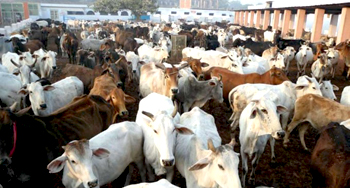
Second BJP leader in Meghalaya quits over Centre's new cattle slaughter rules

June 6, 2017

Tura (meghalaya), Jun 6: The Bharatiya Janata Party (BJP) in Meghalaya suffered yet another major political setback when one more senior party member quit over the Centre's new cattle trade and slaughter rules.cattle

Bachu Marak, the district president of the BJP in North Garo Hills, alleged that BJP leaders were “attempting to impose its non-secular ideology on the indigenous people in Meghalaya”.

Bachu Marak's resignation came after Bernard Marak's, who as the district president of the BJP in West Garo Hills, had accused that the leaders of the party were “not respecting the tradition and culture of the indigenous people”.

“As a responsible leader, I cannot mislead the people and allow them (BJP) to impose the non-secular ideology on us. They cannot impose the beef ban in our state,” Marak said over phone.

“Beef is one of our traditional diet and no government can restrict people's food habit. The moment they impose such restriction the ruling party would surely lose people's confidence,” he said.

State BJP President Shibun Lyngdoh, however, dismissed Marak's claim.

“He (Bachu Marak) is making such statement to mislead the people. The party has no intention to impose any anti-constitutional measures to the people. The objective of (Prime Minister Narendra) Modi government is to ensure all round development across India,” Lyngdoh told IANS.

Last week, some BJP leaders in the state had threatened to quit the party if the central government refused to repeal the new cattle trade and slaughter rules.

“Most party leaders in Meghalaya are not happy with the new rules which are directly affecting the socio-economic status of the people,” BJP Vice President John Antonius Lyngdoh said.

“We cannot accept the new rules on cattle trade and slaughter. We cannot go against our food behaviour besides putting the economic interest of those people dealing in cattle trade and slaughter in jeopardy,” he said.

Comments

Add new comment

  • Coastaldigest.com reserves the right to delete or block any comments.
  • Coastaldigset.com is not responsible for its readers’ comments.
  • Comments that are abusive, incendiary or irrelevant are strictly prohibited.
  • Please use a genuine email ID and provide your name to avoid reject.
News Network
April 24,2020

New Delhi, Apr 24: The trajectory of COVID-19 cases could have plateaued and might even fall for some weeks after the lockdown is lifted but India is likely to see a second wave in late July or August with a surge in the number of cases during the monsoon, say scientists.

The timing of the peak will depend on how India is able to control physical distancing and on the level of infection spreads after restrictions are relaxed, they said.

It looks apparent that the trajectory of daily new cases has reached a plateau and eventually it will take a downward fall, maybe for some weeks or even months, Samit Bhattacharya, associate professor at the Department of Mathematics, Shiv Nadar University, said.

Still, we may get a surge of new cases of the same coronavirus and this will be considered a second wave, Bhattacharya explained.

The second epidemic may come back in late July or August in the monsoon, although the peak timing will depend on how we control social distancing during that time, he said.

Rajesh Sundaresan, professor at Bengaluru's Indian Institute of Science (IISc), agreed.

“Once we return to normal activity levels, there is a chance that infection may begin to rise again. China is seeing this to some extent post easing of some restrictions on travel,” Sundaresan, corresponding author of a working paper by researchers at IISc and the Tata Institute of Fundamental Research (TIFR) in Mumbai, said.

On March 25, when the number of coronavirus cases was 618 with 13 deaths, the government announced a nationwide lockdown that was later extended to May 3.

On Friday, the death toll due to COVID-19 rose to 718 and the number of cases to 23,077, according to the Union Health Ministry.

In good news, officials said this week that the doubling rate of cases has slowed down in the period, going from 3.4 days before lockdown to 7.5 days, with 18 states doing better than the national average. The recovery rate has also almost doubled in the last 10 days.

"Looking at the new cases in the past few days, it seems the growth of new daily infection is much slower than earlier. This apparently indicates that we might have reached at the plateau of the growth curve, Bhattacharya said.

He noted that recent studies in China and Europe observed that the infection might relapse in those people who have already recovered from earlier phases.

So, there is no evidence that the earlier infection may help acquire immunity against the second infection. And in that way, the entire population may be vulnerable to the second wave to some extent, said the scientist.

In their study unveiled this week, IISc and TIFR researchers analysed the impact of strategies such as case isolation, home quarantine, social distancing and various post-lockdown restrictions on COVID-19 that might remain in force for some time.

The study modelled on Bengaluru and Mumbai suggests the infection is likely to have a second wave and the public health threat will remain, unless steps are taken to aggressively trace, localise, isolate the cases, and prevent influx of new infections.

The new levels and the peaking times for healthcare demand depend on the levels of infection spreads in each city at the time of relaxation of restrictions, they said.

The lockdown is currently upon us. It has given us valuable time. Let us test, trace, quarantine, isolate, practice better hygiene, search for a vaccine, etc. We should do these anyway, and these are being done. When and how to lift the lockdown is going to be a difficult decision to make, said Sundaresan.

It's clear that it's going to be phased. What our team is focusing on is to come up with tools to help the decision makers assess the public health impact of various choices, he said.

According to the experts, infectious diseases spread via contact between infectious and susceptible people. In the absence of any control measures, an outbreak will grow as long as the average number of people infected by each infectious person is more than one.

Once enough people are immune there will be fewer people susceptible to the infection and the outbreak will die.

However, when an outbreak is brought under control by social distancing and other interventions, it is possible only a small proportion of the population will have been infected and gained immunity, they said.

This means enough susceptible people may remain to fuel a second wave if controls are relaxed and infection is reintroduced.

Until the vaccine comes on the market, we have to remain alert Once sporadic cases occur here and there in the country, we immediately need to implement quarantine or social distancing locally for the people in that region, and also need to perform tests to identify positive cases irrespective of showing symptoms, Bhattacharya explained.

Note that these monsoon months are also flu season in many places of India. So, we should not ignore the early signs of the flu symptoms. Irrespective of symptoms, we need to increase tests in the hotspots to identify people and contain the surge, he said.

Sundaresan added that the timeline for a second wave will depend on a lot of circumstances which may change as the time passes.

Significant testing may have been underway, there may be behavioural changes with people becoming more careful about their hygiene, wearing masks may become more common, etc. All these responses may help restrict the second wave, he said.

A study published in The Lancet journal earlier this month modelled the potential adverse consequences of premature relaxation of interventions, and found it might lead to a second wave of infections.

The finding is critical to governments globally, because it warns against premature relaxation of strict interventions, the researchers said.

While interventions to control the spread of SARS-CoV-2 are in place, countries will need to work toward returning to normalcy; thus, knowledge of the effect of each intervention is urgently required, they said in the study.

According to a recent analysis by the Harvard Chan School of Public Health, the best strategy to ease the critical care burden and loss of life from COVID-19 might be on-again, off-again social distancing.

In the absence of such interventions, surveillance and intermittent distancing may need to be maintained into 2022, which would present a substantial social and economic burden, the researchers wrote.p


Comments

Add new comment

  • Coastaldigest.com reserves the right to delete or block any comments.
  • Coastaldigset.com is not responsible for its readers’ comments.
  • Comments that are abusive, incendiary or irrelevant are strictly prohibited.
  • Please use a genuine email ID and provide your name to avoid reject.
News Network
May 22,2020

Bengaluru, May 22: Amazon.com Inc’s India unit said it would hire 50,000 temporary workers to meet a surge in online shopping in the country, where customers have been stuck indoors for two months in a lockdown to fight the coronavirus outbreak.

E-commerce firms faced massive disruption in the initial days of the lockdown in India, but a slow easing of the stringent regulations has allowed them to resume large parts of their operations.

"We want to continue helping customers all over India get everything they need so they can continue to practice social distancing," Amazon senior executive Akhil Saxena said in a statement on the company's blog. (bit.ly/2A1Wv7O)

“(The move) will also keep as many people as possible working during this pandemic while providing a safe work environment for them,” said Saxena, Amazon’s VP for customer fulfillment operations in APAC, MENA & Latam.

The temporary hires will work in Amazon’s fulfillment centers and as part of its delivery network, the company said, making the announcement at a time when various other companies in the country have been forced to cut jobs as they try to tide over the health crisis.

Amazon itself has pushed its annual global Prime Day event, traditionally a summer affair, to September, the Wall Street Journal reported on Thursday.

In India, where the Jeff Bezos-led company faces stiff competition from Walmart Inc’s Flipkart, Amazon earlier said it plans to create 1 million jobs by 2025.

The company also said on Thursday it plans to enter the food delivery business in India, pitting itself against well-established startups such as Swiggy and Zomato.

Comments

Add new comment

  • Coastaldigest.com reserves the right to delete or block any comments.
  • Coastaldigset.com is not responsible for its readers’ comments.
  • Comments that are abusive, incendiary or irrelevant are strictly prohibited.
  • Please use a genuine email ID and provide your name to avoid reject.
News Network
January 31,2020

New Delhi, Jan 31: The Supreme Court Friday dismissed the plea filed by one of the four death row convicts in the Nirbhaya gang-rape and murder case, Pawan Gupta, seeking review of its order rejecting his juvenility claim.

The review plea filed earlier in the day was taken up for consideration in-chamber by a bench comprising Justices R Banumathi, Ashok Bhushan and A S Bopanna. 

On January 20, the apex court had rejected the plea by Pawan who had challenged the Delhi High Court's order dismissing his juvenility claim.

Advocate A P Singh, who is representing Pawan in the case, said he filed a petition on his behalf seeking review of the top court's January 20 order on Friday.

While dismissing the plea, the top court had said there was no ground to interfere with the high court order that rejected Pawan's plea and his claim was rightly rejected by the trial court as also the high court.

It had said the matter was raised earlier in the review petition before the apex court which rejected plea of juvenility taken by Pawan and another co-accused Vinay Kumar Sharma and that order has attained finality.

Singh had argued that as per his school leaving certificate, he was a minor at the time of the offence and none of the courts, including trial court and high court, ever considered his documents.

Solicitor General Tushar Mehta, appearing for the Delhi Police, had said Pawan's claim of juvenility was considered at each and every judicial forum and it will be a travesty of justice if the convict is allowed to raise the claim of juvenility repeatedly and at this point of time.

The trial court on January 17 issued black warrants for the second time for the execution of all the four convicts in the case -- Mukesh Kumar Singh (32), Pawan (25), Vinay (26) and Akshay (31) -- in Tihar jail at 6 am on February 1. Earlier, on January 7, the court had fixed January 22 as the hanging date.

As of now, only Mukesh has exhausted all his legal remedies including the clemency plea which was dismissed by President Ram Nath Kovind on January 17 and the appeal against the rejection was thrown out by the Supreme Court on January 29.

Convict Akshay's curative petition was dismissed by the top court on January 30. Another death row convict Vinay moved mercy plea before President on January 29, which is pending.

Singh has also approached the trial court seeking stay on the execution scheduled on February 1, saying the legal remedies of some of the convicts are yet to be availed.

A 23-year-old paramedic student, referred to as Nirbhaya, was gang-raped and brutally assaulted on the intervening night of December 16-17, 2012, in a moving bus in south Delhi by six people before she was thrown out on the road.

Comments

Add new comment

  • Coastaldigest.com reserves the right to delete or block any comments.
  • Coastaldigset.com is not responsible for its readers’ comments.
  • Comments that are abusive, incendiary or irrelevant are strictly prohibited.
  • Please use a genuine email ID and provide your name to avoid reject.