


The secrets of Udupi's Madhwa Brahmin kitchen leaked!

[email protected] (News Network | KM Acharya)
August 26, 2015

Udupi, Aug 26: What connects Bisi Bele Hulianna, Saaru, Modaka, Huggi, Majjige Palidya and Drakshi Gojju? These are some of the famed dishes of the Madhwa Brahmin community of Udupi, a coastal town in Karnataka where the Krishna temple acts as a pivot in people's lives.
brahmin

Laying out the geographical expanse and scientific logic to the regions Madhwa Brahmins vegetarian food habits, culinary expert Malati Srinivasan and arts and crafts connoisseur Geetha Rao showcase the hitherto unknown vegetarian recipes from Udupi in their book "The Udupi Kitchen."

The authors straddle the traditional and modern and list what was once easily cooked in Udupi households - spice powders, salads and chutneys, savoury snacks, desserts - and elaborate on several recipes which are all-time favourites like Bisi Bele Hulianna, Saaru, Masal Dose and Modaka.

While Bisi Bele Hulianna is a dish of spicy red gram, rice and vegetables, Saaru is spicy red gram soup, Huggi is rice and green gram with black pepper and cumin and Modaka is dumplings with coconut and jiggery filling.

Majjige Palidya is ash gourd with coconut and cumin in sour yoghurt and Drakshi Gojju is raisins in sweet, sour and spicy gravy.

Split into 12 sections, the Udupi Kitchen, published by Westland Ltd, celebrates vegetarian food with aplomb from a town where food is religion as well as a complete mouth-watering experience.

At the core of Udupi cuisine is the use of indigenous vegetables and fruits, cereals and pulses special to the Parashurama Kshetra and traditional Brahmins ate only vegetarian fare without onion and garlic.

According to the authors, Udupi cuisine has a vast variety and is not limited to tiffins or snacks.

"As I began working on this project, I realised how vast and varied our family’s repertoire of Udupi (Madhwa) cuisine was. I wrote down 175 recipes, but have used about a 100 of them in the book," says Srinivasan.

"Writing a cook book for both Indian and non-Indian readers required that a comprehensive multi-lingual glossary be compiled. It also meant using internationally accepted terminology: 'henchu' or 'tava' became griddle, bandle or 'kadhai' became wok, 'tappele' or 'bartan' became saucepan," says Rao.

She says for some kitchen tools like 'eelgemane' and 'ogarane chamcha', which had no "internationally understood" words, substitute words like curved knife blade and tempering-ladle had to be coined.

The story of Udupi cuisine is the story of how a temple-based, Brahmanical culinary tradition got modernised and became a global phenomenon. Food is religion in Udupi.

Fourteen varieties of food are cooked daily and offered to the deity at different times of the day. The food offered to god is 'naivediya', and the food eaten by human beings is 'prasada', food that is blessed.

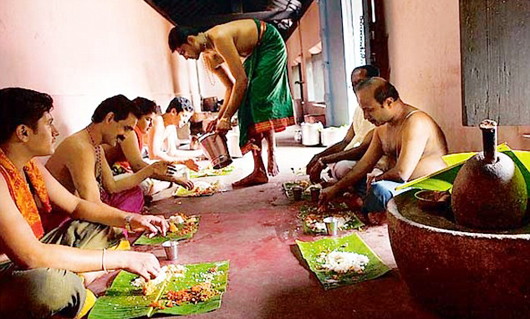
In Udupi, meals are served on banana leaves in a particular order. Many recipes and foods have also proven health benefits. For example, dishes made from the inner banana stem prevent kidney stones, pepper rasam helps with the lactation of new mothers, jackfruit seeds have high protein content and so on.

The authors also say that the original of the masal dose or the famous masala dosa is attributed to Udupi.

Before it was invented, plain dosa was served with potato playa, without onions, in a separate cup. With changing food tastes, the Udupi chefs began to saute the mashed potatoes with onions and spices.

"As onions were considered taboo food for orthodox Brahmins, it is said that the doses were stuffed with onion-laced playa, instead of served in a separate cup, so that the onion could be 'hidden'," the authors say.

Comments

Usha moorthy
 - 
Wednesday, 8 Jun 2016

I'm extremely pleased that I now have a book to refer to for genuine udupi food!!! Thanks to the authors for painstakingly bringing together these wonderful recipes!!;

Add new comment

  • Coastaldigest.com reserves the right to delete or block any comments.
  • Coastaldigset.com is not responsible for its readers’ comments.
  • Comments that are abusive, incendiary or irrelevant are strictly prohibited.
  • Please use a genuine email ID and provide your name to avoid reject.
News Network
March 2,2020

Kochi, Mar 2: The Vatican has rejected the second appeal by Sister Lucy Kalappura -- one of the nuns who protested against rape accused Bishop Franco Mulakkal -- against her expulsion from Franciscan Clarist Congregation (FCC).

In her plea, she had demanded that her version be heard and her expulsion from FCC revoked.

She was expelled from FCC for participating in public protests demanding the arrest of Franco Mulakkal in the nun rape case.

''I got a letter from Vatican which says my appeal has been rejected. But the rest of the letter is written in the Latin language. So after I understand it, I will respond," Sister Lucy told news agency.

''The authorities are contemptuous of those who make such complaints. That is why the letter is written in Latin. Sister Lucy would continue her legal fight in the courts,'' said George Moolechalil, who has been authorised by Sister Lucy to communicate with the media on her behalf.

A petition of Sister Lucy is still pending at Mananthavady Munsif Court at Wayanad that demands that she should not be expelled from the convent where she is staying.

Comments

fairman
 - 
Wednesday, 4 Mar 2020

Religious issues should be resolved within the guidelines of devine laws.


Unfortunately the Chrisitianity is no more in its originality.

The holy bible has been systematically abused and edited to the benefits of rulers.


The book has been contaminated with lots of editions.


People should search for truth and follow it.


Example, the religion never told to remain unmarried for priests or nuns.

They go against its teaching inveting their own idea against God's teaching.


Abdul Gaffar Bolar
 - 
Monday, 2 Mar 2020

Vatican is a corporate person.

Add new comment

  • Coastaldigest.com reserves the right to delete or block any comments.
  • Coastaldigset.com is not responsible for its readers’ comments.
  • Comments that are abusive, incendiary or irrelevant are strictly prohibited.
  • Please use a genuine email ID and provide your name to avoid reject.
coastaldigest.com news network
May 29,2020

Mangaluru, May 29: The southwest monsoon is expected to reach the Karnataka coast on June 1 or 2, earlier than forecast by the India Meteorological Department (IMD).

Normally, Karnataka witnesses the onset of monsoon either five or six days after it had entered Kerala. However, this time, Karnataka will also witness the arrival of monsoon either on June 1 or June 2, according to meteorologists at the Karnataka State Natural Disaster Monitoring Cell (KSNDMC).

The gradual formation of two low-pressure areas over the Arabian Sea located close to the western peninsular coast and gaining momentum has helped Karnataka mark the start of the four-month-long rainy season expected to revive the back-to-back drought-stricken state.

Confirming the changes in the atmospheric pattern, Dr GS Srinivasa Reddy, Director KSNDMC said, “Karnataka will also witness the onset of monsoon on the same time that of Kerala.”

The early onset of monsoon over Karnataka coast is attributed to prevailing to weather pattern over the Arabian Sea. 

“The two low-pressure areas over the Arabian Sea are steadily gaining momentum. They may reach the peak by the weekend and may concentrate further into depression causing widespread rainfall in the peninsular region and thereby advancing the onset of monsoon over the region,” Dr Reddy explained.

The KSNDMC, based on the Indian Meteorological Department (IMD) forecast, stated that due to 'prevailing favourable conditions over the Indian Ocean and Pacific Ocean regions', the monsoon will be normal and above normal over coastal and south-interior Karnataka according to the present scenario.

The IMD, which had initially issued a forecast of five-day delay in the onset, had issued a fresh forecast on Wednesday cautioning the states along the West coast about the formation of two intense low-pressure areas in South-East and East-Central Arabian Sea region.

Following the forecast, a yellow alert has also been issued in Kerala and coastal areas suggesting significant rainfall starting from this weekend. “Fishermen have also been advised not to venture into deep-sea due to high turbulent conditions,” an IMD official revealed.

Comments

Add new comment

  • Coastaldigest.com reserves the right to delete or block any comments.
  • Coastaldigset.com is not responsible for its readers’ comments.
  • Comments that are abusive, incendiary or irrelevant are strictly prohibited.
  • Please use a genuine email ID and provide your name to avoid reject.
News Network
January 25,2020

New Delhi, Jan 25: The latest edition of the Oxford Advanced Learner's Dictionary features 26 new Indian English words, including Aadhaar, chawl, dabba, hartal and shaadi.

The 10th edition of the dictionary, which was launched on Friday, has 384 Indian English words and incorporates over 1,000 new words such as chatbot, fake news and microplastic.

The dictionary focuses on language change and its evolution through the years, and has ensured that the language and examples used in the new edition are relevant and up to date with the times, Oxford University Press (OUP) said.

The new edition comes with interactive online support through the Oxford Learner's Dictionaries website and an app. The website includes advanced features such as audio-video tutorials, video walkthroughs, self-study activities and enhanced iWriter and iSpeaker tools.

"This edition has 26 new Indian English words of which 22 figure in the printed dictionary. The other four are in the digital version," said Fathima Dada, Managing Director (Education Division) at OUP.

Some of other new Indian words in the dictionary are auntie (while aunty already figures in the English dictionary, auntie is an Indianism), bus stand, deemed university, FIR, non-veg, redressal, tempo, tube light, veg and videograph.

The four new Indian English words in the online version of the dictionary are current (for electricity), looter, looting and upazila (one of the areas that a district is divided into for administration purposes).

According to OUP, the new edition provides better, more accurate and understandable definitions with examples, usage notes and additional resources to help the learner use the right word in the right context.

"Prevalence and common usage are the main criteria for enlisting new words. We scan the globe for words which are often used by people while speaking English. Then these words go through a rigorous testing process," Dada said.

"As OUP is the custodian of English language globally, these words have to go through its processes," she told PTI.

The Oxford Advanced Learner's Dictionary, she said, has been reinventing itself for nearly eight decades, anticipating the growing learning requirements of learners.

"The 10th edition also is equipped with a strong digital support system, including an app," she said.

It is equipped with several digital tools. With iSpeaker, learners can get help preparing for speaking exams and presentations. With iWriter, learners can plan, write and review their written work. Text Checker allows the teacher to check any text against the Oxford 3000, 5000, and OPAL (Oxford Phrasal Academic Lexicon) written word list.

Resources accessible through online premium access include lesson plans, worksheets, video walkthroughs, and classroom and self-study activities. With the OALD app one can find 86,000 words, 95,000 phrases, 112,000 meanings and 237,000 examples.

The dictionary, which spans 77 years, was originally published in Japan in 1942 and was first brought out by OUP in 1948. The learner's dictionary is based on the original values of its creator, Albert Sydney Hornby, whose aim was to help language learners worldwide understand the meaning of English words.

Comments

Add new comment

  • Coastaldigest.com reserves the right to delete or block any comments.
  • Coastaldigset.com is not responsible for its readers’ comments.
  • Comments that are abusive, incendiary or irrelevant are strictly prohibited.
  • Please use a genuine email ID and provide your name to avoid reject.