


Sena hits out at BJP for 'free publicity' to Kanhaiya

March 7, 2016

Mumbai, Mar 7: In a veiled attack on the BJP for letting JNUSU President Kanhaiya Kumar get "free publicity", ally Shiv Sena today sought to know how he got bail in such a short span of time when others charged with 'sedition' are still languishing in jails.
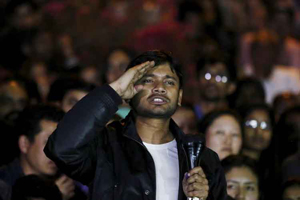
kanhaiyyaaa"(Union Minister) Venkaiah Naidu said Kanhaiya Kumar is getting free publicity. If that is so, who is responsible for letting him get free publicity? Today, nothing comes for free," the Sena said in an edit in its mouthpiece 'Saamana'.

"A price has to be paid for even the smallest of things. Working class people, labourers who used to save money in PF, will now be taxed on their earnings. In short, the government has only shown people nothing will be given for free," it said.

It said that Hardik Patel, who led the Patel agitation demanding reservation for his community in Gujarat is still behind bars after being charged with 'sedition' and so are people like Colonel Purohit and Sadhvi Pragya.

"Then how did Kanhaiya get bail so easily? Was it that keeping him behind bars was becoming a problem for the government and that it had to answer too many questions?" the Sena asked.

"If Naidu says Kanhaiya is getting free publicity, then our system and administration is responsible for it. He has become a hero because people are announcing reward for attack on Kanhaiya," it said, referring to BJP leader Kuldeep Varshnay announcing Rs 5 lakh prize money for cutting off the tongue of Kanhaiya, who he had alleged, was speaking against BJP and PM Narendra Modi after being released on bail.

A poster announcing Rs 11 lakh prize money to anyone "shooting down" Kumar was also spotted in Delhi.

The Sena further said that the sole aim (of politicians) is to win elections and form a government.

"Promises made before elections vanish into the air and farmers, labourers, working class and students are made victims. If this continues, there would be human bombs made within the country. These youngsters will be exploited for political games," the Sena warned.

Kumar, who was arrested on February 12 on sedition charges, was released from Tihar jail on March 3 after the Delhi High Court granted him interim bail for six months.

Comments

Rikaz
 - 
Monday, 7 Mar 2016

Of course he has become a household name around the world....he simply raised his voice against PEKU....great job....

Add new comment

  • Coastaldigest.com reserves the right to delete or block any comments.
  • Coastaldigset.com is not responsible for its readers’ comments.
  • Comments that are abusive, incendiary or irrelevant are strictly prohibited.
  • Please use a genuine email ID and provide your name to avoid reject.
News Network
June 25,2020

India has jumped past 4.5 lakh coronavirus cases and 14,476 people have succumbed to the viral infection so far. In this backdrop, speaking to IANS in an exclusive interview, AIIMS Director Randeep Guleria said India is also vulnerable to second wave of coronavirus and people should continue to follow social distancing, wearing mask and other precautions, after cases begin to decline.

He added that in order to contain the outbreak of Covid-19, a limited lockdown in hotspots, where volume of cases is very high, may be considered along with a micro-plan to prevent leakage of cases from these areas to other non-containment areas. Excerpts of the interview are below:

Q: Reports say China and South Korea are witnessing a second wave of coronavirus infection, what is this second wave, is India also vulnerable to this?

A: When cases come down significantly, people tend to drop their guard against the viral infection, and this leads to the second wave (which means a sudden increase in the number of cases). After cases begin to decline, people should continue to follow the precautions -- continue to maintain social distancing and wear masks regularly. See what happened in Singapore, it was struck by a second wave of coronavirus. Look, what happened in the 1918 pandemic, people dropped their guard and the second wave of viral infection struck back. If people do not follow social distancing then the spike in cases is apparent. We need to take these precautions at least for one year. India is also vulnerable to this second wave.

Q: If Covid-19 cases continue to rise rapidly, do you think we need another lockdown in areas where volume of cases are very high?

A: A large volume of cases is concentrated in specific areas like hotspots, and in order to maintain things in order, we may need a limited lockdown in these areas. This should be followed by a micro-plan which entails extensive testing of people and also extensive contact tracing of people who have got in touch with positive people. Need to ensure there is no leakage of cases from these areas. People from these areas should not mix with others in non-containment areas. This will aid in containing the outbreak of the virus. People who have developed symptoms should get themselves tested, especially in the containment areas.

Q: With more than 4.5 lakh cases and close to 14,500 deaths, do you think India has reached its peak and a decline in cases is prominent?

A: The cases will continue to increase for some time. The doubling time of cases has also increased. But, the cases will also begin to flatten. Though, it is difficult to give an exact time period in this viral infection, it seems, the growth in cases will flatten in the end of July or beginning of August. A decline will come to this viral infection, but it does not mean that people should drop their guard. As a measure, we need to decrease community participation and citizens should continue to follow social distancing. People should get themselves tested. All these efforts will help in preventing people from contracting this virus. These precautions will also prevent us from the second wave, and we must continue to take precautions. The virus has not gone away, it is still lurking.

Q: India has crossed the 4.5 lakh coronavirus cases so far, although our recovery rate is good, but still 10,000 to 15,000 cases are reported daily. Why do cases continue to spiral, what is the reason?

A: We have to remember a few things -- the bulk of cases are in 10 cities, nearly 70 per cent, and if we take into account cases per million population, the number is not very high, as compared with countries including countries in Europe. Many European countries put together still do not add up to the Indian population. Do not compare India to countries like Italy, Spain etc. We need to focus on hotspots, which contribute to between 70 -80 per cent of cases, and we have to identify cases in these areas at an early stage. The population density is very high in these cities. People in lower socio-economic status are highly vulnerable to the viral infection, as many live together in small spaces and there is a lot of mixing of people happening there. Look at the market places, people are not following social distancing and not wearing masks. In fact, many are in close vicinity of each other.

Comments

Add new comment

  • Coastaldigest.com reserves the right to delete or block any comments.
  • Coastaldigset.com is not responsible for its readers’ comments.
  • Comments that are abusive, incendiary or irrelevant are strictly prohibited.
  • Please use a genuine email ID and provide your name to avoid reject.
News Network
January 29,2020

Aurangabad, Jan 29: Accusing Prime Minister Narendra Modi and Union Home Minister Amit Shah of creating a conflict between Hindu and Muslim communities in the country, former JNU student leader Kanhaiya Kumar has said the Citizenship (Amendment) Act (CAA) was adding fuel to the fire.

He was speaking at a rally held on Tuesday at Pathri in Parbhani district of Maharashtra against the CAA and the National Register of Citizens (NRC). It was organised by NCP MLC Abdullah Durrani.

"Modi and Shah used to create conflicts between Hindus and Muslims during the Gujarat elections. Now they are adopting the same strategy in the country," Kumar alleged.

Citizens should keep the religious conflicts aside and question the present government about unemployment and the poor state of the economy, he said.

"Through the CAA, the government is adding fuel to the fire, which is already raging in the country," he alleged.

When anyone questions the government about the problems existing in the country, it in turn asks him about his citizenship, the former JNUSU leader alleged.

Comments

Add new comment

  • Coastaldigest.com reserves the right to delete or block any comments.
  • Coastaldigset.com is not responsible for its readers’ comments.
  • Comments that are abusive, incendiary or irrelevant are strictly prohibited.
  • Please use a genuine email ID and provide your name to avoid reject.
News Network
January 10,2020

Mumbai, Jan 10: India’s oil demand growth is set to overtake China by mid-2020s, priming the country for more refinery investment but making it more vulnerable to supply disruption in the Middle East, the International Energy Agency (IEA) said on Friday.

India’s oil demand is expected to reach 6 million barrels per day (bpd) by 2024 from 4.4 million bpd in 2017, but its domestic production is expected to rise only marginally, making the country more reliant on crude imports and more vulnerable to supply disruption in the Middle East, the agency said.

China’s demand growth is likely to be slightly lower than that of India by the mid-2020s, as per IEA’s China estimates given in November, but the gap would slowly become bigger thereafter.

“Indian economy is and will become even more exposed to risks of supply disruptions, geopolitical uncertainties and the volatility of oil prices,” the IEA said in a report on India’s energy policies.

Brent crude prices topped USD 70 a barrel on rising geopolitical tensions in the Middle East, putting pressure on emerging markets such as India. Like the rest of Asia, India is highly dependent on Middle East oil supplies with Iraq being its largest crude supplier.

India, which ranks No 3 in terms of global oil consumption after China and the United States, ships in over 80 per cent of its oil needs, of which 65 per cent is from the Middle East through the Strait of Hormuz, the IEA said.

The IEA, which coordinates release of strategic petroleum reserves (SPR) among developed countries in times of emergency, said it is important for India to expand its reserves.

REFINERY INVESTMENTS

India is the world’s fourth largest oil refiner and a net exporter of refined fuel, mainly gasoline and diesel.

India has drawn plans to lift its refining capacity to about 8 million bpd by 2025 from the current about 5 million bpd.

The IEA, however, forecasts India’s refining capacity to rise to 5.7 million bpd by 2024.

This would make “India a very attractive market for refinery investment,” IEA said.

Drawn to India’s higher fuel demand potential, global oil majors like Saudi Aramco, BP, Abu Dhabi National Oil Co and Total are looking at investing in India’s oil sector.

Saudi Aramco and ADNOC aim to own a 50 per cent stake in a planned 1.2-million bpd refinery in western Maharashtra state, for which land is yet to be acquired.

Comments

Add new comment

  • Coastaldigest.com reserves the right to delete or block any comments.
  • Coastaldigset.com is not responsible for its readers’ comments.
  • Comments that are abusive, incendiary or irrelevant are strictly prohibited.
  • Please use a genuine email ID and provide your name to avoid reject.