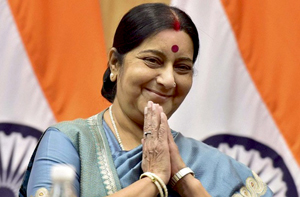
Sushma Swaraj announces new Post Office Passport Seva Kendras

Agencies
June 17, 2017

New Delhi, Jun 17: No Indian will have to travel more than 50 km to get their passport, as the government is planning to set up a comprehensive network of Passport Seva Kendras (PSK) across the nation, with major post offices to also provide the service, External Affairs Minister Sushma Swaraj said on Saturday.sushma 2

The Minister, announcing the opening of 149 new Post Office Passport Seva Kendras (POPSKs), said these will be set up in the second phase. In the first phase 86 POPSKs were to be set up -- 52 of which are now functional.

Apart from centres in the post offices, the government had earlier also announced 16 full-fledged PSKs taking the total number of new centres to the "auspicious" 251, she said.

"When I started at the Ministry, we had only 77 PSKs to cater to the whole nation. I realised that distance was the biggest hurdle for people to get their passports," she said.

Even after pushing through 16 more PSKs apart from 86 of them in post offices, Sushma Swaraj said she felt it was not enough.

"We planned to set a target and decided that no individual should have to travel more than 50 km for a passport."

"With that criterion for selection, today I announce 149 new POPSKs," she said.

Sushma Swaraj also launched a web portal for the ministry's flagship "Know India Programme" aimed at connecting the Indian youth living abroad with Indian culture and heritage.

Under the programme, the Indian diaspora would visit the country for a 25-day tour fully funded by the government.

Comments

Abv
 - 
Sunday, 18 Jun 2017

Shushmaji is doing grate work right candidate for PM for next two years

Add new comment

  • Coastaldigest.com reserves the right to delete or block any comments.
  • Coastaldigset.com is not responsible for its readers’ comments.
  • Comments that are abusive, incendiary or irrelevant are strictly prohibited.
  • Please use a genuine email ID and provide your name to avoid reject.
Media Release
May 6,2020

Mangaluru, May 6: The Kanara Chamber of Commerce and Industry has urged the government to consider erstwhile undivided Dakshina Kannada (now DK & Udupi) as one unit for the purpose of movement of people. KCCI president Isaac Vas has written a letter to Karnataka chief secretary T M Vijay Bhaskar in this regard. 

Mr Vas said: Even though the erstwhile Dakshina Kannada district was bifurcated in 1997 for administration purposes, the two districts are actually an urban agglomeration with most of the population residing in suburbs/towns. Office Staff, technical crew and labour of many industries reside in either district and commute daily for work within an efficient transport system.

The present restriction on Inter-district movement in view of the Lockdown is hindering the kick starting of industries and commerce. Workers are deprived of their livelihood and Industry and business owners are finding it challenging to move forward. To add to this, the migrant labour is moving back to their native places further aggravating the situation. Many Industries and Commercial establishments have requested us to take up this matter with the government, he said.

“Hence, we kindly request you to consider these two districts as one geographical area for the movement of people and private vehicles,” he said adding that this would facilitate movement of people for employment and business in either districts of Dakshina Kannada & Udupi.

He pointed out that Bangalore Rural, Bangalore Urban, Ramanagara, Chikkaballapur and Kolar are considered as a single unit as per your order No. RD158/TNR 2020 dt 03/05/2020 (Clause 2(a)).

Comments

Add new comment

  • Coastaldigest.com reserves the right to delete or block any comments.
  • Coastaldigset.com is not responsible for its readers’ comments.
  • Comments that are abusive, incendiary or irrelevant are strictly prohibited.
  • Please use a genuine email ID and provide your name to avoid reject.
Wafa Sultana
April 4,2020

Over the last couple of days when the world was occupied with unifying efforts to fight the deadly Covid19 pandemic, sections of Indian media provided viewers a familiar scapegoat – the Indian Muslims – who are often stereotyped as a community being constantly at loggerheads with the citizenry and the State. Biased media channels were quick to resort to blaming the entire Muslim community for the spread of the disease in the country, thanks to an ill-timed Tablighi Jamaat gathering at its international headquarters in Delhi’s Nizamuddin. Unsurprisingly, the opprobrium was also marked by a sudden spike in WhatsApp forwards of videos with people wearing skullcaps licking spoons and performing Sufi breathing rituals, suggesting some sort of wild conspiracy on the part of the community to spread the virus.  Some media channels were quick to formulate, hypothesize and provide loose definitions of a newly discovered form of Jihad i.e. ‘Corona Jihad ’ thereby vilifying the Islamic faith and its followers.

While the investigation on the culpability of the organizers of the Nizamuddin event is still ongoing, there is enough information to suggest that the meeting was held before any lockdown was in force, and the problem began when there was no way of getting people out once the curfew was announced. Be that as it may, there is little doubt that organizing a meet of such a scale when there is a global pandemic smacks of gross misjudgment, and definitely the organizers should be held accountable if laws or public orders were defied. Attendees who attempt to defy quarantine measures must be dealt with strictly. However, what is alarming is that the focus and narrative have now shifted from the unfortunate event at Nizamuddin to the Tablighi Jamaat itself.

For those not familiar with the Tablighi Jamaat, the organization was founded in 1926 in Mewat by scholar Maulana Mohammad Ilyas. The Jamaat’s main objective was to get Muslim youth to learn and practice pristine Islam shorn of external influences. This is achieved through individuals dedicating time for moral and spiritual upliftment secluded from the rest of the world for a brief period of time. There is no formal membership process. More senior and experienced participants typically travel from one mosque to other delivering talks on religious topics, inviting local youth to attend and then volunteer for a spiritual retreat for a fixed number of days to a mosque in a nearby town or village to present the message to their co-religionists. Contrary to ongoing Islamophobic rhetoric, the movement does not actively proselytize. The focus is rather on getting Muslims to learn the teachings and practices of Islam.  This grassroots India-based movement has now grown to almost all countries with substantial Muslim populations. Its annual meets, or ‘ijtemas’ are among the largest Islamic congregations in the world after the annual Haj. One of the reasons for its popularity and wide network in the subcontinent and wordwide is the fact that it has eschewed the need for scholarly intervention, focusing on peer learning of fundamental beliefs and practice rather than high-falutin ideological debates. The Tablighi Jamaat also distinguishes itself from other Islamic movements through its strictly apolitical nature, with a focus on individual self-improvement rather than political mobilization. Hardships and difficulty in the world are expected to be face through ‘sabr’ (patience) and ‘dua’ (supplication),  than through quest for political power or influence. In terms of ideology, it is very much based on mainstream Sunni Islamic principles derived from the Deobandi school.

So, why is all this background important in the current context? While biased media entities have expectedly brought out their Islamophobic paraphernalia out for full display, more neutral commentators have tried to paint the Tablighi Jamaat as a fringe group and have tried to distance it from 'mainstream Muslims'. While the intent is no doubt innocent, this is a trap we must not fall into. This narrative, unfortunately, is also gaining ground due to apathy some Muslims have for the group, accusing it of being “disconnected from the realities of the world”. Unlike other Muslim organizations and movements, the Tablighi Jamat, by virtue of its political indifference, does not boast of high-profile advocates and savvy spokespersons who can defend it in mainstream or social media.  The use of adjectives such as 'outdated' and 'orthodox' by liberal columnists to describe the Jamaat feeds into the malignant attempt to change the narrative from the control of the spread of the pandemic due to the Nizamuddin gathering to 'raison d'etre' of the organization itself.

A large mainstream religious group like the Tablighi Jamaat with nearly a hundred-year history, normally considered to be peaceful, apolitical and minding its own business is now suddenly being villainized owing to unfortunate circumstances. Biased media reactions filled with disgust and hate seem to feed the Indian public conscience with a danngerous misconception - to be a nominal Muslim is okay but being a practicing one is not.  For those committed to the truth and fighting the spread of Islamophobia, the temptation to throw the entire Tablighi Jamaat under the bus must be resisted.

The writer is a lawyer and research scholar at Qatar University. Her research interests include Islamic law and politics.


Comments

zahoorahmed
 - 
Saturday, 4 Apr 2020

great article! provides a great perspective on tableeg jamat

Add new comment

  • Coastaldigest.com reserves the right to delete or block any comments.
  • Coastaldigset.com is not responsible for its readers’ comments.
  • Comments that are abusive, incendiary or irrelevant are strictly prohibited.
  • Please use a genuine email ID and provide your name to avoid reject.
News Network
June 23,2020

Bengaluru, June 23: Karnataka Congress chief D K Shivakumar has urged his party colleagues to be active on social media to counter the propaganda of Bharatiya Janata Party.

Speaking to media persons, the KPCC president said that no more than 20 out of the 68 Congress MLAs are active on social media.

“All those MLAs who are doing well need to be projected. We want leaders, not mere followers. They all should be the face of Congress in Karnataka. Party should not depend on just my face or Siddaramaiah’s,” he said.

Shivakumar’s diktat has resulted in the party’s social media unit scrambling to get leaders to create their accounts.

“We’re pressuring all the party MLAs and leaders. We’re asking their personal assistants or gunmen to operate their accounts if they are not savvy with social media,” KPCC social media chief A N Nataraj Gowda said.

He pointed out that the 20 MLAs who are active on social media include U T Khader, Dinesh Gundu Rao, Priyank Kharge, Krishna Byre Gowda among others.

“We’re also trying to get the accounts verified of those who are beginning to get active. For example, it was only recently that we got the accounts of S R Patil and Vijay Singh verified,” Gowda said.

Tapping the full potential of social media is crucial for the Congress because the BJP has found much success in reaching out to voters through various online platforms.

In fact, ahead of the 2018 Assembly elections, the Congress found that there were 10 ministers and some 40 MLAs who had turned a blind eye towards social media.

Shivakumar said he was also working on putting in place a system in the party under which all developments related to the state and country will be communicated to all party leaders at 10 am every day.

Comments

Add new comment

  • Coastaldigest.com reserves the right to delete or block any comments.
  • Coastaldigset.com is not responsible for its readers’ comments.
  • Comments that are abusive, incendiary or irrelevant are strictly prohibited.
  • Please use a genuine email ID and provide your name to avoid reject.