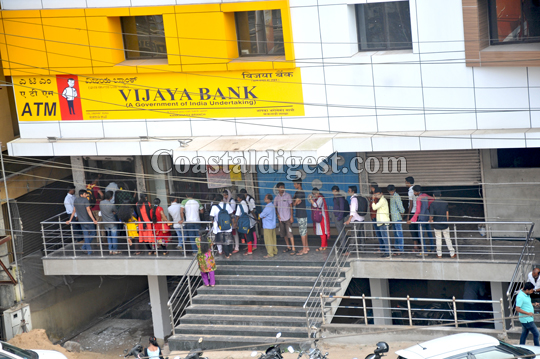
Udupi: 96-year-old dies in note exchange queue before a bank

[email protected] (CD Network | Suresh)
November 12, 2016

Udupi, Nov 12: A 96-year-old man collapsed and died in a queue at a village in Udupi district as cash-strapped common people in the region continued to throng banks and ATM counters for withdrawal of some money to meet their daily expenses on Saturday.

bankqueu

Gopal Shetty (96), a resident of Ajekar village was standing in the before a branch of Corporation bank for exchanging currency. Around 12 noon he collapsed and died on the spot.

It is said that he had only a few notes of Rs 1000 and Rs 500 denomination but waited in queue for a long time.

Though he was rushed to a nearby clinic by some people who saw him collapse, he was declared dead, sources said.

The deceased is the father of Sudhakar Shetty, founder of Jnana Sudha educational institution of Karkala.

Comments

Rikaz
 - 
Saturday, 12 Nov 2016

See, poors will have to suffer, riches have already shifted their amounts 'to foreign countries.....they are safe....poor's had some amount of hard earned money that they will have to lose for unwanted reason....the curse of these people will surely fall on these bloody useless politicians....

I haven't seen any politicians standing in line in front of banks to withdraw money....why why why....have they been given a chance of exchanging their money earlier than the announcement, public needs to know.....this is very bad...

people should teach them nice lesson in next election....

A.Mangalore
 - 
Saturday, 12 Nov 2016

Don't worry let him die . don't disturb our Modiji he is enjoying his Japan trip.

Add new comment

  • Coastaldigest.com reserves the right to delete or block any comments.
  • Coastaldigset.com is not responsible for its readers’ comments.
  • Comments that are abusive, incendiary or irrelevant are strictly prohibited.
  • Please use a genuine email ID and provide your name to avoid reject.
News Network
July 27,2020

Kasaragod, Jul 27: Seven persons belonging to two relative-families who attended a funeral recently had been tested positive for Coronavirus on Monday.

Sources said the two families had been to Thavinjal near here for the funeral of a man who died at the Kozhikode Medical College Hospital on July 19.

Later, the samples of these seven persons were sent for testing after they developed symptoms of COVID-19, the result of which came out on Monday.

Comments

Add new comment

  • Coastaldigest.com reserves the right to delete or block any comments.
  • Coastaldigset.com is not responsible for its readers’ comments.
  • Comments that are abusive, incendiary or irrelevant are strictly prohibited.
  • Please use a genuine email ID and provide your name to avoid reject.
News Network
April 13,2020

Lucknow, Apr 13: Muslims in Uttar Pradesh are now worried that the intense communal profiling of the Corona patients by the official agencies could lead to lynching incidents once the lockdown is lifted.

Muslim scholar and former SP spokesman, Abdul Hafiz Gandhi, on Monday said, "The manner in which the government agencies are identifying persons belonging to Tablighi Jamaat in the list of Covid-19 patients is now translating into intense communal profiling which has been prohibited by the World Health Organization and the central government. A very small percentage of Muslims subscribe to the Tablighi Jamaat ideology but the impression going around is that the Muslim community, in general, is spreading coronavirus."

He said that there was a strong possibility of Muslims, in general, being attacked after the lockdown is lifted.

"This is exactly what happened on the cow slaughter issue. Even a small rumour led to people being lynched by mobs across the country. Corona is a pandemic and should be treated like one. We should fight against the virus together instead of creating a communal divide. Every day, the government spokesman lays down the number of Corona positive cases and then goes on to say how many of them are from Tablighi Jamaat," he explained.

Amir Haider, a social activist and also a veteran Congress leader, echoed similar sentiments when he said, "We strongly condemn the Tablighi Jamaat for ignoring the protocols and holding the congregation but why is the state government repeatedly harping on the religious angle. Shia and Sunni clerics are repeatedly asking the people to adhere to government guidelines and follow safety protocols.

He said that efforts to create a communal divide on the corona issue could have dangerous ramification after the lockdown is lifted."

A retired IAS officer, who did not wish to be named, said, that people have already started objecting to taking home deliveries from Muslim employees.

"My neighbours refused to take delivery of groceries from a Muslim boy. This is just the beginning of the narrative that is being drilled into the minds. We must check this before it explodes into something very dangerous," he said.


Comments

Wellwisher
 - 
Tuesday, 14 Apr 2020

What ever yogi want to do let him and keep faith on the creator and live fear lessly. Almighty is watching you and your faith.His decision  is vast  and he will protect his believer's always.


Add new comment

  • Coastaldigest.com reserves the right to delete or block any comments.
  • Coastaldigset.com is not responsible for its readers’ comments.
  • Comments that are abusive, incendiary or irrelevant are strictly prohibited.
  • Please use a genuine email ID and provide your name to avoid reject.
News Network
February 28,2020

Bengaluru, Feb 28: Historian S. Shettar, 85, breathed his last early on February 28 in Bengaluru. He was suffering from respiratory problems and was hospitalised for over a week.

Shettar was known for his multi-disciplinary work, encompassing linguistics, epigraphy, anthropology, the study of religions and art history. He had extensively worked on the Jain practice of ritual death in Karnataka and Asoka edicts. He had studied and compiled early edicts in Kannada and worked extensively on the growth of Kannada language down the ages.

Born in 1935 at Hampasagara, Ballari district, he went on to study at Cambridge University and started his career as a Professor of History at Karnatak University, Dharwad, his alma mater. He later headed the National Museum Institute of the History of Art, Conservation and Museology in 1978 and Indian Council for Historical Research in 1996. He was also a visiting professor at the National Institute of Advanced Studies, Bengaluru.

He was a bilingual historian who wrote in English for most of his career, but started writing in Kannada in later years. In the last two decades, he developed a keen interest in linguistics and wrote multiple books on classical Kannada and Prakrit. His 2007 book “Shangam Tamilagam” is considered a seminal work in the study of the early period of Dravidian languages. It won him Bhasha Samman from Central Sahitya Akademi. He later wrote two works on Halegannada, classical Kannada. His most recent work was “Prakrita Jagadvalaya” in 2018.

Comments

Add new comment

  • Coastaldigest.com reserves the right to delete or block any comments.
  • Coastaldigset.com is not responsible for its readers’ comments.
  • Comments that are abusive, incendiary or irrelevant are strictly prohibited.
  • Please use a genuine email ID and provide your name to avoid reject.