


Udupi judge’s daughter Meghana is 1st lady fighter pilot from South India

coastaldigest.com news network
June 17, 2018

Udupi, Jun 17: India’s coffee cradle Chikkamagaluru has given South India’s first ever woman fighter pilot. Meghana Shanbhag was the only woman among the 113 flight cadets who graduated as flying officers of the Indian Air Force at the combined graduation parade at Telangana’s Dundigal yesterday.

She has joined the club of five other women fighter pilots of the IAF, who hail from Madhya Pradesh, Rajasthan, Bihar and Uttar Pradesh.

Meghana was born in Chikkamagaluru in a family of lawyers. Her father M K Ramesh is a practising lawyer and mother S C Shobha serves as a judge in the district consumer forum in Udupi. She had her schooling at Little Rock Indian School, a boarding school at Brahmavar, Udupi. She did her BE in Information Science and Engineering at the Sri Jayachamarajendra College of Engineering, Mysuru in the 2011-15 batch.

After joining the flying branch of the Air Force Academy in January 2017, she was cleared for flying in the fighter stream in a trifurcation board in December 2017. She will be the sixth woman fighter pilot to be inducted into the IAF. The other five are north Indians. After her graduation in 2015, she did basic mountaineering course in Manali and trained in paragliding at Goa during 2016, before joining the Air Force.

A TV channel quoted the Meghana as saying that she got inspired to become a fighter pilot in June 2016 when she read the stories of Indian Air Force’s first fighter pilots Avani Chaturvedi, Bhawana Kanth and Mohana Singh.

Comments

Runa Mohammed
 - 
Monday, 18 Jun 2018

Congratulations on this achievement. This motivates girls  to take-up challenging assignments in Services.

Ibrahim
 - 
Sunday, 17 Jun 2018

Its a good sign that a woman choosing this field and achieving heights. 

Add new comment

  • Coastaldigest.com reserves the right to delete or block any comments.
  • Coastaldigset.com is not responsible for its readers’ comments.
  • Comments that are abusive, incendiary or irrelevant are strictly prohibited.
  • Please use a genuine email ID and provide your name to avoid reject.
coastaldigest.com news network
August 7,2020

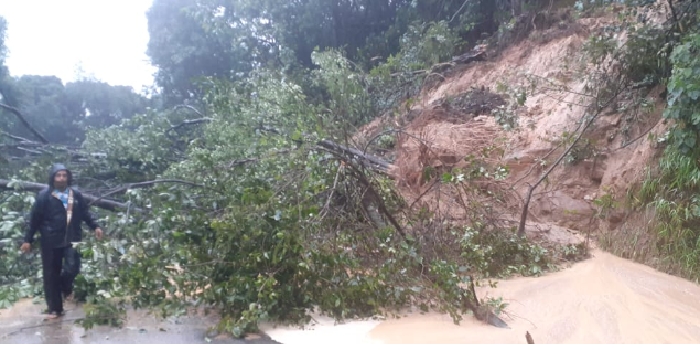
Mangaluru, Aug 7: Following the incessant rain for last few days and subsequent landslides reported at various places along Charmadi Ghat, the movement of vehicles been banned for two days. 

Charmadi Ghat road connects Dakshina Kannada and Chikkamagaluru districts on National Highway-73. The fresh landslides caused cracks on the road and uprooted many trees. 
Officials have closed Charmadi as well as Kottigehara check posts as a precautionary measure.

Belthangady tahsildar Mahesh J confirmed that multiple landslides have hit Charmadi Ghat road.

"The road has been closed for vehicular movement as the officials are at the spot to clear landslide debris. As a precautionary measure, vehicular movement has been banned as there are chances of further landslides," he said.

Hundreds of commuters who were stuck on various stretches of the ghat following a landslide between Maleyamaruta and Alekan falls in Chikkamagaluru district have been rescued.

Comments

Add new comment

  • Coastaldigest.com reserves the right to delete or block any comments.
  • Coastaldigset.com is not responsible for its readers’ comments.
  • Comments that are abusive, incendiary or irrelevant are strictly prohibited.
  • Please use a genuine email ID and provide your name to avoid reject.
Wafa Sultana
April 4,2020

Over the last couple of days when the world was occupied with unifying efforts to fight the deadly Covid19 pandemic, sections of Indian media provided viewers a familiar scapegoat – the Indian Muslims – who are often stereotyped as a community being constantly at loggerheads with the citizenry and the State. Biased media channels were quick to resort to blaming the entire Muslim community for the spread of the disease in the country, thanks to an ill-timed Tablighi Jamaat gathering at its international headquarters in Delhi’s Nizamuddin. Unsurprisingly, the opprobrium was also marked by a sudden spike in WhatsApp forwards of videos with people wearing skullcaps licking spoons and performing Sufi breathing rituals, suggesting some sort of wild conspiracy on the part of the community to spread the virus.  Some media channels were quick to formulate, hypothesize and provide loose definitions of a newly discovered form of Jihad i.e. ‘Corona Jihad ’ thereby vilifying the Islamic faith and its followers.

While the investigation on the culpability of the organizers of the Nizamuddin event is still ongoing, there is enough information to suggest that the meeting was held before any lockdown was in force, and the problem began when there was no way of getting people out once the curfew was announced. Be that as it may, there is little doubt that organizing a meet of such a scale when there is a global pandemic smacks of gross misjudgment, and definitely the organizers should be held accountable if laws or public orders were defied. Attendees who attempt to defy quarantine measures must be dealt with strictly. However, what is alarming is that the focus and narrative have now shifted from the unfortunate event at Nizamuddin to the Tablighi Jamaat itself.

For those not familiar with the Tablighi Jamaat, the organization was founded in 1926 in Mewat by scholar Maulana Mohammad Ilyas. The Jamaat’s main objective was to get Muslim youth to learn and practice pristine Islam shorn of external influences. This is achieved through individuals dedicating time for moral and spiritual upliftment secluded from the rest of the world for a brief period of time. There is no formal membership process. More senior and experienced participants typically travel from one mosque to other delivering talks on religious topics, inviting local youth to attend and then volunteer for a spiritual retreat for a fixed number of days to a mosque in a nearby town or village to present the message to their co-religionists. Contrary to ongoing Islamophobic rhetoric, the movement does not actively proselytize. The focus is rather on getting Muslims to learn the teachings and practices of Islam.  This grassroots India-based movement has now grown to almost all countries with substantial Muslim populations. Its annual meets, or ‘ijtemas’ are among the largest Islamic congregations in the world after the annual Haj. One of the reasons for its popularity and wide network in the subcontinent and wordwide is the fact that it has eschewed the need for scholarly intervention, focusing on peer learning of fundamental beliefs and practice rather than high-falutin ideological debates. The Tablighi Jamaat also distinguishes itself from other Islamic movements through its strictly apolitical nature, with a focus on individual self-improvement rather than political mobilization. Hardships and difficulty in the world are expected to be face through ‘sabr’ (patience) and ‘dua’ (supplication),  than through quest for political power or influence. In terms of ideology, it is very much based on mainstream Sunni Islamic principles derived from the Deobandi school.

So, why is all this background important in the current context? While biased media entities have expectedly brought out their Islamophobic paraphernalia out for full display, more neutral commentators have tried to paint the Tablighi Jamaat as a fringe group and have tried to distance it from 'mainstream Muslims'. While the intent is no doubt innocent, this is a trap we must not fall into. This narrative, unfortunately, is also gaining ground due to apathy some Muslims have for the group, accusing it of being “disconnected from the realities of the world”. Unlike other Muslim organizations and movements, the Tablighi Jamat, by virtue of its political indifference, does not boast of high-profile advocates and savvy spokespersons who can defend it in mainstream or social media.  The use of adjectives such as 'outdated' and 'orthodox' by liberal columnists to describe the Jamaat feeds into the malignant attempt to change the narrative from the control of the spread of the pandemic due to the Nizamuddin gathering to 'raison d'etre' of the organization itself.

A large mainstream religious group like the Tablighi Jamaat with nearly a hundred-year history, normally considered to be peaceful, apolitical and minding its own business is now suddenly being villainized owing to unfortunate circumstances. Biased media reactions filled with disgust and hate seem to feed the Indian public conscience with a danngerous misconception - to be a nominal Muslim is okay but being a practicing one is not.  For those committed to the truth and fighting the spread of Islamophobia, the temptation to throw the entire Tablighi Jamaat under the bus must be resisted.

The writer is a lawyer and research scholar at Qatar University. Her research interests include Islamic law and politics.

Comments

zahoorahmed
 - 
Saturday, 4 Apr 2020

great article! provides a great perspective on tableeg jamat

Add new comment

  • Coastaldigest.com reserves the right to delete or block any comments.
  • Coastaldigset.com is not responsible for its readers’ comments.
  • Comments that are abusive, incendiary or irrelevant are strictly prohibited.
  • Please use a genuine email ID and provide your name to avoid reject.
News Network
July 3,2020

New Delhi, Jul 3: Accredited Social Health Activists (ASHAs) in Karnataka have emerged as a "crucial pillar in the state's success" in combating Covid-19, the Union Health Ministry said on Friday.

Acknowledging and praising their work, the ministry said they have been actively participating in household surveys in the state, screening inter-state passengers, migrant workers and others in the community for symptoms of the infection,

“Around 42,000 ASHAs have emerged as a crucial pillar in the state's success” in combating Covid-19, the ministry said.

"Recognizing the increased vulnerability of certain population groups to Covid-19, in a one-time survey to identify households with the elderly, persons with co-morbidities, and immune-compromised individuals, about 1.59 crore households were covered," the ministry said in a statement.

ASHAs regularly monitor such high-risk groups in their area with a periodicity of follow-up visits varying from once a day in the containment zones to once every 15 days in other areas, it said.

They also visit the houses of persons complaining influenza-like-illness (ILI) symptoms and severe acute respiratory infections (SARI), besides high-risk individuals who have called the state health department helpline numbers, the ministry said.

ASHAs are a part of the Rural Task Force, headed by Panchayat Development Officer (PDO) at the Gram Panchayat level, for addressing public grievances on both Covid-19 and non-Covid-19 related services.

ASHAs are trained female community health activists selected from the village itself and accountable to it. They are trained to work as an interface between the community and the public health system.

In the urban areas too, they have been at the forefront of dissemination of various awareness activities in fever clinics and swab collection centres in urban areas.

They have also actively screened cases of ILI and SARI in urban areas. They are also part of the screening teams at international and interstate check-posts.

Karnataka has reported 272 Covid-19 deaths and 18,016 cases, according to the health ministry data updated at 8 AM.

Comments

Add new comment

  • Coastaldigest.com reserves the right to delete or block any comments.
  • Coastaldigset.com is not responsible for its readers’ comments.
  • Comments that are abusive, incendiary or irrelevant are strictly prohibited.
  • Please use a genuine email ID and provide your name to avoid reject.