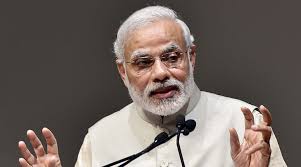
Unity & Love are basic mantras to address Kashmir problem: PM

August 28, 2016

New Delhi, Aug 28: Prime Minister Narendra Modi today said "Ekta" (unity) and "Mamata" (love) are the basic mantras for addressing the Kashmir problem even as he slammed those pushing children to create unrest, saying they will have to give answers to those "innocent" kids some day. He emphasised that if any life is lost in Kashmir, whether of any youth or any securityman, "that loss is ours, of our own country".

modipmSpeaking on the unrest in the valley in his monthly radio programme 'Mann Ki Baat', Modi said, "From the interactions I had with all parties on Kashmir, one thing emerged from those, which can be put in simple words as 'Ekta' and 'Mamata'. These two things were the basic mantra."

He said all the political parties had spoken in one voice on Kashmir, sending out a "message to the world as well as separatist forces" besides conveying "our sentiments to the people of Kashmir". He equated it to the passage of landmark GST Bill by Parliament for which all the parties came together.

"It is the view of all of us, the view of 125 crore people from a pradhan of a village to the Prime Minister, that if any life is lost in Kashmir, whether of any youth or any securityman, that loss is ours, our own country," Modi said.

At the same time, he slammed "those people who push small children to try to create unrest in Kashmir", saying "some day, they will have to give answers to these innocent children". The Prime Minister's remarks came a day after Jammu and Kashmir Chief MInister Mehbooba Mufti met him and presented a "three-pronged action plan" that includes dialogue with all stakeholders.

Comments

abdul
 - 
Sunday, 28 Aug 2016

Devil preaching the peace & harmony

Add new comment

  • Coastaldigest.com reserves the right to delete or block any comments.
  • Coastaldigset.com is not responsible for its readers’ comments.
  • Comments that are abusive, incendiary or irrelevant are strictly prohibited.
  • Please use a genuine email ID and provide your name to avoid reject.
News Network
January 9,2020

Mumbai, Jan 9: India's weddings are famously lavish -- lasting days and with hundreds if not thousands of guests -- but this season many families are cutting costs even if it risks their social standing.

It is symptomatic of a sharp slowdown in the world's fifth-largest economy, with Indians spending less on everything from daily essentials to once-in-a-lifetime celebrations.

Growth has hit a six-year low and unemployment a four-decade high under Prime Minister Narendra Modi. Prices are rising too, squeezing spending on everything from shampoo to mobile data.

Chartered accountant Palak Panchamiya, for example, has already slashed the budget on her upcoming Mumbai nuptials by a third, trimming spending on clothing and the guest list.

"Initially I chose a dress that cost 73,000 rupees ($1,000)," Panchamiya told news agency as she picked through outfits at a recent marriage trade fair.

"But my partner felt it was too expensive, and so now I am here reworking my options and looking for something cheaper."

India's massive wedding industry is worth an estimated $40-50 billion a year, according to research firm KPMG.

The celebrations can last a week and involve several functions, a dazzling variety of cuisines, music and dance performances, and lots of gifts.

Foreigners can even buy tickets to some events.

But these days, except for the super-rich -- a recent Ambani family wedding reportedly cost $100 million -- extravagance is out and frugality is in as families prioritise saving.

"Earlier Indian weddings were like huge concerts, but now things have changed," said Maninder Sethi, founder of Wedding Asia, which organises marriage fairs around the country.

Cracks emerged in 2016 when the Indian wedding season, which runs from September to mid-January, was hit by the government's shock withdrawal of vast amounts of banknotes from circulation in a bid to crack down on undeclared earnings.

Mumbai-based trousseau maker Sapna Designs Studio shut for months as the economy was turned on its head by Modi's move.

"No exhibitions were happening and there were no avenues for us to sell either," said Vishal Hariyani, owner of the clothing studio.

Hopes for a recovery proved short-lived when the cash ban was followed by a botched rollout of a nationwide goods and services tax (GST) in 2017 that saw many small-scale businesses close.

Since then, keeping his studio afloat has been a challenge, with consumers increasingly reluctant to spend too much, says Hariyani.

"We customise our clothes as per their budgets, and now week-long weddings have been converted to just a 36-hour ceremony," he told news agency.

"We have to pay GST, pay workers and even offer discounts to customers," he added.

"The whole economy has slowed down and reduced spending on weddings is a by-product of that. Everyone except the super-rich are affected," Pradip Shah from IndAsia Fund Advisors told news agency.

"It is reflective of how sombre the mood is," he said.

In a country where families traditionally spend heavily on weddings -- including taking on debt in some cases -- the downturn is also a source of sadness and shame, with elaborate celebrations often seen as a measure of social status.

"We haven't even invited our neighbours. It is embarrassing but the current situation doesn't offer us much respite," 52-year-old Tara Shetty said ahead of her son's wedding.

"In my era, we always spent a lot and had thousands of people attending the weddings," she explained.

"My wedding was supremely grand, and now my son's is the polar opposite."

Comments

Add new comment

  • Coastaldigest.com reserves the right to delete or block any comments.
  • Coastaldigset.com is not responsible for its readers’ comments.
  • Comments that are abusive, incendiary or irrelevant are strictly prohibited.
  • Please use a genuine email ID and provide your name to avoid reject.
News Network
January 10,2020

Mumbai, Jan 10: India’s oil demand growth is set to overtake China by mid-2020s, priming the country for more refinery investment but making it more vulnerable to supply disruption in the Middle East, the International Energy Agency (IEA) said on Friday.

India’s oil demand is expected to reach 6 million barrels per day (bpd) by 2024 from 4.4 million bpd in 2017, but its domestic production is expected to rise only marginally, making the country more reliant on crude imports and more vulnerable to supply disruption in the Middle East, the agency said.

China’s demand growth is likely to be slightly lower than that of India by the mid-2020s, as per IEA’s China estimates given in November, but the gap would slowly become bigger thereafter.

“Indian economy is and will become even more exposed to risks of supply disruptions, geopolitical uncertainties and the volatility of oil prices,” the IEA said in a report on India’s energy policies.

Brent crude prices topped USD 70 a barrel on rising geopolitical tensions in the Middle East, putting pressure on emerging markets such as India. Like the rest of Asia, India is highly dependent on Middle East oil supplies with Iraq being its largest crude supplier.

India, which ranks No 3 in terms of global oil consumption after China and the United States, ships in over 80 per cent of its oil needs, of which 65 per cent is from the Middle East through the Strait of Hormuz, the IEA said.

The IEA, which coordinates release of strategic petroleum reserves (SPR) among developed countries in times of emergency, said it is important for India to expand its reserves.

REFINERY INVESTMENTS

India is the world’s fourth largest oil refiner and a net exporter of refined fuel, mainly gasoline and diesel.

India has drawn plans to lift its refining capacity to about 8 million bpd by 2025 from the current about 5 million bpd.

The IEA, however, forecasts India’s refining capacity to rise to 5.7 million bpd by 2024.

This would make “India a very attractive market for refinery investment,” IEA said.

Drawn to India’s higher fuel demand potential, global oil majors like Saudi Aramco, BP, Abu Dhabi National Oil Co and Total are looking at investing in India’s oil sector.

Saudi Aramco and ADNOC aim to own a 50 per cent stake in a planned 1.2-million bpd refinery in western Maharashtra state, for which land is yet to be acquired.

Comments

Add new comment

  • Coastaldigest.com reserves the right to delete or block any comments.
  • Coastaldigset.com is not responsible for its readers’ comments.
  • Comments that are abusive, incendiary or irrelevant are strictly prohibited.
  • Please use a genuine email ID and provide your name to avoid reject.
News Network
March 7,2020

New Delhi, Mar 7: No country in the world says everybody is welcome, External Affairs Minister S Jaishankar said on Saturday, hitting out at those criticising India over the Citizenship (Amendment) Act.

Jaishankar criticised the United Nations Human Rights Council (UNHRC) for its criticism on the situation in Jammu and Kashmir, saying its director had been wrong previously too and one should look at the UN body's past record on handling the Kashmir issue.

"We have tried to reduce the number of stateless people through this legislation. That should be appreciated," he said when asked about the CAA at the ET Global Business Summit. "We have done it in a way that we do not create a bigger problem for ourselves."

"Everybody, when they look at citizenship, have a context and has a criterion. Show me a country in the world which says everybody in the world is welcome. Nobody says that," the minister said.

The external affairs minister said moving out of the Regional Comprehensive Economic Partnership (RCEP) was in the interest of India's business.

Asked about the UNHRC director not agreeing with India on the Kashmir issue, Jaishankar said: "UNHRC director has been wrong before.

"UNHRC skirts around cross-border terrorism as if it has nothing to do with country next door. Please understand where they are coming from; look at UNHRC's record how they handled Kashmir issue in past," he added.

Comments

Add new comment

  • Coastaldigest.com reserves the right to delete or block any comments.
  • Coastaldigset.com is not responsible for its readers’ comments.
  • Comments that are abusive, incendiary or irrelevant are strictly prohibited.
  • Please use a genuine email ID and provide your name to avoid reject.