


US Army allows hijabs, beards, turbans for servicemen

January 5, 2017

Washington, Jan 5: The US Army has issued a new regulation under which servicemen who wear turbans, hijabs or beards can now be enrolled in the military, making the force more inclusive of minority religions and cultures.
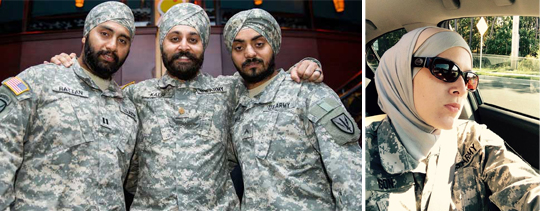
Untitled-1 copy

The new set of rules, issued by Secretary of the Army Eric Fanning, allows religious accommodations to be approved at the brigade-level. Previously it was at the level of Secretary.

Once that approval occurs, the change will ensure that the religious accommodation is enduring and applies to most positions within the US Army.

"This is a major progress, not just for the Sikh-American community but for our nation's military. Sikh-Americans love this country and want a fair chance to serve in our country on equal footing. Today's announcement will help do just that," Congressman Joe Crowley said welcoming the directive issued by the US Army Secretary.

"We are a stronger nation, with a stronger military because of our respect for religious and personal freedom," he said.

The move has been welcomed by Sikh-Americans and US lawmakers who have been on the forefront of a national campaign in this regard for the past several years. Before the January 3 changes announced by the US Army, Sikh-Americans and others had to be granted a limited accommodation or permission to serve in the army while maintaining their articles of faith.

Such accommodations were neither permanent nor guaranteed, and had to be renewed after virtually every assignment. Service members had also been required to remove their articles of faith while their accommodation request is pending, once again subjecting them to the difficult position of choosing between their faith and job.

Sikh-American Coalition, which has been on the forefront of such a campaign, welcomed the move, but said that this is still short of what they have been asking for.

"While we still seek a permanent policy change that enables all religious minorities to freely serve without exception, we are pleased with the progress that this new policy represents for religious tolerance and diversity by our nation's largest employer," said the coalition's legal director Harsimran Kaur.

The new provisions updates rules governing religious liberty that significantly improve the standards for Sikhs and other religious minorities who seek to serve their country with their religious articles of faith intact, she said.

Under the new policy, Brigade commanders must grant religious accommodations for unshorn beards, unshorn hair, turbans and Muslim hijabs unless the requestor's religious belief is not sincere or the army identifies a specific, concrete hazard.

Last week, the New York Police Department (NYPD), in a move aimed at inclusiveness, said it will allow its Sikh officers to wear turbans and maintain beards.

According to the latest regulation, accommodations must be granted across all duty positions except in certain limited circumstances.

The army intends to conduct additional testing for the use of protective equipment by bearded soldiers.

"The Sikh articles of faith have always been consistent with the best of American values and we are pleased that the burden no longer rests with Sikh soldiers to prove this through a lengthy administrative process," said Amandeep Sidhu, partner at McDermott Will and Emery.

In 1981, a prohibitive ban was placed on Sikh-American soldiers.

Last year, four Sikh-American soldiers, including the decorated Captain Simratpal Singh, filed a lawsuit against the US Army in this regard.

"My turban and beard represent my commitment to pluralism and equality. This policy change underscore's the military's commitment to these values and is a sign of meaningful progress that will ensure the strength of our democracy," said Major Kalsi, who was the first Sikh-American in more than a generation to be allowed to serve in the US military without violating his articles of faith.

Comments

s
 - 
Thursday, 5 Jan 2017

and our army does not allow anything except turbans, sighting reasons of uniformity. allowing such things only shows the diversity in our army and the public will realize all faiths support the army and are protecting the country. this is very important in the current political climate of polarization and divisiveness.

Add new comment

  • Coastaldigest.com reserves the right to delete or block any comments.
  • Coastaldigset.com is not responsible for its readers’ comments.
  • Comments that are abusive, incendiary or irrelevant are strictly prohibited.
  • Please use a genuine email ID and provide your name to avoid reject.
coastaldigest.com news network
February 3,2020

Dammam, Feb 3: Harish Bangera, 32, who was arrested in Kingdom of Saudi Arabia more than a month ago after offensive Facebook post went viral, has remained incommunicado.

Bangera, who hails from Goyadibettu in Bijadi village of Kundapur taluk, Udupi district, was an air-conditioning technician for a company in Dammam, capital of Saudi's eastern province.

He was arrested on December 20, 2019 after he posted derogatory messages on Facebook against crown prince Mohammad bin Salman and went on to claim that a Ram temple will be built in the holy city of Makkah too just like in Ayodhya where the Babri mosque was demolished.

Fearing legal action, he later posted a video pleading for forgiveness. “I have committed a mistake. Please forgive me. I will never upload any such posts again," he is seen saying in the video.

After his arrest, his roommate, who happens to be a Pakistani, has reportedly made several attempt to contact him, but in vain. He also has approached many Indian and Saudi authorities in his bid to get Bangera out of prison, sources said.

The Saudi authorities have not even responded to the messages of Indian Ministry of External Affairs. "We've made many efforts to contact the Saudi authorities but they haven't responded,” MEA sources said.

Comments

fairman
 - 
Monday, 3 Feb 2020

There can be many such people in the Kingdom. 


They should be identified and treated in the same way.

These are real terrorists, keep him few years in jail,  they should not be let free. Otherwise they will forget and commit again.

May God help us.


Suresh SS
 - 
Monday, 3 Feb 2020

Well done Saudi Authorities, this kind of mentality should be eleminated even any whare in any country we have many BJP dogs barking nonsence always all should be eleminated.

Add new comment

  • Coastaldigest.com reserves the right to delete or block any comments.
  • Coastaldigset.com is not responsible for its readers’ comments.
  • Comments that are abusive, incendiary or irrelevant are strictly prohibited.
  • Please use a genuine email ID and provide your name to avoid reject.
coastaldigest.com web desk
July 27,2020

New Delhi, Jul 27: A month after banning 59 Chinese applications, the government of Indian has now reportedly banned 47 more apps of Chinese origin in the country. According to sources, the 47 banned Chinese apps were operating as clones of the earlier banned apps. 

The list of the 47 Chinese applications banned by the Indian government will be released soon.

India has also prepared a list of over 250 Chinese apps, including apps linked to Alibaba, that it will examine for any user privacy or national security violations, government sources said. The list also includes Tencent-backed gaming app PUBG.

Some top gaming Chinese applications are also expected to be banned in the new list that is being drawn up, sources said. The Chinese applications, that are being reviewed, have allegedly been sharing data with the Chinese agencies.

Today's decision follows after a high-profile ban of 59 Chinese apps including TikTok, as border tensions continued in Ladakh after a violent, fatal face-off between the Indian and Chinese armies. The government said these apps were engaged in activities that were prejudicial to the sovereignty, integrity and defence of India.

A government press release announcing the ban stated: "The Ministry of Information Technology, invoking it's power under section 69A of the Information Technology Act read with the relevant provisions of the Information Technology (Procedure and Safeguards for Blocking of Access of Information by Public) Rules 2009 and in view of the emergent nature of threats has decided to block 59 apps since in view of information available they are engaged in activities which is prejudicial to sovereignty and integrity of India, defence of India, security of state and public order".

A day later, Google said it has removed all the banned applications from the Play Store. Following the ban, TikTok refuted the claims that suggest it will pursue legal action against the Indian government for banning the app in India.

Reacting to the 59 apps banned by India, the Chinese Foreign Ministry said the country is "strongly concerned regarding the decision of the Indian government".

“China is strongly concerned, verifying the situation,” Chinese Foreign Ministry spokesperson Zhao Lijian was quoted as saying by news agency ANI.

"We want to stress that the Chinese government always asks Chinese businesses to abide by international and local laws-regulations. The Indian government has a responsibility to uphold the legal rights of international investors including Chinese ones," Zhao Lijian said.

Comments

Add new comment

  • Coastaldigest.com reserves the right to delete or block any comments.
  • Coastaldigset.com is not responsible for its readers’ comments.
  • Comments that are abusive, incendiary or irrelevant are strictly prohibited.
  • Please use a genuine email ID and provide your name to avoid reject.
News Network
May 23,2020

Bengaluru, May 23: SSLC and PUC students residing in containment zones will not be able to write the exams scheduled to be held in June and July, respectively, but will be given opportunity to write the supplementary examination and treated as fresh candidates.

Primary and Secondary Education Minister S. Suresh Kumar announced this at a press conference on Friday.

In turn, officials in the Department of Primary and Secondary Education will start collecting the list of students in containment zones. However, they are worried since the list of containment zones is dynamic and a particular locality can be declared a containment zone even the night before the examination.

“If any examination centre is located in the containment zone, then we can change the centre and move it to a non-containment zone. However, if a student resides in a zone that is declared containment zone just before the exam, there is no option but for the person to skip the exam,” an official said.

Officials of the department are worried about another scenario as well. “There is a chance that midway through the examination, an area is becomes a containment zone. Then some students may write a few papers and give the rest a miss. Implementation at the district- and block-levels will be a challenge,” said an official.

Sources said that the department is working out several situations that may arise and trying to work on providing practical solutions to the students.

Around 5.98 lakh students have registered for the second pre-university English examination that is scheduled to be held on June 18. As many as 8.48 lakh students have registered for the SSLC examination scheduled to be held between June 25 and 4 July. Currently, there are 261 containment zones in Karnataka that have 5.49 lakh people residing in these zones.

Meanwhile, the Karnataka Secondary Education and Examination Board has decided to ensure that only 18 students are seated in a classroom to write the SSLC examination. This is to ensure that social distancing is maintained in the exam hall.

Comments

Add new comment

  • Coastaldigest.com reserves the right to delete or block any comments.
  • Coastaldigset.com is not responsible for its readers’ comments.
  • Comments that are abusive, incendiary or irrelevant are strictly prohibited.
  • Please use a genuine email ID and provide your name to avoid reject.