Vikas College brings out handbook for Class 10 students to ‘Score More’

[email protected] (CD Network, Photos by Suresh)
January 17, 2015

Mangaluru, Jan 17: In view of the recent revision in the SSLC syllabus textbooks from the state syllabus to that recommended by National Council of Educational Research and Training (NCERT) for Class 10 students, academic staff of Vikas P U College, Mangaluru have jointly compiled a handbook to help the students prepare well for their final board examinations.

The handbook ‘Score More’ is a compilation of all chapters from the four core subjects – Physics, Chemistry, Biology and Mathematics in textbooks of Class 10.

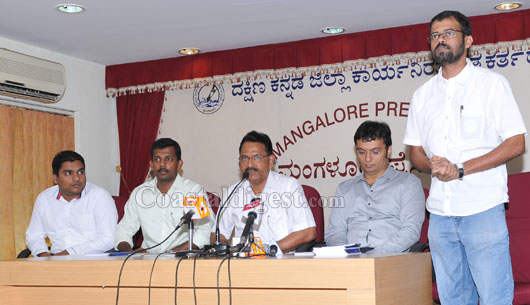
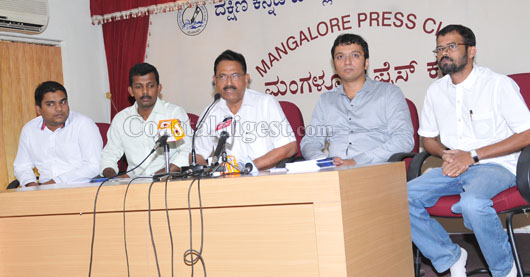
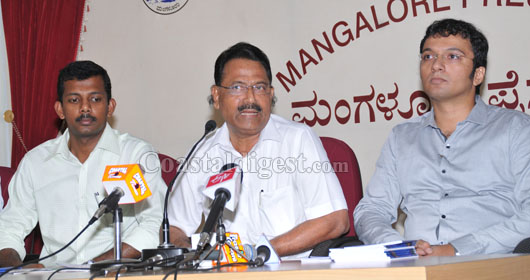
Releasing the book at a press conference here on Saturday, Chairman of Vikas Education Trust and former minister Krishna Palemar said that the book aimed at reducing the stress caused among students due to the sudden change in syllabus in textbooks prepared for Class 10. This handbook is prepared with the important sections of chapters in a capsule format and makes studying simpler for students during their preparation for board exams, he said.

He said that the compiled book would be distributed free of cost at the campus premises for SSLC students. A total of 10,000 copies have been printed in the first phase, which will be distributed to few schools in the district as well as other districts in the state, he said, adding that the handbook would be printed for Kannada-medium students based on the demand.

He informed that the handbook could be collected from the college campus by SSLC students free of cost before February 28. Dean of Academics Jinu, Ananth Prabhu, Sharath and Yathin Shetty were present on the occasion.

Vikas college 1

Vikas college 2

Vikas college 3

Vikas college 4

Comments

Add new comment

  • Coastaldigest.com reserves the right to delete or block any comments.
  • Coastaldigset.com is not responsible for its readers’ comments.
  • Comments that are abusive, incendiary or irrelevant are strictly prohibited.
  • Please use a genuine email ID and provide your name to avoid reject.
coastaldigest.com news network
June 28,2020

Mangaluru, Jun 28: The patience and presence of mind exhibited by the family members of youth covid-19 victim thwarted the attempt by a few miscreants to create communal disharmony in the coastal city today.

A 31-year-old youth from Idya in Surathkal, who was under treatment for covid-19 at designated Wenlock Hospital in the city, passed away last night. 

Even though there is a Muslim graveyard under the jurisdiction of Idya mosque, it was waterlogged due to heavy rains. 

Hence, the Idya mosque management had obtained permission from Mangaluru’s Bolar mosque management to bury the mortal remains of the youth in Bolar graveyard. 

All necessary arrangements were made at the Bolar graveyard for the burial this morning. Meanwhile, a few residents of Bolar belonging to another community staged a protest against bringing covid-19 victim’s mortal remains to Bolar.

Mohammad Husain, general secretary of Bolar mosque, said that the family members of the departed youth exhibited their presence of mind and urged the Muslims of Bolar to preserve communal harmony.

“The Bolar mosque committee had given green signal for the burial and all arrangements were made. Meanwhile, a few people staged protest and warned us against burying the covid-19 victim’s body. When the aggrieved family members came to know this, they immediately cancelled the plan,” he said. 

“The aggrieved family requested us to uphold communal amity and co-existence. They decided to bury the body in Idya itself. Then the protesters also returned,” he said.

Burial in Bolar after DC’s intervention

When the mortal remains were being taken towards Surathkal in the ambulance, the Deputy Commissioner of Dakshina Kannada ordered the authorities concerned to take a U-turn and bring back mortal remains to Bolar.  

The DC said it was wrong to take the mortal remains to another place after making all necessary armaments in Bolar graveyard. In order to pacify the porters it was decided to dig another grave on the other side of the graveyard, sources said.

Comments

Kudla
 - 
Sunday, 28 Jun 2020

we know the mentality of these... they are educate but their brain is full of dumb...


if tommorow some of their family member die in COVID and we will see how they manage..


first we are all human being and we must repsect the dead person..


Add new comment

  • Coastaldigest.com reserves the right to delete or block any comments.
  • Coastaldigset.com is not responsible for its readers’ comments.
  • Comments that are abusive, incendiary or irrelevant are strictly prohibited.
  • Please use a genuine email ID and provide your name to avoid reject.
News Network
May 12,2020

Bengaluru, May 12: People returning to Karnataka from other states will have to remain in quarantine">institutional quarantine even if they are asymptomatic, according to Department of Health and Family Welfare Services, Government of Karnataka

"All persons returning to Karnataka from any State, symptomatic or asymptomatic shall be kept in quarantine">institutional quarantine," read an order issued by the State Health and Family Welfare Services.

It further read, "For persons claiming to come from Goa, Deputy Commissioner of receiving district should verify and in the event of adequate capacity not being available, can put them in home quarantine for a period of 14 days, if the claim regarding the origin state is confirmed."

"Deputy Commissioner/Special Commissioner, BBMP will fix the rates for hotels where such returnees will be staying on a payment basis," the statement read.

Comments

Add new comment

  • Coastaldigest.com reserves the right to delete or block any comments.
  • Coastaldigset.com is not responsible for its readers’ comments.
  • Comments that are abusive, incendiary or irrelevant are strictly prohibited.
  • Please use a genuine email ID and provide your name to avoid reject.
Media Release
February 14,2020

Veteran journalist P. Sainath has said that the nation is in a crisis. And this crisis is not limited to just the rural area. It has become a national crisis at various areas such as agriculture, education, economy, job creation etc.

He was delivering the endowment lecture on the topic ‘Indian democracy at the post-liberalization and post-truth era’ at Media Manthan 2020 organized by the PG department of journalism and mass communication at St Aloysius College (Autonomous). 

Mr Sainath said that the many policies adopted in the 90s led to India becoming unusually unequal. Referring to the speech Ambedkar had made at the Constituent Assembly while handing over the draft of the Constitution, Mr Sainath said, “Ambedkar had warned about the weakness of Indian democracy that liberty without equality allows the supremacy of a few over the multitude. Liberty, equality and fraternity must be kept together as we cannot have one without the other.” 

Mr Sainath stated that the agrarian crisis was no longer about the loss of productivity, employment or about farmer suicide; it was a societal, civilizational crisis. Commenting on the lopsided policies such as cow-slaughter ban, he explained how cow slaughter ban had adversely affected many industries due to their interdependency. While Muslims who slaughtered cows were rendered helpless, the cattle traders who were mostly OBCs lost their earnings as the cattle prices crashed. An important industry like Kolhapur sandals industry in Maharashtra went bankrupt as a result of the cow slaughter ban in Maharashtra. He said the policymakers had no idea how the rural industries were interconnected. Demonetisation too devastated the rural economy as 98 percent of rural transactions happen through cash. 

Mr Sainath also spoke about the crisis of inequality which affects the Dalits and the Adivasis far more than anyone else as 90 percent of the rural households take home less than Rs 10,000/- per month. “Women are yet another group whose labour is never counted in the gross domestic product. Women and girls globally do unpaid work which amounts to about 12.5 billion working hours per year. Monetarily speaking, this is worth 10.8 trillion dollars,” Mr Sainath added. 

Speaking about the crisis of jobs Mr Sainath said that major companies were laying off employees just to create more profits for the investors and the adoption of artificial intelligence in the industry would further destroy millions of jobs.

Rector of St Aloysius College Institutions Fr Dionysius Vaz SJ, Principal Dr (Fr) Praveen Martis SJ, HOD of Journalism and Mass Communication department Dr (Fr) Melwyn Pinto SJ were present.

‘Veerappan and Vijay Mallya’s business models are interesting!’

Addressing the gathering during his endowment lecture on Friday, Mr Sainath made an interesting comment on the so called ‘revenue model’. “Whenever I visit IIMs and IITs for lectures on my PARI project, the students there ask me what my revenue model for my project is. I tell them that I do not have a revenue model. In fact, journalism does not begin with a revenue model. Gandhiji, Ambedkar, Bhagat Singh were all great journalists. But they did not have a revenue model,” Mr Sainath said.

On a lighter note, he said that the best revenue model that he liked was that of forest brigand Veerappan and liquor baron Vijay Mallya. “Veerappan ruled the forest for forty years and from the top ministers to the villagers he could dictate terms and liver royally. Similarly, Mallya’s revenue model was to steal the banks and run away abroad and live like a king,” Mr Sainath added.

Journalism is not and can never be a business. It is a calling, he opined. While newspaper can be a business, television can be a business, journalism per se cannot be reduced to a business. “Unfortunately today, journalists are recruited on a contract basis and they have no bargaining power; and there are no unions to fight for their cause. Hence, they are at the mercy of the corporate media houses for their survival and are made to write stories that cannot be called journalism,” Mr Sainath said.

Answering a question as to the pressures he faced as a journalist, he said that external pressures from the government or others could be very well handled. It is the internal pressures from once own media house that journalists find it difficult to manage.


 

Comments

Add new comment

  • Coastaldigest.com reserves the right to delete or block any comments.
  • Coastaldigset.com is not responsible for its readers’ comments.
  • Comments that are abusive, incendiary or irrelevant are strictly prohibited.
  • Please use a genuine email ID and provide your name to avoid reject.