


18m vehicles likely on Saudi roads by year-end

October 23, 2014

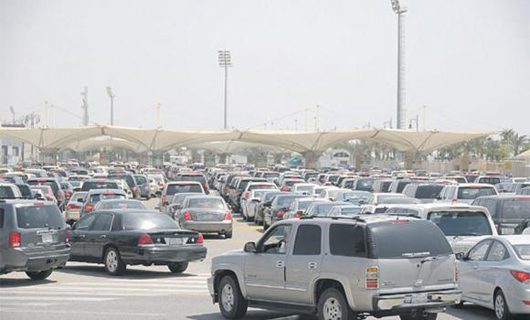
Riyadh, Oct 23: Eighteen million licensed vehicles are likely to be on Saudi roads by the end of this year, from 17 million last year, according to a study published by Al-Eqtisadiah daily.

The number of licensed cars rose by 7 percent from 2011 to 2012, to 15.9 million vehicles, it said. This was a rise of 975,000 cars from the 14.9 million in 2011.
saudivehicle

About 81 percent of the registered vehicles in 2012 were in the three major provinces of Makkah, Riyadh and the Eastern Province.

Makkah province registered 5.1 million vehicles accounting for 32 percent of the total of 12.8 million vehicles registered in the three provinces in that year.

Riyadh province followed with 4.8 million registered vehicles accounting for 30 percent of the total vehicles registered followed by the Eastern Province with more than 3 million vehicles accounting for 19 percent of all registered vehicles, the report said.

The country’s traders paid SR356 billion to import cars over the past six years. The cost of imports rose 3 percent from SR77 billion in 2012 to SR79 billion last year, according to the study.

The study stated that SR53.8 million worth of cars were imported in 2008, falling 22 percent to SR41.9 billion in 2009, attributed largely to the global financial crisis. However, it increased 22 percent in 2010 to SR51 billion, then SR53.7 billion in 2011 and R76.6 billion in 2012.

Makkah has the dubious credit of recording the most accidents at 1,993 in 2013, followed by the Eastern Province with 1,018, and Riyadh with 554.

Comments

Add new comment

  • Coastaldigest.com reserves the right to delete or block any comments.
  • Coastaldigset.com is not responsible for its readers’ comments.
  • Comments that are abusive, incendiary or irrelevant are strictly prohibited.
  • Please use a genuine email ID and provide your name to avoid reject.
News Network
May 20,2020

Cairo, May 20: A senior Kuwaiti lawmaker has called for imposing a tax on expatriates’ remittances to shore up the country’s finances.

MP Khalil Al Saleh, the head of the parliament’s Human Resources Committee, has presented a draft law on the proposed tax to the legislature.

“Imposing fees on expatriates’ transfers will have a role in improving the state's revenues and diversify sources of income,” he told Al Rai newspaper.

Migrant workers transfer about 4.2 billion dinars annually from Kuwait, he added, citing figures from Kuwait’s Central Bank.

“This system is in effect in most countries of the world and in more than one Gulf country. Expats there have not objected to it. Allowing this money to exit the country is very dangerous and has a direct effect on economy,” MP Al Saleh said.

“We do not target brotherly expats because imposing symbolic fees on financial transfers will not affect their money, but will have a positive effect on the state’s sources,” he said. “This has become a necessity after the money transferred outside Kuwait has reached 4.2 billion dinars annually without the state [Kuwait] making any benefit from this.”

Foreign workers make up 3.3 million of Kuwait’s 4.6 million population.

Several Kuwaiti public figures have recently pushed for redrawing the demographic imbalance in the country, accusing expatriates of straining health facilities and increasing the Covid-19 threat.

Comments

Add new comment

  • Coastaldigest.com reserves the right to delete or block any comments.
  • Coastaldigset.com is not responsible for its readers’ comments.
  • Comments that are abusive, incendiary or irrelevant are strictly prohibited.
  • Please use a genuine email ID and provide your name to avoid reject.
Agencies
July 14,2020

Dubai, Jul 14: The UAE-based parents of children under 12 stranded in India are in a tight spot with multiple airlines refusing to accept unaccompanied minors.

Starting July 12, Indians wanting to return to the UAE have been given a 15-day window to travel back on the condition that they have valid residency permits. They also have to produce a negative Covid-19 test result.

But parents of minors said they are feeling helpless as children are unable to avail of the travel opportunity despite having return permits.

"It has been more than three months since my daughter has been stuck in India. We have GDRFA approval for her but the airlines are not accepting her booking, saying she is under 12," Poonam Sapre, a Dubai-based mother, told Khaleej Times.

Her daughter Eva Sapre, 10, is in Hyderabad and is awaiting a reunion with her parents.

"She is just 10 and it has already taken an emotional toll on her. She is eager to come back and is asking me every day about her return. This is so frustrating."

Barring Emirates and Etihad, other airlines including flydubai, Air Arabia and Air India Express are not accepting unaccompanied minors. With India extending the travel freeze till July 31, normal flights are yet to resume and only special flights are allowed between India and UAE under a bilateral agreement.

Sapre said only flydubai is flying the Hyderabad-Dubai route, and the carrier has restrictions on minors travelling alone. "My daughter is too young to fly through indirect routes," claims the mother.

When Khaleej Times reached out to the airlines for comment, they confirmed that such rules on unaccompanied minors were already in place even before Covid-19 travel restrictions came into effect.

Another Dubai-based distressed parent, who did not want to be named, said her eight-year-old son is in Kerala and is unable to fly due to airline policies on unaccompanied minors.

"I called up Air India Express and they said this has been their rule even before the Covid-19 outbreak. I am appealing to them to re-consider and make an exception during these trying times so that our children can come home safely," she said.

Faced with this eventuality, some parents are forced to fly out of the UAE so they can accompany their children on the flight back home.

An Indian mother, who is currently in Mumbai, said she flew out of Dubai on Monday morning solely for the purpose of bringing back her twin daughters, aged 10.

"I had no choice. Ideally, they could have travelled together, but under these circumstances I thought it best to get them with me personally," said the mother.

Comments

Add new comment

  • Coastaldigest.com reserves the right to delete or block any comments.
  • Coastaldigset.com is not responsible for its readers’ comments.
  • Comments that are abusive, incendiary or irrelevant are strictly prohibited.
  • Please use a genuine email ID and provide your name to avoid reject.
Agencies
May 18,2020

Jeddah, May 18: Saudi Arabia’s Grand Mufti and head of the Council of Senior Scholars and the Department of Scientific Research and Ifta Sheikh Abdul Aziz Al Asheikh ruled that it is permissible to perform Eid Al-Fitr prayer at home under exceptional circumstances similar to the current pandemic situation. The prayer consists of two rakats with reciting more numbers of takbeer and without a sermon.

Speaking to Okaz/Saudi Gazette, he said that Zakat Al-Fitr could be distributed through charitable societies if they are reliable ones, with the condition that it should be distributed before the day of Eid. The Grand Mufti urged parents to bring joy and happiness to their children and their families by spending more on them.

Meanwhile, Sheikh Abdul Salam Abdullah Al-Sulaiman, member of the Council of Senior Scholars and the Standing Committee of Fatwa, said that Eid prayer could be performed individually or in congregation.

Speaking to Okaz/Saudi Gazette, he said that the worshiper will recite takbeer to start salat and then follow it with six more takbeer in the first rakat before reciting Fatiha loudly and then it is ideal to recite Surah Al-Qaf.

In the second rakat, there will be five takbeer after the takbeer at the start of the rakat before starting to recite Surah Fatiha and then Surah Al-Qamar, following the example of the Prophet (peace be upon him). It is also ideal to recite Surah Al-A’la and Al-Ghashiya instead of Al-Qaf and Al-Qamar in each rakat respectively.

Sheikh Al-Sulaiman also cited the example of Anas Bin Malik, a prominent companion of the Prophet (pbuh). When Anas (May Allah be pleased with him), was at his home in Zawiya, a place near Basra, he did not find any Eid congregation prayer and therefore he performed prayer along with his family members and his aide Abdullah Bin Abi Otba.

The scholar said that the time for Eid prayer begins after sunrise and the best time is after the sun rises by the height of one or two spears as agreed by most scholars. This means 15 or 30 minutes after sunrise and its time continues until the end of the time of the Duha prayer; that is before the Zuhr prayer begins.

The prayer is forbidden at the moment when the sun rises, and the majority of jurists, including the schools of thought of Shafi, Maliki, and Hanbali opposed prayer at sunrise and favored to perform the prayer only after the sun rises by the height of one or two spears in the sky.

Regarding the recitation of takbeer on the occasion of Eid Al-Fitr, Sheikh Al-Suleiman said that it should begin during the night of the Eid and continue until the beginning of the Eid prayer.

Comments

Add new comment

  • Coastaldigest.com reserves the right to delete or block any comments.
  • Coastaldigset.com is not responsible for its readers’ comments.
  • Comments that are abusive, incendiary or irrelevant are strictly prohibited.
  • Please use a genuine email ID and provide your name to avoid reject.