



Afghanistan, Pak earthquake: Over 260 dead, 1200 injured

October 27, 2015

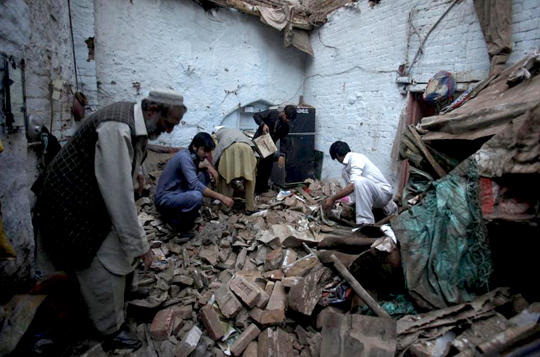
Islamabad, Oct 27: A massive earthquake struck remote and impoverished regions of northern Afghanistan and Pakistan on Monday, killing at least 263 people as it shook buildings across South Asia and knocked out power and communications to already-isolated areas.
earthquake copy

The 7.5-magnitude quake was centered deep beneath the Hindu Kush mountains in Afghanistan's sparsely populated Badakhshan province, which borders Pakistan, Tajikistan and China, the US Geological Survey said.

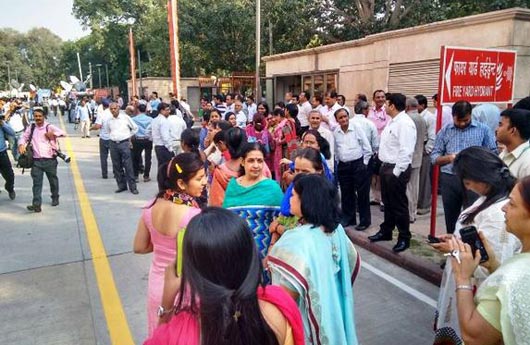
In the Afghan capital of Kabul, buildings shook for up to 45 seconds, walls cracked and cars rolled in the streets as electricity went out. Frightened workers who had just returned from lunch also rushed from swaying buildings in the Pakistani capital of Islamabad and to the south in the Indian capital of New Delhi.

"I was praying when the massive earthquake rattled my home. I came out in a panic," said Munir Anwar of Liaquat Pur in Pakistan's eastern Punjab province.

At least 228 people were killed in Pakistan, with more than 1,000 injured, while Afghan officials reported 33 dead and more than 200 injured, and authorities in the Indian-controlled Kashmir region reported two deaths. Officials expected the casualty toll to rise as they reached the remote areas.

Authorities struggled to reach the hardest-hit areas in Afghanistan near the epicenter, located 73 kilometers (45 miles) south of Fayzabad, the capital of Badakhshan province.

Abdul Humayoon Dehqan, the head of the National Disaster Management Authority's provincial office, said he knew of only 12 dead and 20 injured in the province, mostly in collapsed buildings, and that his teams would not reach affected areas until Tuesday morning to get a better count.

Despite vast mineral deposits, Badakhshan is one of Afghanistan's poorest provinces. It is often hit by earthquakes, but casualty figures are usually low because it is so sparsely populated, with fewer than 1 million people spread across its vast mountains and valleys. It also suffers from floods, snowstorms and mudslides.

Taliban-led insurgents have used its remote valleys as cover recently to seize districts as they spread their footprint across the country. Dehqan said some districts remain under Taliban control "and we don't know how we will be able to help people in those areas."

In Takhar province, west of Badakhshan, 12 students at a girls' school were killed in a stampede as they fled shaking buildings, said Sonatullah Taimor, the spokesman for the provincial governor. Another 42 girls were taken to a hospital in the provincial capital of Taluqan.

Afghanistan's Chief Executive Abdullah Abdullah convened an emergency meeting of disaster officials and urged them to ensure that people were prepared for aftershocks. That could mean many hundreds would be forced to sleep outdoors in nighttime temperatures dropping below freezing. He instructed doctors and hospitals to be prepared to receive casualties.

President Ashraf Ghani sent condolences to those who lost relatives and property and appointed an "assessment committee" to ensure emergency relief reached the needy as soon as possible, his office said.

The US said it has emergency shelters and relief supply kits stored in warehouses throughout Afghanistan that could be used.

White House spokesman Josh earnest says the US government has been in touch with officials in Afghanistan and Pakistan and is ready to provide any additional support.

Pakistan Prime Minister Nawaz Sharif, who was completing a trip to the US, said in a televised comment from London that he planned to fly to the quake-affected region Tuesday. He called the quake a "tragedy," saying most of the casualties and damage were reported in remote areas in the country's northwest.

Pakistan's army chief, Gen. Raheel Sharif, ordered troops to the areas, the military said.

Indian Prime Minister Narendra Modi had contacted Sharif to offer help, Pakistani state-run media said. Pakistani TV said Sharif thanked Modi for the offer but provided no further details.

Pakistan will not issue any appeals to the international community for help as the country has the required resources to carry out the rescue and relief work, said Information Minister Pervez Rashid.

"We have enough resources to handle the situation. Our top priority is to help those affected because of the earthquake," Rashid told a news conference.

Pakistani meteorological department official Zahid Rafiq said the quake was felt across the country. As buildings in Islamabad shook, panicked residents poured into the streets, and many recited verses from the Quran.

Many Pakistanis recall the 7.6-magnitude earthquake of October 8, 2005, that killed more than 80,000 people and left more than 3 million homeless, most in the northwest of the country and in the divided region of Kashmir.

That quake was much shallower than Monday's — 10 kilometers (6 miles) below the surface, compared with 213 kilometers (130 miles) — and thus caused greater damage, said Mohammad Hanif, an official at the Meteorological Department.

In Srinagar, the main city in the India-controlled portion of Kashmir, tremors lasted at least 40 seconds, with buildings swaying and electrical wires swinging wildly, residents said. People ran from buildings shouting, crying and chanting religious hymns to try to keep calm.

"I thought it was the end of the world," shopkeeper Iqbal Bhat said. Kashmir's Chief Secretary BR Sharma said the quake had caused limited damage, though in some areas "many houses and government buildings have developed cracks, and some have also partially collapsed."

quake

Comments

Add new comment

  • Coastaldigest.com reserves the right to delete or block any comments.
  • Coastaldigset.com is not responsible for its readers’ comments.
  • Comments that are abusive, incendiary or irrelevant are strictly prohibited.
  • Please use a genuine email ID and provide your name to avoid reject.
News Network
July 20,2020

Paris, Jul 20: Two coronavirus vaccine candidates have proven safe for humans and produced strong immune reactions among patients involved in separate clinical trials, doctors said on Monday.

The first trial among more than 1,000 adults in Britain found that the vaccine induced "strong antibody and T cell immune responses" against the novel coronavirus.

A separate trial in China involving more than 500 people showed most had developed widespread antibody immune response.

The studies, published in The Lancet medical journal, constitute a major step on the road towards a COVID-19 vaccine that is effective and safe for widespread use.

The authors of the studies said that they encountered few adverse side-effects from the vaccine candidates.

However, they cautioned that more research was needed, particularly among older adults, who are disproportionately at risk of dying of COVID-19.

Co-author Sarah Gilbert from the University of Oxford said the results "hold promise".

"If our vaccine is effective, it is a promising option as these types of vaccine can be manufactured at large scale."

Comments

Add new comment

  • Coastaldigest.com reserves the right to delete or block any comments.
  • Coastaldigset.com is not responsible for its readers’ comments.
  • Comments that are abusive, incendiary or irrelevant are strictly prohibited.
  • Please use a genuine email ID and provide your name to avoid reject.
News Network
February 3,2020

Beijing, Feb 3: The first batch of patients arrived on Monday at a specialised hospital built in just 10 days as part of China's intensive efforts to fight a new virus.

Huoshenshan Hospital and a second facility with 1,500 beds that's due to open this week were built by construction crews who are working around the clock in Wuhan, the city in central China where the outbreak was first detected in December.

The Wuhan treatment centres mark the second time Chinese leaders have responded to a new disease by building specialised hospitals almost overnight. As severe acute respiratory syndrome, or SARS, spread in 2003, a facility in Beijing for patients with that viral disease was constructed in a week.

The first batch of patients arrived at the Huoshenshan Hospital at 10 am on Monday, according to state media. The reports gave no details of the patients' identities or conditions.

The ruling Communist Party's military wing, the People's Liberation Army, sent 1,400 doctors, nurses and other personnel to staff the Wuhan hospital, the official Xinhua News Agency said. The government said earlier some have experience fighting SARS and other outbreaks.

Authorities have cut most road, rail and air access to Wuhan and surrounding cities, isolating some 50 million people, in efforts to contain the viral outbreak that has sickened more than 17,000 and killed more than 360 people.

The Huoshenshan Hospital was built by a 7,000-member crew of carpenters, plumbers, electricians and other specialists, according to the Xinhua News Agency.               Photos in state media showed workers in winter clothing, safety helmets and the surgical-style masks worn by millions of Chinese in an attempt to avoid contracting the virus.

About half of the two-storey, 600,000-square-foot building is isolation wards, according to the government newspaper Yangtze Daily. It has 30 intensive care units.

Doctors can talk with outside experts over a video system that links them to Beijing's PLA General Hospital, according to the Yangtze Daily. It said the system was installed in less than 12 hours by a 20-member "commando team" from Wuhan Telecom Ltd.

The building has specialised ventilation systems and double-sided cabinets that connect patient rooms to hallways and allow hospital staff to deliver supplies without entering the rooms.

The hospital received a donation of "medical robots" from a Chinese company for use in delivering medicines and carrying test samples, according to the Shanghai newspaper The Paper.

In other cities, the government has designated hospitals to handle cases of the new virus.

In Beijing, the Xiaotangshan Hospital built in 2003 for SARS is being renovated by construction workers. The government has yet to say whether it might be used for patients with the new disease.

Comments

Add new comment

  • Coastaldigest.com reserves the right to delete or block any comments.
  • Coastaldigset.com is not responsible for its readers’ comments.
  • Comments that are abusive, incendiary or irrelevant are strictly prohibited.
  • Please use a genuine email ID and provide your name to avoid reject.
News Network
June 2,2020

Jun 2: A new female billionaire has emerged from one of Asia's most-expensive breakups.

Du Weimin, the chairman of Shenzhen Kangtai Biological Products Co., transferred 161.3 million shares of the vaccine maker to his ex-wife, Yuan Liping, according to a May 29 filing, immediately catapulting her into the ranks of the world's richest.

The stock was worth $3.2 billion as of Monday's close.

Yuan, 49 this year, owns the shares directly, but signed an agreement delegating the voting rights to her ex-husband, the filing shows. The Canadian citizen, who resides in Shenzhen, served as a director of Kangtai between May 2011 and August 2018. She's now the vice general manager of subsidiary Beijing Minhai Biotechnology Co. Yuan holds a bachelor's degree in economics from Beijing's University of International Business and Economics.

Kangtai shares have more than doubled in the past year and have continued their ascent since February, when the company announced a plan to develop a vaccine to fight the coronavirus. They slipped for a second day Tuesday following news of the divorce terms, losing 3.1% as of 9:43 a.m. in Hong Kong and bringing the company's market value to $12.9 billion.

Du's net worth has now dropped to about $3.1 billion from $6.5 billion before the split, excluding his pledged shares.

The 56-year-old was born into a farming family in China's Jiangxi province. After studying chemistry in college, he began working in a clinic in 1987 and became a sales manager for a biotech company in 1995, according to the prospectus of Kangtai's 2017 initial public offering. In 2009, Kangtai acquired Minhai, the company Du founded in 2004, and he became the chairman of the combined entity.

China's rapidly growing economy has been an engine for the country's richest, and Du is not the only tycoon who's had to pay a steep price for a divorce. In 2012, Wu Yajun, at one point the nation's richest woman, transferred a stake worth about $2.3 billion to her ex-husband, Cai Kui, who co-founded developer Longfor Group Holdings Ltd. In 2016, tech billionaire Zhou Yahui gave $1.1 billion of shares in his online gaming company, Beijing Kunlun Tech Co., to ex-wife Li Qiong after a civil court settlement.

Sometimes, a goodbye can be time-consuming too. South Korean tycoon Chey Tae-won's wife filed a lawsuit in December asking for a 42.3% stake in SK Holdings Co. valued at $1.2 billion. That would make her the second-largest shareholder of the company should she win the case, which is still ongoing.

The most expensive divorce in history is that of Jeff and MacKenzie Bezos. The Amazon.com Inc. founder gave 4% of the online retailer to Mackenzie, who now has a $48 billion fortune and is the world's fourth-richest woman.

Comments

Add new comment

  • Coastaldigest.com reserves the right to delete or block any comments.
  • Coastaldigset.com is not responsible for its readers’ comments.
  • Comments that are abusive, incendiary or irrelevant are strictly prohibited.
  • Please use a genuine email ID and provide your name to avoid reject.