



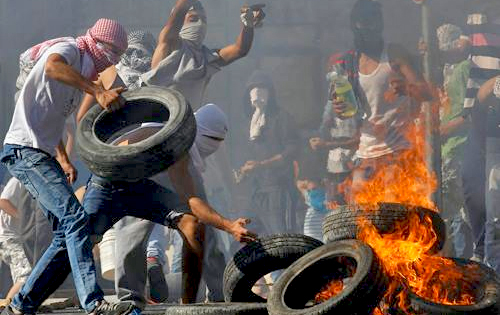
As ceasefire collapses, Israel targets top Hamas leader; death toll reached 200

July 16, 2014

Ceasefire collapses

Jul 16: Israel resumed its air strikes in the Gaza Strip on Wednesday a day after holding its fire in deference to an Egyptian-proposed cease-fire deal that failed to get Hamas militants to halt rocket attacks.

New Israeli air strikes in Gaza in the early hours of Wednesday killed several people, and destroyed the house of Mahmoud Zahar - who is believed to be in hiding elsewhere - in the first apparent targeting of a top Hamas political leader.

The week-old conflict seemed to be at a turning point on Tuesday, with Hamas defying Arab and Western calls to cease fire and Israel threatening to step up an offensive that could include an invasion of the densely populated enclave of 1.8 million.

Hamas' armed wing, the Izz el-Deen al-Qassam Brigades, rejected the ceasefire deal, a proposal that addressed in only general terms some of its key demands, and said its battle with Israel would "increase in ferocity and intensity". But Moussa Abu Marzouk, a Hamas political official who was in Cairo, said the movement, which is seeking a deal that would ease the Egyptian and Israeli border restrictions throttling Gaza's economy, had made no final decision on Cairo's proposal.

The Israeli military said that since the cease-fire deal was to have gone into effect, Hamas had fired 123 rockets at Israel, one killing a civilian - the first Israeli fatality in the fighting.

Gaza medical officials say 202 Palestinians, including at least 150 civilians, among them 31 children, have been killed.

Israel's Iron Dome anti-missile system intercepted 20 of the Hamas projectiles, including two over the Tel Aviv area, and the rest caused no damage or casualties.

Hamas and Islamic Jihad claimed responsibility for the attack against Israel's commercial capital, which has been targeted frequently since the war began, as well as for the rocket that killed the Israeli man along the border.

Israel, citing the persistent salvoes, resumed attacks in Gaza six hours after implementation of the truce was to have begun. The military said it targeted at least 20 of Hamas' hidden rocket launchers, tunnels and weapons storage facilities.

Prime Minister Benjamin Netanyahu said in broadcast remarks late on Tuesday that Israel had no choice but to "expand and intensify" its campaign on Hamas, though he did not specifically mention the possibility of a ground incursion.

The Iron Dome has shot down most projectiles liable to hit Israeli towns and cities, but the rocket salvoes have made a rush to shelters a daily routine for hundreds of thousands of people across the country.

The surge in hostilities over the past week was prompted by the murder last month of three Jewish seminary students in the Israeli-occupied West Bank and the revenge killing on July 2 of a Palestinian youth in Jerusalem. Israel said on Monday three Jews in police custody had confessed to killing the Palestinian.

KERRY CONDEMNS "BRAZEN" HAMAS ROCKET FIRE

Speaking in Vienna, US Secretary of State John Kerry supported Israel saying, "I cannot condemn strongly enough the actions of Hamas in so brazenly firing rockets, in multiple numbers, in the face of a goodwill effort (to secure) a cease-fire."

Netanyahu, whose security cabinet voted 6-2 earlier on Tuesday to accept the truce, had cautioned that Israel would respond strongly if rockets kept flying.

He said he expected the "full support from the responsible members of the international community" for any intensification of Israeli attacks in response to Hamas spurning a truce.

Other Palestinian militant groups - Islamic Jihad, the Popular Front for the Liberation of Palestine and the Democratic Front for the Liberation of Palestine - also said they had not yet agreed to the Egyptian offer.

ISRAELI GROUND ASSAULT POSSIBLE

Israel had mobilised tens of thousands of troops for a threatened Gaza invasion if the rocket volleys persisted.

"We still have the possibility of going in, under cabinet authority, and putting an end to (the rockets)," Amos Gilad, a senior Israeli defence official, said.

Under the proposal announced by Egypt's Foreign Ministry, high-level delegations from Israel and the Palestinian factions would hold separate talks in Cairo within 48 hours to consolidate the cease-fire with "confidence-building measures".

Comments

Add new comment

  • Coastaldigest.com reserves the right to delete or block any comments.
  • Coastaldigset.com is not responsible for its readers’ comments.
  • Comments that are abusive, incendiary or irrelevant are strictly prohibited.
  • Please use a genuine email ID and provide your name to avoid reject.
News Network
April 24,2020

Washington, Apr 24: The number of coronavirus cases in the US has surpassed 850,000, Johns Hopkins University Coronavirus Resource Center data revealed on Thursday (local time).
The country now has registered 8,56,209 cases overall, according to the data, including 47,272 deaths.

The US currently leads the world in the number of reported COVID-19 deaths and confirmed cases.

There are more than 2.6 million COVID-19 cases around the world and more than 1,85,000 deaths, according to the data.

Comments

Add new comment

  • Coastaldigest.com reserves the right to delete or block any comments.
  • Coastaldigset.com is not responsible for its readers’ comments.
  • Comments that are abusive, incendiary or irrelevant are strictly prohibited.
  • Please use a genuine email ID and provide your name to avoid reject.
News Network
February 18,2020

Beijing, Feb 18: A hospital director at the epicentre of China's virus epidemic died on Tuesday, state media said, the latest medical worker to fall victim to the new coronavirus spreading across the country.

The COVID-19 virus, which is believed to have originated in Wuhan late last year, has infected more than 72,000 people and killed nearly 1,900.

Liu Zhiming, the director of Wuchang Hospital in Wuhan, died Tuesday morning after "all-out rescue efforts failed," state broadcaster CCTV reported.

China said last week that six medical workers had died from the virus, while 1,716 have been infected.

Liu's death was initially reported by Chinese media and bloggers shortly after midnight on Tuesday -- but the stories were later deleted and replaced with reports that doctors were still trying to save him.

After initial reports of his death were denied, the hospital told AFP on Tuesday morning that doctors were giving him life-saving treatment.

Liu's death has echoes of that of Wuhan ophthalmologist Li Wenliang, who had been punished by authorities for sounding the alarm about the virus in late December.

Li's death prompted a national outpouring of grief as well as anger against the authorities, who were accused of mishandling the crisis.

People took to social media to mourn Liu on Tuesday, with many users on the Twitter-like Weibo platform drawing critical comparisons between Liu's death and Li's.

In both cases their deaths were initially reported in state media posts -- later deleted -- and their deaths denied, before being finally confirmed again.

"Has everyone forgotten what happened to Li Wenliang? They forcefully attempted resuscitation after he died," one Weibo commenter wrote.

Another commenter said, Liu "already died last night, (but) some people are addicted to torturing corpses".

A hashtag about Liu's death had 29 million views by Tuesday afternoon.

Doctors in Wuhan face shortages of masks and protective bodysuits, with some even wearing makeshift hazmat suits and continuing to work despite showing respiratory symptoms, health workers have told AFP.

Hubei province and its capital Wuhan have been the hardest hit by the virus, accounting for nearly 1,800 of the deaths from the virus so far.

Comments

Add new comment

  • Coastaldigest.com reserves the right to delete or block any comments.
  • Coastaldigset.com is not responsible for its readers’ comments.
  • Comments that are abusive, incendiary or irrelevant are strictly prohibited.
  • Please use a genuine email ID and provide your name to avoid reject.
News Network
June 26,2020

Washington, Jun 26: The US is reviewing its global deployment of forces to ensure it is postured appropriately to counter the People's Liberation Army, given the increasing threat posed by China to Asian countries like India, Malaysia, Indonesia, and the Philippines, Secretary of State Mike Pompeo said on Thursday.

Mr Pompeo made those remarks in response to a question during the virtual Brussels Forum 2020 of the German Marshall Fund.

"We're going to make sure we're postured appropriately to counter the PLA. We think that the challenge of our times, and we're going to make sure we have resources in place to do that," Mr Pompeo said.
 
The force posture review is being done at the direction of President Donald Trump, as part of which the US is reducing the number of its troops in Germany from about 52,000 to 25,000, he said.

Mike Pompeo said that the force posture would be dictated by the ground realities.

"In certain places there will be fewer American resources. There'll be other places - I just talked about the threat from the Chinese Communist Party, so now threats to India, threats to Vietnam, threats to Malaysia, Indonesia, South China Sea challenges, the Philippines," he said.

"To the extent that that changed, the difference in what the US decided to do impacts adversely a threat some place, it may be that other nations need to step up and take responsibility for their own defense in ways that they hadn't done previously. So, we want to do this in full consultation with all of our partners all around the world, and certainly our friends in Europe," Mr Pompeo said.

President Trump is being criticised for reducing troops from Germany. His critics say that this will increase the threat from Russia to Europe.

Mike Pompeo, however, did not agree with that argument.

It has been a long time since there has been a strategic review of our force posture all across the world. The US undertook that starting about 2.5 years ago, whether that was our forces in Africa, our forces in Asia, the force we have in the Middle East and in Europe, he said.

"We began to say these are often decisions that were made in a different time. Should we reallocate those a different way? Should we have a different composition of those forces? Everyone always wants to talk about ground troops. I get it. I was a young tank officer. You described that. There's nothing I like as much as a good M1 tank.

"But it's often the case that the capacity to deter Russia or other adversaries isn''t determined any longer by just having a bunch of folks garrisoned someplace. So, we really went to back fundamentally relook, what is the nature of the conflict, what''s the nature of the threat, and how should we allocate our resources, whether that''s our resources in the intelligence community, our resources from the Air Force or the Marines and Army," Mr Pompeo said.

Last week, Mike Pompeo criticised the Chinese Army for "escalating" the border tension with India and militarising the strategic South China Sea. He also described the ruling Communist Party of China (CPC) as a "rogue actor".

"Our broad set of allocation of security apparatus, our ability to counter cyber threats, how do we allocate them? What''s the best way to do this? And the decision that you see the president made with respect to Germany is an outcome from a collective set of decisions about how we''re going to posture our resources around the world," said the top American diplomat on Thursday.

Changes in force posture is being taken in consultations with allies and friends, Mr Pompeo said.

"President Trump has spoken to this. (Defense) Secretary (Mark) Esper will be in London today and in Brussels tomorrow. We''ll talk about our plan and how we''re thinking about delivering it," he said.

"But you should understand this, and I hope our European partners will understand this as well. When you see what we ultimately conclude, how we ultimately deliver on the statements of the president made, that they''re aimed squarely at what we believe to be democracies'' fundamental interest and certainly America's most fundamental interest," Mr Pompeo said.

Earlier this month, Mike Pompeo had said that China's actions, be it on the India border, or in Hong Kong or in the South China Sea, were part of the behaviour of the ruling Communist Party in Beijing in the recent past.

China has been fast expanding military and economic influence in the Indo-Pacific region, triggering concern in various countries of the region and beyond.

China is engaged in hotly contested territorial disputes in both the South China Sea and the East China Sea. Beijing has built up and militarised many of the islands and reefs it controls in the region. Both areas are stated to be rich in minerals, oil and other natural resources and are vital to global trade.

Comments

Add new comment

  • Coastaldigest.com reserves the right to delete or block any comments.
  • Coastaldigset.com is not responsible for its readers’ comments.
  • Comments that are abusive, incendiary or irrelevant are strictly prohibited.
  • Please use a genuine email ID and provide your name to avoid reject.