



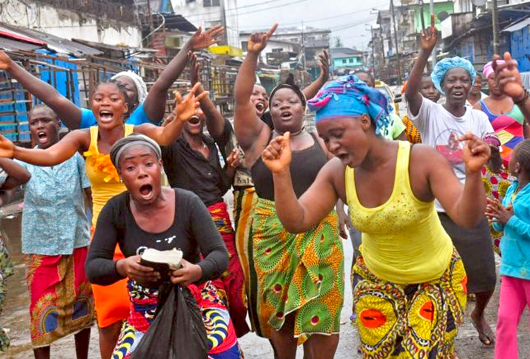
Celebration in Liberia slum as Ebola quarantine lifted

September 1, 2014

Ebola quarantine lifted

Monrovia/Conakry, Sep 1: Crowds sang and danced in the streets of a seaside neighborhood in Liberia on Saturday as the government lifted quarantine measures designed to contain the spread of the deadly Ebola virus.

Faced with the worst Ebola outbreak in history, West African governments have struggled to find an effective response. More than 1,550 people have died from the hemorrhagic fever since it was first detected in the forests of Guinea in March.

Residents of the impoverished seaside district of West Point in Monrovia were forcibly cut off from the rest of the capital in mid-August after a crowd attacked an Ebola center there, allowing the sick to flee.

The quarantine sparked protests and security forces responded with tear gas and bullets, killing a teenaged boy.

But at dawn on Saturday, the community woke up to find the soldiers and barricades gone.

"I tell God thank you. I tell everyone thank you," said Koffa, a female resident of West Point. Others danced in the streets chanting slogans like "we are free" while others rolled about on the asphalt pavement in celebration.

President Ellen Johnson-Sirleaf, a U.S.-educated Nobel Peace Prize winner, has sought to quell criticism of the government's response by issuing orders threatening officials with dismissal for failing to report for work or for fleeing the country, and has ordered an investigation into the West Point shooting.

Liberia, where infection rates are highest, plans to build five new Ebola treatment centers each with capacity for 100 beds, government and health officials said on Saturday.

In neighboring Sierra Leone, President Ernest Bai Koromo dismissed his health minister Miatta Kargbo on Friday over her handling of the epidemic which has killed more than 400 people there.

Her replacement Abubakarr Fofana on Saturday confirmed that a third doctor in the county had died from Ebola, further hampering its ability to respond to the outbreak.

"It is with a deep sense of sadness that we have lost one of our finest physicians in the line of duty at a time like when we need a lot of them to help in out fight against Ebola," he said.

Physician Dr. Sahr Rogers caught the disease while treating outpatients in the same hospital where a doctor died last month and where British nurse William Pooley was also infected.

SPREAD TO SENEGAL

Transmitted through the vomit, blood and sweat of the sick, Ebola has also spread to Nigeria and Senegal, which reported its first confirmed case on Friday - a Guinean student who was lost to authorities in his own country while under surveillance.

"His brother came from Sierra Leone where he was infected and has died. Shortly afterwards, this student left for Senegal," said Dr. Rafi Diallo, spokesman for the Guinean health ministry.

Two other members of his family - his sister and mother - have died from Ebola, Guinean health ministry sources said.

A resident in the suburb of the Senegalese capital Dakar where the student resided said on Saturday that a team of health ministry officials wearing white protective suits and masks came to spray disinfectant at his home and a local grocer's shop.

Many Dakar residents worry that the student could have spread the highly contagious virus in the three weeks since he was last reported in Guinea.

In Nigeria, where an infected traveler collapsed after arriving the Lagos airport, there have so far been 19 suspected, probable and confirmed cases and seven deaths.

"To avoid a situation like Nigeria, they need to be able to follow hundreds of contacts," said epidemiologist Jorge Castilla of the European Commission's Humanitarian Aid and Civil Protection Department in Dakar. "Whatever they do, there will probably be a second set of sick people as this guy has been here for some time."

Senegal has since closed its land border with Guinea and halted flights to Guinea, Sierra Leone and Liberia, defying advice from the World Health Organization (WHO) that there is no need for travel restrictions.

A note from the WHO and the International Civil Aviation Organization sent to health ministries on Aug. 29 said: "Lives are being unnecessarily lost because health care workers cannot travel to the affected countries, and delivery of life saving equipment and supplies is being delayed."

The World Food Programme said it needs to raise $70 million to feed 1.3 million people at risk from shortages in the Ebola-quarantined areas in West Africa, with the agency's resources already stretched by several major humanitarian crises.

Comments

Add new comment

  • Coastaldigest.com reserves the right to delete or block any comments.
  • Coastaldigset.com is not responsible for its readers’ comments.
  • Comments that are abusive, incendiary or irrelevant are strictly prohibited.
  • Please use a genuine email ID and provide your name to avoid reject.
News Network
May 30,2020

Washington, May 30: President Donald Trump said Friday he would strip several of Hong Kong's special privileges with the United States and bar some Chinese students from US universities in anger over Beijing's bid to exert control in the financial hub.

In a day of concerted action, the United States and Britain also raised alarm at the UN Security Council over a controversial new security law for Hong Kong, angering Beijing which said the issue had no place at the world body.

In a White House appearance that Trump had teased for a day, the US president attacked China over its treatment of the former British colony, saying it was "diminishing the city's longstanding and proud status."

"This is a tragedy for the people of Hong Kong, the people of China and indeed the people of the world," Trump said.

Trump also said he was terminating the US relationship with the World Health Organization, which he has accused of pro-China bias in its management of the coronavirus crisis.

But Trump was light on specifics and notably avoided personal criticism of President Xi Jinping, with whom he has boasted of having a friendship even as the two powers feud over a rising range of issues.

"I am directing my administration to begin the process of eliminating policy that gives Hong Kong different and special treatment," Trump said.

"This will affect the full range of agreements, from our extradition treaty to our export controls on dual-use technologies and more, with few exceptions," he said.

Secretary of State Mike Pompeo on Wednesday informed Congress that the Trump administration would no longer consider Hong Kong to be separate under US law, but it was up to Trump to spell out the consequences.

China this week pressed ahead on a law that would ban subversion and other perceived offenses against its rule in Hong Kong, which was rocked by months of massive pro-democracy protests last year.

US restricts students

In one move that could have long-reaching consequences, Trump issued an order to ban graduate students from US universities who are connected to China's military.

"For years, the government of China has conducted elicit espionage to steal our industrial secrets, of which there are many," Trump said.

Hawkish Republicans have been clamoring to kick out Chinese students enrolled in sensitive fields. The FBI in February said it was investigating 1,000 cases of Chinese economic espionage and technological theft.

But any move to deter students is unwelcome for US universities, which rely increasingly on tuition from foreigners and have already been hit hard by the COVID-19 shutdown.

China has been the top source of foreign students to the United States for the past decade with nearly 370,000 Chinese at US universities, although Trump's order will not directly affect undergraduates.

Critics say Trump has been eager to fan outrage about China to deflect attention from his own handling of the coronavirus pandemic that has killed more than 100,000 people in the United States, the highest number of deaths of any country.

Chuck Schumer, the top Democrat in the Senate, called Trump's announcement "just pathetic."

Eliot Engel, a Democrat who heads the House Foreign Affairs Committee, noted that Trump treaded lightly on Hong Kong during last year's protests as he sought a trade deal with Xi.

"Now, the president wants to shift the blame for his failures onto China, so he's doing the right thing for the wrong reason," Engel said.

Trump's order could also trigger retaliation. China in March expelled US journalists after the Trump administration tightened visa rules for staff at Chinese state media.

Clash at UN

The United States and Britain earlier in the day urged China to reconsider the Hong Kong law during talks at the UN Security Council, where China wields a veto -- making any formal session, let alone action against Beijing, impossible.

The Western allies raised Hong Kong in an informal, closed-door videoconference where China cannot block the agenda.

They said China was violating an international commitment as the 1984 handover agreement with Britain, in which Beijing promised to maintain the financial hub's separate system until at least 2047, was registered with the United Nations.

"The United States is resolute, and calls upon all UN members states to join us in demanding that the PRC immediately reverse course and honor its international legal commitments to this institution and to the Hong Kong people," said US Ambassador Kelly Craft, referring to the People's Republic of China.  

China demanded that the United States and Britain "immediately stop interfering in Hong Kong affairs," saying the law did not fall under the Security Council's mandate.

"Any attempt to use Hong Kong to interfere in China's internal matters is doomed to fail," warned a statement from China's UN mission.

"There was no consensus, no formal discussion in the Security Council, and the US and the UK's move came to nothing," it said.

Comments

Add new comment

  • Coastaldigest.com reserves the right to delete or block any comments.
  • Coastaldigset.com is not responsible for its readers’ comments.
  • Comments that are abusive, incendiary or irrelevant are strictly prohibited.
  • Please use a genuine email ID and provide your name to avoid reject.
News Network
July 3,2020

Jul 3: China under President Xi Jinping has stepped up its "aggressive" foreign policy toward India and "resisted" efforts to clarify the Line of Actual Control that prevented a lasting peace from being realised, according to a report released by a US Congress appointed commission.

The armies of India and China have been locked in a bitter standoff at multiple locations in eastern Ladakh for the last seven weeks, and the tension escalated after 20 Indian soldiers were killed in a violent clash in the Galwan Valley on June 15.

“Under General Secretary of the Chinese Communist Party (CCP) Xi Jinping, Beijing has stepped up its aggressive foreign policy toward New Delhi. Since 2013, China has engaged in five major altercations with India along the Line of Actual Control (LAC),” said a brief issued by US-China Economic and Security Review Commission.

"Beijing and New Delhi have signed a series of agreements and committed to confidence-building measures to stabilise their border, but China has resisted efforts to clarify the LAC, preventing a lasting peace from being realised,” said the report and was prepared at the request of the Commission to support its deliberations.

Authored by Will Green, a Policy Analyst on the Security and Foreign Affairs Team at the Commission, the report says that the Chinese government is particularly fearful of India’s growing relationship with the United States and its allies and partners.

“The latest border clash is part of a broader pattern in which Beijing seeks to warn New Delhi against aligning with Washington,” it said.

After Xi assumed power in 2012, there was a significant increase in clashes, despite the fact that he met Prime Minister Narendra Modi several times and Beijing and New Delhi have agreed to a series of confidence-building mechanisms designed to mitigate tensions.

Prior to 2013, the last major border clash was in 1987. The 1950s and 1960s were a particularly tense period, culminating in 1962 with a war that left thousands of soldiers dead on both sides, according to the records of China's People's Liberation Army, the report said.

“The 2020 skirmish is in line with Beijing’s increasingly assertive foreign policy. The clash came as Beijing was aggressively pressing its other expansive sovereignty claims in the Indo-Pacific region, such as over Taiwan and in the South and East China seas,” it said.

China is engaged in hotly contested territorial disputes in both the South China Sea and the East China Sea. Beijing has built up and militarised many of the islands and reefs it controls in the region. Both areas are stated to be rich in minerals, oil and other natural resources and are vital to global trade.

China claims almost all of the South China Sea. Vietnam, the Philippines, Malaysia, Brunei and Taiwan have counter claims over the area.

Several weeks before the clash in the Galwan Valley, Chinese Defence Minister Wei Fenghe called on Beijing to “use fighting to promote stability” as the country’s external security environment worsened, a potential indication of China’s intent to proactively initiate military tensions with its neighbours to project an image of strength, the report said.

Comments

Add new comment

  • Coastaldigest.com reserves the right to delete or block any comments.
  • Coastaldigset.com is not responsible for its readers’ comments.
  • Comments that are abusive, incendiary or irrelevant are strictly prohibited.
  • Please use a genuine email ID and provide your name to avoid reject.
Agencies
March 14,2020

Nairobi, Mar 14: Kenya and Ethiopia on Friday announced their first confirmed cases of coronavirus, as East Africa, which has so far been unscathed by the global pandemic, scaled up emergency measures to contain its spread.

In Kenya, a 27-year-old Kenyan woman tested positive for the virus on Thursday in Nairobi, a week after returning from the United States via London.

She was in a stable condition and recovering, Health Minister Mutahi Kagwe told reporters.

"We wish to assure all Kenyans that the government will use all the resources available to fight coronavirus," he said, as the government rolled out a raft of new containment measures.

The government had traced all the contacts of the patient since she arrived back in Kenya on March 5, he said.

"At the moment, there is absolutely no need for panic and worry," he said.

Kenya, with a population of 50 million people, saw a spree of panic buying among the middle-class in Nairobi supermarkets, in the wake of the announcement.

Meanwhile Ethiopia, Africa's second most populous nation with over 100 million people, said a 48-year-old Japanese man who had arrived in the country on March 4 from Burkina Faso was confirmed to have contracted the virus.

"He is undergoing medical follow-up and is in a stable condition. Those who have been in contact with this person are being traced and quarantined," the health ministry said in a statement.

Burkina Faso only confirmed its first case on Tuesday -- a couple returning from France -- and the Japanese patient had been in that country since February 24.

Ethiopian Health Minister Lia Tadesse said three other patients were in isolation.

Ethiopia becomes the 15 country in Africa with a confirmed case of the virus that has swept the globe, infecting more than 130,000 people and killing nearly 5,000 since it first emerged in China.

But to date the continent has been spared the worst of the pandemic.

Only five people have succumbed to coronavirus so far -- all in north Africa -- with the sub-Saharan region recording no deaths and very low numbers of confirmed cases.

But countries in East Africa -- which until the positive case in Kenya, had only recorded negative test results -- have been taking precautions.

Some flights have been restricted, with Kenya Airways suspending its route to Rome, and charter flights from Italy to the Kenyan coast on hold.

It has also suspended international conferences, a top earner in Nairobi, a hub for such events in the region, and non-essential travel abroad for politicians.

The government announced more expansive restrictions on Friday, including a temporary ban on major public gatherings, prison visits and activities between schools.

Other countries in the region have been rolling out their own measures.

In Rwanda, which shares a border with the Democratic Republic of Congo, which has confirmed cases, washing basins with soap and sanitiser have been placed on streets for commuters to use before boarding buses.

Authorities in Kigali, the capital, have also banned concerts, rallies and trade fairs -- although like in Kenya and Uganda, church services have been proceeding and bars, restaurants and entertainment precincts remain open.

Neighbouring Burundi, meanwhile, has quarantined 34 people in a hotel in Bujumbura as a precaution.

Uganda has ordered that visitors from a number of affected countries self quarantine for 14 days, or consider simply not visiting at all.

South Sudan's health ministry said meanwhile that it was "temporarily suspending direct flights between South Sudan and all affected countries".

Kagwe, the Kenyan health minister, also addressed a rumour circulating on social media that people with black skin cannot contract the virus.

"I would like to disabuse that notion. The lady (confirmed with coronavirus in Kenya) is an African, like you and I," he said.

Comments

Add new comment

  • Coastaldigest.com reserves the right to delete or block any comments.
  • Coastaldigset.com is not responsible for its readers’ comments.
  • Comments that are abusive, incendiary or irrelevant are strictly prohibited.
  • Please use a genuine email ID and provide your name to avoid reject.