


Chinese Communist Party officials harden rhetoric on Muslims

March 13, 2017

Beijing, Mar 13: China's ruling Communist Party is hardening its rhetoric on Islam, with top officials making repeated warnings about the spectre of global religious extremism seeping into the country and the need to protect traditional Chinese identity.
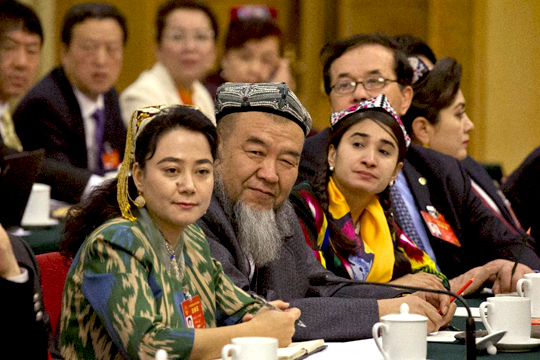
Chinese

Shaerheti Ahan, a top political and legal affairs party official in Xinjiang, today became the latest official from a predominantly Muslim region to warn political leaders gathered in Beijing for this month's National People's Congress about China becoming destabilised by the "international anti-terror situation".

Over the past year, President Xi Jinping has directed the party to "Sinicise" the country's ethnic and religious minorities, while regional leaders in Xinjiang, home to the Uighur (pronounced WEE-gur) ethnic minority, have ramped up surveillance measures, police patrols and demonstrations amid an uptick in violence blamed on Islamic separatists.

Although some scholars question whether global jihadi networks have indeed penetrated the country, top Chinese officials, including those overseeing areas outside Xinjiang, are increasingly echoing certain strands of international discourse to back up claims that Islamic extremism is growing worldwide and needs to be rolled back.

Officials from Ningxia Hui Autonomous Region, which has an ethnic Hui population that is predominantly Muslim but, unlike Xinjiang, rarely sees separatist or religious violence, warned similarly this past week about the perils of Islamic extremism. Speaking at a regional meeting open to the media, Ningxia Communist Party secretary Li Jianguo drew comparisons to the policies of President Donald Trump's administration to make his point.

"What the Islamic State and extremists push is jihad, terror, violence," Li said. "This is why we see Trump targeting Muslims in a travel ban. It doesn't matter whether anti-Muslim policy is in the interests of the US or it promotes stability, it's about preventing religious extremism from seeping into all of American culture."

Wu Shimin, a former ethnic affairs official from Ningxia, said that ideological work must be strengthened in the region to promote a Chinese identity among its Hui population, the descendants of Muslim traders plying the Silk Road centuries ago.

"The roots of the Hui are in China," Wu said. "To discuss religious consciousness, we must first discuss Chinese consciousness. To discuss the feelings of minorities, we must first discuss the feelings of the Chinese people."

Mohammed al-Sudairi, a doctoral student at the University of Hong Kong and an expert on Islam in China, said the comments by Ningxia party officials reflected the increasingly anti-Islamic rhetoric that has been rolled out over the past year by the top leadership in Beijing.

Comments

Add new comment

  • Coastaldigest.com reserves the right to delete or block any comments.
  • Coastaldigset.com is not responsible for its readers’ comments.
  • Comments that are abusive, incendiary or irrelevant are strictly prohibited.
  • Please use a genuine email ID and provide your name to avoid reject.
News Network
April 26,2020

Apr 26: The remarkable story of an airman who overcame prejudice to become one of only a handful of Indian fighter pilots in the First World War has emerged in newly-released archive files by the UK's Commonwealth War Graves Commission (CWGC).

Lieutenant Shri Krishna Chanda Welinkar is one of the thousands of moving stories from the war preserved in family correspondence and being brought alive as part of a digitisation project.

The never-before-published files contain thousands of letters, pictures and other papers sent between the Commission and the next of the kin of First World War dead.

Among them is the story of Welinkar, who hailed from Bombay in colonial India. After much hardship and discrimination, he eventually became a pilot and went missing while on patrol over the skies above the Western Front in June 1918.

His family had to wait nearly three years before they finally knew for certain that he had died, and his grave was located.

“For everyone who died in the First World War, there was inevitably a partner, parent or child back home who had questions. The heartbreaking letters in CWGC's archive give us an insight into what it was like for those families trying to come to terms with their loss,” said Andrew Fetherston, chief archivist for CWGC.

“They are stories that show desperate searches for closure, former enemies uniting and, on many occasions, the sad realisation that a missing loved one would always remain so. We are pleased to be able to make this invaluable piece of World War history accessible to a new generation and help deepen our understanding of how the First World War impacted those who were left behind,” he said.

Welinkar was one of the 1.3 million Indians who answered the call to fight for the British Empire. Nearly 74,000 never saw their homeland again and are remembered today in cemeteries and memorials throughout the world, including France, Belgium, the Middle East and Africa.

Welinkar was a well-educated man studying at Cambridge University. He trained to become an aviator in Middlesex and wished to join the Royal Flying Corps, later known as the Royal Air Force.

Upon attempting to enlist, Welinkar encountered the same prejudices as his other fellow Indian airmen and was encouraged to become an air mechanic instead.

He was eventually given a commission in the Royal Flying Corps as an Officer. In 1918, he was posted to France and patrolled the skies above the Western Front.

In June 1918, Lieutenant Welinkar embarked on what would be his final patrol; he did not return and was reported missing. His fate remained unknown for many months afterwards.

The newly-released e-files chronicle the remarkable discovery of Welinkar and his final resting place long after the war had ended. Colonel Barton, who knew Welinkar, acted on behalf of his mother and helped find her missing son. They spoke to former enemies and honed their search to the grave of an unidentified man, buried by the Germans as “Oberleutnant S.C. Wumkar” in a grave in Rouvroy, Belgium.

The body was later moved and reinterred in Hangard Communal Cemetery Extension but it wasn't until the vital clue, found in the original German burial records in February 1921, that it was confirmed beyond doubt this grave was of Welinkar's.

In May 1921, Colonel Barton, on behalf of Welinkar's mother, requested that a Commission headstone be placed on the grave with the following personal inscription: “To the Honoured Memory of One of the Empire's Bravest Sons”.

This records – known as Enquiry Files – are part of a collection of nearly 3,000 files which have never been made available to the public before. Nearly half have been digitised so far, alongside a previously unreleased collection of more than 16,000 photographs held in negatives in the Commission's archive.

The files, internally referred to simply as E-Files, contain correspondence between the CWGC and the next of kin of the war dead. They often contain letters, typed memos between Commission staff and on occasion photos, maps and diagrams.

CWGC only holds an enquiry file for a small proportion of the 1.7 million people it commemorates from the Commonwealth. Today it is only possible to release those surviving records from the First World War because correspondence with families of Second World War casualties often involves people still alive today and cannot be made public for many years, due to the UK's data protection rules.

To date, more than 1,300 of the surviving 3,000 First World War enquiry files have been digitised.

The CWGC commemorates the 1.7 million Commonwealth servicemen and women who died during the two World Wars. It also holds and updates an extensive and accessible records archive, while operating over 23,000 locations in more than 150 countries and territories.

Comments

Add new comment

  • Coastaldigest.com reserves the right to delete or block any comments.
  • Coastaldigset.com is not responsible for its readers’ comments.
  • Comments that are abusive, incendiary or irrelevant are strictly prohibited.
  • Please use a genuine email ID and provide your name to avoid reject.
Agencies
February 23,2020

Wuhan, Feb 23: Ninety-seven more people died in China due to coronavirus, taking the death toll to 2,442, officials said on Sunday, as a team of WHO experts visited the worst-affected Wuhan city in Hubei province.

By the end of Saturday, a total of 2,442 people had died of the disease and 76,936 confirmed cases of novel coronavirus infection had been reported in 31 provincial-level regions, China's National Health Commission (NHC) said in its daily update on Sunday.

Ninety-six deaths were reported from Hubei province and one from Guangdong province on Saturday besides 648 new confirmed cases of coronavirus infections, it said.

Hubei province, where the virus first emerged in December last, reported 630 new confirmed cases, taking the total confirmed cases in the hard-hit province to 64,084, state-run Xinhua news agency reported.

The NHC also said China's daily number of newly cured and discharged novel coronavirus patients has surpassed that of new confirmed infections for the fifth consecutive day, indicating that cases of infections are coming down.

Saturday saw 2,230 people walk out of hospital after recovery, much higher than the number of the same day's new confirmed infections, which was 648, Xinhua reported.

A total of 22,888 patients infected with the novel coronavirus had been discharged from hospital after recovery by the end of Saturday, NHC said.

Meanwhile, a team of public health experts from the World Health Organisation (WHO) visited Wuhan on Saturday to conduct a detailed probe about the virus which reportedly originated from a seafood market in the city in December last year.

The NHC said WHO experts along with their Chinese counterparts who formed a joint investigation team have held talks with the local health authority in Wuhan and visited relevant healthcare institutions.

The UN team comprises specialists from the United States, Germany, Japan, Nigeria, Russia, Singapore and South Korea, Hong-Kong based South China Morning Post reported.

The 12-member team, which arrived in China on Monday, was initially designated to visit only Beijing, Guangdong and Sichuan provinces, while the worst-affected Hubei province and its capital Wuhan were missing from the list.

However, the team was finally given permission to visit Wuhan by the Chinese government.

Besides controlling the spread of the virus, a major task for the WHO team along with their Chinese counterparts was to come up with standard medicine to cure the disease.

The NHC said on Saturday that the team had met top Chinese respiratory disease expert Zhong Nanshan in Guangdong, and visited the centre for disease control and prevention in Guangdong and the city of Shenzhen, and Sichuan.

The specialists also discussed quarantine measures, the wild animal trade and community prevention measures with their Chinese counterparts, it said.

Comments

Add new comment

  • Coastaldigest.com reserves the right to delete or block any comments.
  • Coastaldigset.com is not responsible for its readers’ comments.
  • Comments that are abusive, incendiary or irrelevant are strictly prohibited.
  • Please use a genuine email ID and provide your name to avoid reject.
Agencies
June 28,2020

Paris, Jun 28: More than 10 million cases of the new coronavirus have been officially declared around the world, half of them in Europe and the United States, according to an AFP tally on Sunday based on official sources.

At least 10,003,942 infections, including 498,779 deaths, have been registered globally.

Europe remains the hardest hit continent with 2,637,546 cases including 195,975 fatalities, while the United States has 2,510,323 infections including 125,539 deaths.

The rate of infections worldwide continues to rise, with one million new cases recorded in just six days.

The tallies, using data collected by AFP from national authorities and information from the World Health Organization (WHO), probably reflect only a fraction of the actual number of infections.

Many countries are testing only symptomatic or the most serious cases and some do not have the capacity to carry out widescale testing.

Comments

Add new comment

  • Coastaldigest.com reserves the right to delete or block any comments.
  • Coastaldigset.com is not responsible for its readers’ comments.
  • Comments that are abusive, incendiary or irrelevant are strictly prohibited.
  • Please use a genuine email ID and provide your name to avoid reject.