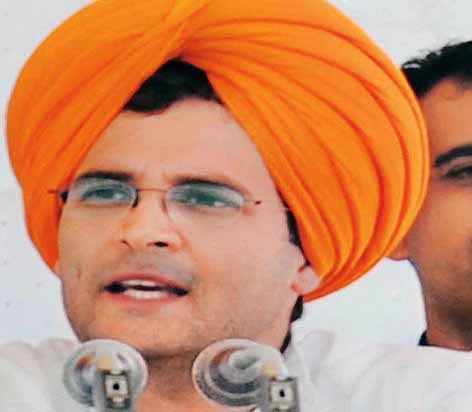
Congress is not an underdog, says Rahul Gandhi

March 16, 2014

Rahul_Gandhi9New Delhi, Mar 16: An upbeat Rahul Gandhi today rejected the view that the Congress party was an "underdog" or that it faced an "uphill" task in the Lok Sabha polls, affirming that there would be a Congress-led UPA III.

Acknowledging that after 10 years in power "there is a certain amount of anti-incumbency against us", the Congress campaign chief, nevertheless, disagreed with senior party leader and Finance Minister P Chidambaram's view that the party was an underdog and faced an uphill task.

"Congress is fighting a challenging election and we will win the election," he said while refusing to hazard a guess about the number of seats the party would get. "I am not a soothsayer but we will do well," he told PTI in an exclusive interview here.

Debunking opinion polls, which he had described as a joke, Gandhi said the party would do better than the 2009 elections when it had won 206 seats. Predictions before 2004 and 2009 elections also were that the Congress was going to lose and get thrashed, he recalled.

Answering a question on the failure of the government and the party to communicate with the people, he admitted, "I think certainly we could have been more aggressive in conveying our achievements. As I said, we have done transformatory work. We could always be better in communication."

Rubbishing the perception that Congress was losing allies, the party vice president said that it had alliances with NCP, RJD, JMM, RLD and the National Conference but had lost the DMK and the Trinamool Congress.

Asked if the Congress could "do business" with TMC and DMK again, Gandhi replied, "We are always willing to work with people who share our ideology and political philosophy, who are determined to fight sectarian and communal forces that seek to divide India for narrow political gains.

Comments

Add new comment

  • Coastaldigest.com reserves the right to delete or block any comments.
  • Coastaldigset.com is not responsible for its readers’ comments.
  • Comments that are abusive, incendiary or irrelevant are strictly prohibited.
  • Please use a genuine email ID and provide your name to avoid reject.
Agencies
January 24,2020

New Delhi, Jan 24: The Election Commission of India on Friday told the Supreme Court that its 2018 direction asking poll candidates to declare their criminal antecedents in electronic and print media has not helped curb criminalisation of politics. The poll panel suggested that instead of asking candidates to declare criminal antecedents in the media, political parties should be asked not to give tickets to candidates with criminal background.

A bench of Justices R F Nariman and S Ravindra Bhat asked the ECI to come up with a framework within one week which can help curb criminalisation of politics in nation's interest.

The top court asked the petitioner BJP leader and advocate Ashiwini Upadhyay and the poll panel to sit together and come up with suggestions which would help him in curbing criminalisation of politics.

In September 2018, a five-judge Constitution bench had unanimously held that all candidates will have to declare their criminal antecedents to the Election Commission before contesting polls and had called for a wider publicity, through print and electronic media about antecedents of candidates.

Comments

Satya Vishwasi
 - 
Saturday, 25 Jan 2020

What about those criminals who were already in parliament and vidahan sabhas? shall the ECI cancel their positions?

Add new comment

  • Coastaldigest.com reserves the right to delete or block any comments.
  • Coastaldigset.com is not responsible for its readers’ comments.
  • Comments that are abusive, incendiary or irrelevant are strictly prohibited.
  • Please use a genuine email ID and provide your name to avoid reject.
News Network
March 3,2020

New Delhi, Mar 3: A day after two new cases of novel coronavirus that included one from Delhi were reported, the Health Ministry on Tuesday said six cases with "high-viral load" were detected during sample testing in Agra and these people have been kept in isolation. The six people had come in contact with a 45-year-old patient from Delhi, whose case came to light on Monday, and they include his family members.

According to government sources, the man, who is a resident of Mayur Vihar, had visited them in Agra.

The six have been kept in isolation at Safdarjung Hospital in Delhi and their samples are being sent to NIV, Pune for confirmation.

Contact tracing of the people who came in contact with the six is simultaneously being done through the Integrated Disease Surveillance Program (IDSP) network, the ministry said in a statement.

Sources said the patient from Mayur Vihar was shifted to a quarantine ward at Safdarjung Hospital on Sunday night.

His other family members have been asked to stay alert and look out for symptoms. One accountant, who came in contact with the man and some of his family members, was also quarantined, they said.

India on Monday reported two new cases of the novel coronavirus, one from Delhi and another one from Hyderabad. The government has stepped up its efforts to detect and check the infection which has killed 2,912 people in China.

On Monday, Rajasthan Health Minister Raghu Sharma had said that an Italian tourist tested positive for coronavirus in Jaipur.

The first sample collected from him on February 29 tested negative but his condition deteriorated, so a second sample was collected which tested positive on Monday, the minister said, adding, "Since there is a variation in the reports, the samples have been sent to the NIV, Pune for testing".

India had earlier reported three cases from Kerala, including two medical students from Wuhan in China, the epicentre of the deadly novel coronavirus. They had self-reported on their return to the country and tested positive for the infection. They were discharged from hospitals last month following recovery.

The infected person from Delhi had travelled to Italy, while the other patient who tested positive for the COVID-19 infection is from Telangana and had recently travelled to Dubai.

Both the patients had self-reported after they developed symptoms.

"They tested positive. They are stable and being closely monitored," ministry said on Monday.

The government has asked people to avoid non-essential travel to Iran, Italy, South Korea and Singapore and said India was in discussions with authorities in Iran and Italy, two countries badly affected by the infection, to evacuate Indians there.

The novel coronavirus or COVID-19, which originated in China, has spread to over 60 countries.

Comments

Add new comment

  • Coastaldigest.com reserves the right to delete or block any comments.
  • Coastaldigset.com is not responsible for its readers’ comments.
  • Comments that are abusive, incendiary or irrelevant are strictly prohibited.
  • Please use a genuine email ID and provide your name to avoid reject.
News Network
March 21,2020

Mar 21: India’s economy, already in the grip of a slowdown, is in for more pain after Prime Minister Narendra Modi appealed to citizens to stay at and work from home to curb the coronavirus outbreak.

The services sector, which accounts for about 55% of India’s gross domestic product, is poised to be the worst hit after Modi, in a late evening address on Thursday, urged citizens to go on a self-imposed curfew for a day and private companies to allow employees to work from home for longer. In the country’s vast informal sector, social-distancing measures could mean a dent to productivity and consumption because of job or pay losses.

“The impact of a partial lock-down or social distancing will be significant,” said Rahul Bajoria, a senior economist at Barclays Plc in Mumbai. “If there’s a widespread community outbreak, GDP could fall as low as 3.5% in the year starting April 1.”

Shrinking output may limit growth in an economy that’s already set to expand at an 11-year low of 5% in the current year to March 31. Before the virus outbreak, India had forecast growth to recover to 6%-6.5% in the next fiscal year. S&P Global Ratings and Fitch Ratings have already slashed their growth forecast by 50 basis points.

“The current social-distancing measures will severely impact airlines, hotels, malls, multiplexes, restaurants and retailers,” according to analysts at Crisil Ltd., the local unit of S&P Global. “Lower footfalls and occupancies, decline in business volume and sub-optimal operating efficiencies will impact cash flows of companies in these sectors,” wrote the analysts led by Chief Economist Dharmakirti Joshi.

The government will try to announce a relief package for virus-affected sectors as early as possible, Finance Minister Nirmala Sitharaman said Friday.

In a televised address, Modi advised all citizens to stay at home for a day on March 22, as he sought to stem the spread of the coronavirus -- cases of which are relatively low in India at about 200, compared with more than 200,000 infected people globally. His government also barred incoming flights for a week from that day, joining a growing list of countries effectively sealing their borders.

What Bloomberg’s Economists Say

We had only earlier this week lowered our GDP outlook to consider the direct impact of the local outbreak as confirmed virus cases exceeded 100 as of March 15 and the federal and state governments announced social distancing measures that have already started to crimp economic activity. We are now revising down our GDP estimate for 4Q fiscal 2020 to 3.3%, from our 3.5%.

-- Abhishek Gupta, India economist

For more, click here

“Consumption being the biggest component of GDP, a lock-down is bound to have a big impact on the economy,” said Devendra Kumar Pant, chief economist at India Ratings and Research, the local unit of Fitch. “Modeling uncertainty in any system will be very difficult, but one can say the slowdown could deepen or prolong further.”

Work From Home

While companies, including billionaire Mukesh Ambani-controlled Reliance Industries Ltd., are asking employees to work from home, the option isn’t feasible in India’s vast informal sector.

“The option to work remotely simply won’t exist for most,” said Shilan Shah, an economist with Capital Economics Pte. in Singapore.

As many households don’t have savings buffers, the government would probably have to back this up with large-scale cash handouts that reach the poorest, he said.

Work from home is posing implementation challenges for the manufacturing sector where workers are required to be physically present at the production sites. The services sector, such as banking and information technology, also needs employees to be present in offices as confidential data is used, according to industry group Federation of Indian Chambers of Commerce and Industry.


Comments

Add new comment

  • Coastaldigest.com reserves the right to delete or block any comments.
  • Coastaldigset.com is not responsible for its readers’ comments.
  • Comments that are abusive, incendiary or irrelevant are strictly prohibited.
  • Please use a genuine email ID and provide your name to avoid reject.