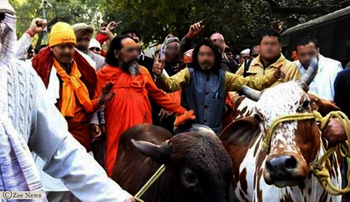
Cow vigilantes have no place in India: Modi govt tells Supreme Court

Agencies
July 21, 2017

New Delhi, Jul 21: The Centre on Friday informed Supreme Court that it does not support any kind of cow vigilantism in any state and no such group has any place in the country as per the procedure of law. The Apex Court then asked all the states to file an affidavit in the matter asking them how they will prevent cow vigilantism.Cowvigilantes

On the other hand, the BJP-ruled states Gujarat and Jharkhand told the top court that action has been taken against those involved in violence related to cow vigilantism.

A petition seeking a ban on cow vigilante groups across the nation was filed in the apex court.The petitioner had alleged that the vigilante groups have unleashed terror on Minority and Dalit communities, where the Centre has proven ineffective in training terror, unleashed by these groups.

Earlier the Court had sought a response from Centre and other states on the issue. Many cases of harassment and violence in the name of "gau raksha" (cow protection) were recorded, on which the nation stands divided.Prime Minister Narendra Modi, in June, had condemned the attacks in the name of cow vigilantism saying, "Killing people in the name of cow is unacceptable. No one has the right to take law into his/her hands. We belong to a land of non-violence. Violence is not the solution to any problem."

Earlier Parliamentary Affairs Minister Ananth Kumar after the all-party meeting had said, "Prime Minister Modi has asked the State Governments to take strict action against the anti-social elements creating violence in the name of cow vigilantism and punish them strictly."

Comments

imran ali
 - 
Monday, 24 Jul 2017

mai jana chahta hu sir maine passport b lga rkha h bt kuch process age nhi badh rhi ..call me 8858408885

Add new comment

  • Coastaldigest.com reserves the right to delete or block any comments.
  • Coastaldigset.com is not responsible for its readers’ comments.
  • Comments that are abusive, incendiary or irrelevant are strictly prohibited.
  • Please use a genuine email ID and provide your name to avoid reject.
News Network
August 5,2020

Bengaluru, Aug 4: Deputy Chief Minister Dr.CN Ashwathnarayan instructed the Bruhat Bengaluru Mahanagara Palike (BBMP) Commissioner Manjunatha Prasad to set up a separate high-level committee to ascertain the exact cause of coronavirus-related deaths in the state.

He spoke to reporters after a meeting with Prasad on Tuesday.

"The committee, headed by senior officials will audit the reason for the increase in death cases. Has there been a death due to treatment delay? Or are there any shortcomings in the treatment process?" the deputy chief minister said.

He pointed out that based on the report, the committee should try to correct the deficiency and reduce the death rate.

"How many beds are in which hospital? How many patients are on a ventilator? How many have gone home from the hospital? Etc. All information needs to be updated online at the moment. He suggested that this information should be made available to the public online," Ashwaththanarayana said.

Stating that some hospitals are not giving details about the number of beds correctly, he instructed the commissioners to take legal action if differences in their data are found.

He said that there is a shortage of ASHA workers in the city and it needs to be hired immediately.

According to the Ministry of Health and Family Welfare, there are 74,477 active COVID-19 cases in Karnataka and the death toll in the state is at 2,594. 

Comments

Add new comment

  • Coastaldigest.com reserves the right to delete or block any comments.
  • Coastaldigset.com is not responsible for its readers’ comments.
  • Comments that are abusive, incendiary or irrelevant are strictly prohibited.
  • Please use a genuine email ID and provide your name to avoid reject.
Wafa Sultana
April 4,2020

Over the last couple of days when the world was occupied with unifying efforts to fight the deadly Covid19 pandemic, sections of Indian media provided viewers a familiar scapegoat – the Indian Muslims – who are often stereotyped as a community being constantly at loggerheads with the citizenry and the State. Biased media channels were quick to resort to blaming the entire Muslim community for the spread of the disease in the country, thanks to an ill-timed Tablighi Jamaat gathering at its international headquarters in Delhi’s Nizamuddin. Unsurprisingly, the opprobrium was also marked by a sudden spike in WhatsApp forwards of videos with people wearing skullcaps licking spoons and performing Sufi breathing rituals, suggesting some sort of wild conspiracy on the part of the community to spread the virus.  Some media channels were quick to formulate, hypothesize and provide loose definitions of a newly discovered form of Jihad i.e. ‘Corona Jihad ’ thereby vilifying the Islamic faith and its followers.

While the investigation on the culpability of the organizers of the Nizamuddin event is still ongoing, there is enough information to suggest that the meeting was held before any lockdown was in force, and the problem began when there was no way of getting people out once the curfew was announced. Be that as it may, there is little doubt that organizing a meet of such a scale when there is a global pandemic smacks of gross misjudgment, and definitely the organizers should be held accountable if laws or public orders were defied. Attendees who attempt to defy quarantine measures must be dealt with strictly. However, what is alarming is that the focus and narrative have now shifted from the unfortunate event at Nizamuddin to the Tablighi Jamaat itself.

For those not familiar with the Tablighi Jamaat, the organization was founded in 1926 in Mewat by scholar Maulana Mohammad Ilyas. The Jamaat’s main objective was to get Muslim youth to learn and practice pristine Islam shorn of external influences. This is achieved through individuals dedicating time for moral and spiritual upliftment secluded from the rest of the world for a brief period of time. There is no formal membership process. More senior and experienced participants typically travel from one mosque to other delivering talks on religious topics, inviting local youth to attend and then volunteer for a spiritual retreat for a fixed number of days to a mosque in a nearby town or village to present the message to their co-religionists. Contrary to ongoing Islamophobic rhetoric, the movement does not actively proselytize. The focus is rather on getting Muslims to learn the teachings and practices of Islam.  This grassroots India-based movement has now grown to almost all countries with substantial Muslim populations. Its annual meets, or ‘ijtemas’ are among the largest Islamic congregations in the world after the annual Haj. One of the reasons for its popularity and wide network in the subcontinent and wordwide is the fact that it has eschewed the need for scholarly intervention, focusing on peer learning of fundamental beliefs and practice rather than high-falutin ideological debates. The Tablighi Jamaat also distinguishes itself from other Islamic movements through its strictly apolitical nature, with a focus on individual self-improvement rather than political mobilization. Hardships and difficulty in the world are expected to be face through ‘sabr’ (patience) and ‘dua’ (supplication),  than through quest for political power or influence. In terms of ideology, it is very much based on mainstream Sunni Islamic principles derived from the Deobandi school.

So, why is all this background important in the current context? While biased media entities have expectedly brought out their Islamophobic paraphernalia out for full display, more neutral commentators have tried to paint the Tablighi Jamaat as a fringe group and have tried to distance it from 'mainstream Muslims'. While the intent is no doubt innocent, this is a trap we must not fall into. This narrative, unfortunately, is also gaining ground due to apathy some Muslims have for the group, accusing it of being “disconnected from the realities of the world”. Unlike other Muslim organizations and movements, the Tablighi Jamat, by virtue of its political indifference, does not boast of high-profile advocates and savvy spokespersons who can defend it in mainstream or social media.  The use of adjectives such as 'outdated' and 'orthodox' by liberal columnists to describe the Jamaat feeds into the malignant attempt to change the narrative from the control of the spread of the pandemic due to the Nizamuddin gathering to 'raison d'etre' of the organization itself.

A large mainstream religious group like the Tablighi Jamaat with nearly a hundred-year history, normally considered to be peaceful, apolitical and minding its own business is now suddenly being villainized owing to unfortunate circumstances. Biased media reactions filled with disgust and hate seem to feed the Indian public conscience with a danngerous misconception - to be a nominal Muslim is okay but being a practicing one is not.  For those committed to the truth and fighting the spread of Islamophobia, the temptation to throw the entire Tablighi Jamaat under the bus must be resisted.

The writer is a lawyer and research scholar at Qatar University. Her research interests include Islamic law and politics.


Comments

zahoorahmed
 - 
Saturday, 4 Apr 2020

great article! provides a great perspective on tableeg jamat

Add new comment

  • Coastaldigest.com reserves the right to delete or block any comments.
  • Coastaldigset.com is not responsible for its readers’ comments.
  • Comments that are abusive, incendiary or irrelevant are strictly prohibited.
  • Please use a genuine email ID and provide your name to avoid reject.
News Network
January 8,2020

Bengaluru, Jan 8: The Karnataka government on Tuesday decided to adopt a no-fail approach for Class 7 examinations for government and private schools following the state syllabus.

The report card of a student doesn’t carry ‘pass’ or ‘fail’ remark, but points to his or her strengths and weaknesses in each subject in the exams, which will now be called Common Evaluation Exam.

The quality cell of the Karnataka Secondary Education Examination Board (which conducts SSLC exams) will prepare question papers, which will be evaluated at the district level by government and private schoolteachers. The Class 7 exams will be held in March.

The Common Evaluation Exam follows the Continuous Comprehensive Evaluation (CCE) currently practised under the Right to Education Act. “The formative and summative assessments (tests, projects and quizzes) will be held as usual,”KG Jagadeesha, commissioner of public instruction, said.

Edu dept to launch helpline by March

For the March exam, summative assessment 2 will be held with half the syllabus. Other modalities (exam duration and total marks) will be announced next week,” said KG Jagadeesha. The CCE system will continue for classes 8 and 9. The government hopes the exam and subsequent interventions in classes 8 and 9 will boost students’ confidence for crucial board examinations.

Minister S Suresh Kumar said, “More than an exam, it’s an evaluation of a child’s knowledge. The Belagavi division has done something similar. The Kalaburagi zone found mathematics and science were areas of concern; language was an issue in Urdumedium schools.” The minister said zilla panchayat CEOs have observed that intervention should start from class 8. “Keeping this in mind, we’ve started necessary preparation for class 7 exam ,” he added.

The education department will start a helpline by March for students, teachers, school managements and educationists to 11 raise problems on day-to-day issues.

Comments

Add new comment

  • Coastaldigest.com reserves the right to delete or block any comments.
  • Coastaldigset.com is not responsible for its readers’ comments.
  • Comments that are abusive, incendiary or irrelevant are strictly prohibited.
  • Please use a genuine email ID and provide your name to avoid reject.