


Egypt and Turkey turn soft on Syria's Assad

December 17, 2016

The Syrian government, flush with pivotal battlefield gains and bolstered by support from Iran and Russia, is finding itself the beneficiary of an evolving regional realignment spurred by the war in Syria.
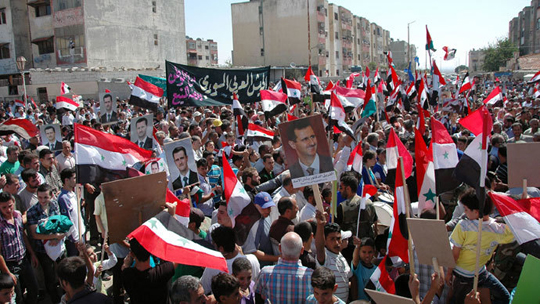
assad

Egypt and Turkey, countries that were once vocal opponents of Syria’s president, Bashar Assad, have, to varying degrees, softened their positions. Egypt, the region’s most populous Sunni country and wary of Iran’s Shiite theocracy, has made its tacit, increasing support of the Syrian government public for the first time. And Turkey, a Sunni regional power, is reshaping the Syrian battlefield by edging closer to Russia and dampening its longtime support for rebels fighting Assad.

The shifts come at a volatile time as countries in West Asia long aligned with the United States are hedging their bets and looking to Moscow for support as Russian intervention transforms the conflict in Syria. The manoeuvring comes as Russia asserts itself across the region to a degree not seen since Soviet times, partnering with an increasingly ambitious Iran. Long-standing US alliances with Turkey, Egypt and Saudi Arabia are frayed, and face new uncertainty with the election of Donald Trump, whose foreign policy remains largely undefined, except for an avowed eagerness to shake things up.

Egypt, which has seen its influence wane, is seeking allies and relevance wherever it can find them, even if that means shelving concerns about Iran. While Russia’s goal seems to be to expand its influence and pave the way for the international rehabilitation of Assad’s government, the scrambling of alliances remains in motion and the results unclear. The new relationships are messy, contradictory works in progress.

“In today’s regional context, this tactical hedging by countries on multiple fronts is likely to continue and may accelerate under a Trump administration,” said Brian Katulis, a senior fellow at the Centre for American Progress in Washington. Egypt and Turkey both provide examples of hedging, testing realignments but not jumping in with both feet.

Turkey has reached a potentially game-changing understanding with Russia in northern Syria – slackening support for besieged rebels in the divided city of Aleppo in exchange for a sphere of influence along its border – but continues to push the deal’s boundaries politically and militarily. And Egypt is diverging from its traditional allies in some ways, by splitting from Saudi Arabia on Syria; it remains financially dependent on the kingdom and hopes to mend fences with the US under Trump.

Egypt, Katulis said, is “seeking to signal that it has an independent perspective and position” on the Syrian conflict and on regional policy, balancing the United States and Russia, not aligning entirely with either the Gulf Arab states or Iran. The emerging “Sissi doctrine,” named for President Abdel-Fattah el-Sissi of Egypt, said Michael Wahid Hanna, a senior fellow at the Century Foundation, a New York research institute, is “rigid anti-Islamism and rigid anti-militancy and a very vocal support for nation states and sovereignty.”

Those positions are congruent with Assad’s. However, they diverge from those of Saudi Arabia, which has long been one of Egypt’s main financial lifelines, supplying aid worth tens of billions of dollars. El-Sissi is also increasingly wary of Turkey. He sees the recent defeat of a coup attempt against Erdogan’s Islamist government as “the birth of a religious state in Europe,” he told Katulis in July during a two-hour interview for a forthcoming report on US policy in Egypt.

Yet, Katulis said, the Egyptian president also made clear that he remained suspicious of Iran’s Shiite brand of Islamism despite its alignment with Assad and opposition to Turkey in Syria. But for now, el-Sissi seems to be putting concerns about Iran on the back burner and focusing more on Sunni Islamist movements, which he sees as a bigger threat. And lending support to Syria helps a weakened Egypt evoke its glory days as the leader of Arab nationalism in the 1960s.

El-Sissi’s emphasis on state sovereignty, supporting Arab states against insurgents, is also a major boon to the Syrian government’s quest for legitimacy, said Kamal Alam, a visiting fellow at the Royal United Services Institute in London and Levant Consultant for the Hoplite Group. Three years ago, Turkey and Egypt were prominent supporters of the Syrian rebellion, aligned with Saudi Arabia in what the Saudis saw as a geopolitical and sectarian struggle against Iran.

Jordan’s role

Today, both countries have tilted to different degrees away from Saudi Arabia and toward Russia, if not directly Iran. So has Jordan, another US ally and mostly Sunni country whose support for rebels had always been relatively lukewarm. All three seek to insulate themselves from the upheaval in Syria — from refugees and migrants, from the Islamist militants like Islamic State and al-Qaeda affiliates that gained footholds within the insurgency they helped support, and from any possible popular revolt.

The first to peel away was Egypt, in 2013, after el-Sissi, an army general, seized power from Mohammed Morsi, a Muslim Brotherhood leader who had emphatically supported the Syrian revolt. Pro-government news media made it clear that the Egyptian stance on Syria had changed; Syrian refugees were even attacked on the streets. Even as an outcry arose over the intensive bombing of Aleppo this week, Egypt in an emergency Security Council meeting justified its decision not to support “any side against the other.” The statement was seen as a polite way of refusing to apologise for not hewing to the Saudi line.

Turkey, too, has been unusually quiet on Aleppo. That, to many observers, confirms it has essentially agreed with Russia on a trade: Turkey allows rebel defeat in Aleppo, in exchange for Russia’s blessing of its incursion into Syria farther north to keep Kurdish militias away from its border. President Recep Tayyip Erdogan of Turkey even submitted to public censure from Russia for declaring his country was still trying to topple Assad. After being asked for clarification by Moscow, Erdogan reversed himself, insisting that Turkey’s goal in Syria was solely to fight terrorism.

But the parameters of the Turkey-Russia deal remain murky and possibly undefined even between the parties, Hanna said, making for a volatile situation. Turkey entered Syria with a force of anti-Assad rebels to set up what it calls a safe zone along the border. But as they move farther south and east, the likelihood increases that they will come into conflict with Russian-backed government forces, or U.S.-backed Kurdish forces.

“It’s a dangerous fault line,” Hanna said. “If you put anti-Assad rebels who have sublimated their goals to serve Turkish interests in very close proximity to regime forces, how much control does Turkey have over its proxies?”

Comments

Add new comment

  • Coastaldigest.com reserves the right to delete or block any comments.
  • Coastaldigset.com is not responsible for its readers’ comments.
  • Comments that are abusive, incendiary or irrelevant are strictly prohibited.
  • Please use a genuine email ID and provide your name to avoid reject.
News Network
July 28,2020

Dubai, Jul 28: A heart-broken father who lost his 19-year-old son in a tragic car accident during Christmas last year has sponsored the repatriation costs of 61 Indians stranded in the UAE.

 The special flydubai repatriation flight, chartered by the All Kerala Colleges Alumni Federation (Akcaf) volunteer group, of which he is a member of, departed from Dubai to Kochi on July 25 carrying 199 passengers.

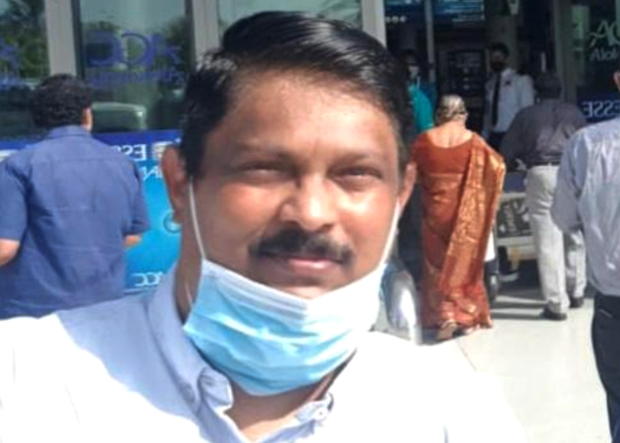
 On this particular flight, I sponsored 55 air tickets," said TN Krishnakumar, a sales and marketing director. He had lost his son Rohit Krishnakumar in a car accident, which also claimed the life of the teen's friend, Sharat Kumar (21).

"All passengers who were registered with the Indian missions were also asked to register on the Akcaf volunteer group website. Each passenger was further vetted, after which we made home visits to ensure that all the applicants were genuinely in need of financial support and repatriation," he said.

Commenting on what inspired him to dedicate himself to community work, Krishankumar said: "When a situation like this comes up, you realise there is no meaning in money. I invested everything I made into my son, and that had crashed in front of my eyes. He was a third-year medical student at the University of Manchester in the UK and had returned home for a vacation when the accident took place. Since then, I have been involved in a lot of social activities. If I do not do this, there is no meaning to my existence."

Since the outbreak of the Covid-19 pandemic, Krishnakumar said the group has supported thousands of individuals in need of help. "We supported unemployed people with several hundred bags of grocery kits and other necessary items. We also supported Covid-19 patients by transferring them to the medical facility in Warsan, etc.," he said.

"I come from a very middle-class family. I got a scholarship to study in college, and I studied with the help of taxpayers' money. I have always wanted to give back to society. I have grown immensely in life and now is my time to give back.," he added.

Krishnakumar also sponsors the education of over 1,000 academically gifted school children in Kerala's government-aided schools. He is a life trustee at the College of Engineering Trivandrum Alumni Galaxy Charitable Trust and an active participant towards various educational causes.

Comments

Add new comment

  • Coastaldigest.com reserves the right to delete or block any comments.
  • Coastaldigset.com is not responsible for its readers’ comments.
  • Comments that are abusive, incendiary or irrelevant are strictly prohibited.
  • Please use a genuine email ID and provide your name to avoid reject.
Agencies
June 18,2020

New Delhi, Jun 18: Reliance Industries Ltd on Thursday said it has sold a 2.32 per cent stake in its digital unit to Saudi Arabia's Public Investment Fund (PIF) for Rs 11,367 crore, taking the cumulative fund raising to about Rs 1.16 lakh crore in two months.

Starting with Facebook Inc on April 22, Reliance has sold almost 25 per cent of equity in Jio Platforms - the maximum reports suggest the company intends to dilute to financial investors.

The investment by Saudi sovereign wealth fund is "at an equity value of Rs 4.91 lakh crore and an enterprise value of Rs 5.16 lakh crore", the company said in a statement.

With this investment, Jio Platforms has raised Rs 115,693.95 crore from some of the leading global investment powerhouses at a time when the world is deeply impacted by the coronavirus pandemic, resulting in a recession kind of environment for the global economy.

"With the addition of PIF's investment, Jio Platforms has established partnerships with a marquee set of global financial investors, who will contribute to establishing the Digital Society vision for India," the statement said.

Jio Platforms houses India's biggest telecom firm by subscribers, Reliance Jio. With more than 388 million users, Jio has forced out several rivals and driven consolidation in the sector since entering the market in 2016 with free voice services and cut-price data.

Over the past two months, billionaire Mukesh Ambani's oil-to-telecom conglomerate has announced the sale of about $14 billion of assets, completed a Rs 53,124 crore rights issue and slowed the run rate of new investment by a quarter.

These will help Reliance meet its target of paying off Rs 1.61 lakh crore of net debt by the end of the year.
This is PIF's largest investment into the Indian economy to date.

Ambani, chairman and managing director of Reliance Industries, said, "We at Reliance have enjoyed a long and fruitful relationship with the Kingdom of Saudi Arabia for many decades. From oil economy, this relationship is now moving to strengthen India's New oil (data-driven) economy, as is evident from PIF's investment into Jio Platforms."

Yasir Al-Rumayyan, governor of PIF, commented: "We are delighted to be investing in an innovative business which is at the forefront of the transformation of the technology sector in India. We believe that the potential of the Indian digital economy is very exciting and that Jio Platforms provides us with an excellent opportunity to gain access to that growth."

"This investment will also enable us to generate significant long-term commercial returns for the benefit of Saudi Arabia's economy and our country's citizens, in line with our mandate to safeguard and grow the national wealth of the Kingdom," he said.

The transaction is subject to Indian regulatory and other customary approvals.

Morgan Stanley acted as financial advisor to Reliance Industries and AZB & Partners and Davis Polk & Wardwell acted as legal counsels.

Prior to this deal, Reliance had sold 22.38 per cent of Jio Platforms to investors including Facebook Inc, securing Rs 104,326.95 crore in eight weeks.

Facebook kicked off the party, investing Rs 43,573.62 crore for a 9.99 per cent stake on April 22. This was closely followed by a further Rs 60,753.33 crore in investment.

Silver Lake - the world's largest tech investor - bought a 1.15 per cent stake in Jio Platforms for Rs 5,665.75 crore on May 4. It invested another Rs 4,546.80 crore for additional 0.93 per cent stake on June 5, taking its total holding to 2.08 per cent
Private equity KKR and Vista Equity Partners have taken 2.32 per cent stake each for Rs 11,367 crore apiece. KKR invested in Jio Platforms on May 22 while Vista invested on May 8.

Abu Dhabi sovereign wealth fund Mubadala Investment Co picked up 1.85 per cent in Jio Platforms for Rs 9,093.60 crore on June 5. Abu Dhabi Investment Authority on June 7 invested Rs 5,683.50 crore for a 1.16 per cent stake in Jio Platforms.

On May 17, global equity firm General Atlantic picked up 1.34 per cent stake in Jio Platforms for Rs 6,598.38 crore.

Global investment firm TPG on June 13 picked up 0.93 per cent for Rs 4,546.80 crore while L Catterton bought 0.39 per cent for Rs 1,894.50 crore.

Comments

Add new comment

  • Coastaldigest.com reserves the right to delete or block any comments.
  • Coastaldigset.com is not responsible for its readers’ comments.
  • Comments that are abusive, incendiary or irrelevant are strictly prohibited.
  • Please use a genuine email ID and provide your name to avoid reject.
News Network
July 23,2020

Beirut, Jul 23: The pandemic will exact a heavy toll on Arab countries, causing an economic contraction of 5.7% this year, pushing millions into poverty and compounding the suffering of those affected by armed conflict, a U.N. report said Thursday.

The U.N.'s Economic and Social Commission for Western Asia expects some Arab economies to shrink by up to 13%, amounting to an overall loss for the region of $152 billion.

Another 14.3 million people are expected to be pushed into poverty, raising the total number to 115 million — a quarter of the total Arab population, it said. More than 55 million people in the region relied on humanitarian aid before the COVID-19 crisis, including 26 million who were forcibly displaced.

Arab countries moved quickly to contain the virus in March by imposing stay-at-home orders, restricting travel and banning large gatherings, including religious pilgrimages.

Arab countries as a whole have reported more than 830,000 cases and at least 14,717 deaths. That equates to an infection rate of 1.9 per 1,000 people and 17.6 deaths per 1,000 cases, less than half the global average of 42.6 deaths, according to the U.N.

But the restrictions exacted a heavy economic toll, and authorities have been forced to ease them in recent weeks. That has led to a surge in cases in some countries, including Lebanon, Iraq and the Palestinian territories.

Wealthy Gulf countries were hit by the pandemic at a time of low oil prices, putting added strain on already overstretched budgets. Middle-income countries like Jordan and Egypt have seen tourism vanish overnight and a drop in remittances from citizens working abroad.

War-torn Libya and Syria have thus far reported relatively small outbreaks. But in Yemen, where five years of civil war had already generated the world's worst humanitarian crisis, the virus is running rampant in the government-controlled south while rebels in the north conceal its toll.

Rola Dashti, the head of the U.N. commission, said Arab countries need to “turn this crisis into an opportunity” and address longstanding issues, including weak public institutions, economic inequality and over-reliance on fossil fuels.

“We need to invest in survival, survival of people and survival of businesses,” she said.

Comments

Add new comment

  • Coastaldigest.com reserves the right to delete or block any comments.
  • Coastaldigset.com is not responsible for its readers’ comments.
  • Comments that are abusive, incendiary or irrelevant are strictly prohibited.
  • Please use a genuine email ID and provide your name to avoid reject.