



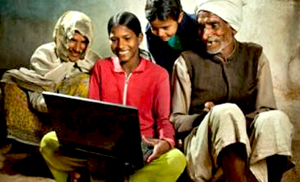
Facebook, Unilever to study Internet adoption in rural India

February 25, 2014

Internet_adoptionBarcelona, Feb 25: FMCG giant Unilever has partnered Internet.org, a Facebook-led alliance, to study how Internet adoption can be increased in rural communities in India.

As an initial step, Internet.org and Unilever will carry out a comprehensive study to examine the opportunities to increase internet adoption in rural communities.

Apart from infrastructure and cost -- which are known barriers to connectivity, the partnership will carefully evaluate other educational and cultural factors that limit Internet use.

"Lowering the barriers to Internet access requires a collaborative effort. Through this partnership, Unilever and Internet.org are pursuing the mission of bringing the benefits of internet access to the two-thirds of the world who are not yet connected," Facebook said.

Internet.org is focussed on enabling the next five billion people without access to come online and has companies like Facebook, Ericsson, MediaTek, Nokia, Opera, Qualcomm and Samsung as its founding members.

The initiative will see the partners collaborate on developing lower-cost, higher-quality smartphones and deploying Internet access in underserved communities.

Unilever and Internet.org will leverage this research to inform on the development of a series of on-the-ground projects with the aim of improving lives in rural India through better connectivity.

"Internet is the foundation of global knowledge economy and a way to deliver basic financial services, health and educational tools. In partnership with Unilever, we hope to break down the barriers to access and, in turn, provide millions of people with the information that can help them, and their communities, thrive," Facebook Director Global Connectivity Chris Weasler said.

Unilever already has extensive experience developing and deploying programmes for rural consumers.

For example, Lifebuoy, a leading health soap, has been promoting hand washing awareness in rural India for several years and has successfully enabled women in remote communities to enhance their incomes through the Shakti ( 526KB ) project.

"Access to the internet is improving in countries like India but there is still a very high proportion of people that would love the opportunity to connect and engage but who cannot enjoy what many of us take for granted."

"Having no Internet access naturally removes all associated opportunities that it brings which, in turn, can be a barrier to learning and ultimately hinder economic development," Unilever Chief Marketing and Communications Officer Keith Weed said.

Comments

Add new comment

  • Coastaldigest.com reserves the right to delete or block any comments.
  • Coastaldigset.com is not responsible for its readers’ comments.
  • Comments that are abusive, incendiary or irrelevant are strictly prohibited.
  • Please use a genuine email ID and provide your name to avoid reject.
News Network
January 17,2020

Bengaluru, Jan 17: India’s latest communication satellite GSAT-30 was successfully launched from the Spaceport in French Guiana during the early hours on Friday.

In a press release, ISRO, has stated that the launch vehicle 'Ariane-5 VA-251' was blasted off from Kourou Launch Base, French Ginana at 0230 hours, carrying India’s GSA-30 and EUTELSAT KONNECT for Eutelasat, as per schedule.

The Ariane 5 upper stage in an elliptical Geosynchronous Transfer Orbit.

With a lift-off mass of 3,357 kg, GSAT-30 will provide continuity to operational services on some of the in-orbit satellites.

GSAT-30 derives its heritage from ISRO’s earlier INSAT/GSAT satellite series and will replace INSAT-4A in orbit.

“GSAT-30 has a unique configuration of providing flexible frequency segments and flexible coverage. The satellite will provide communication services to Indian mainland and islands through Ku-band and wide coverage covering Gulf countries, a large number of Asian countries and Australia through C-band," ISRO Chairman Dr K Sivan said.

Dr Sivan also said that “GSAT-30 will provide DTH Television Services, connectivity to VSATs for ATM, Stock-exchange, Television uplinking and teleport Services, Digital Satellite News Gathering (DSNG) and e-governance applications. The satellite will also be used for bulk data transfer for a host of emerging telecommunication applications.”

ISRO’s Master Control Facility (MCF) at Hassan in Karnataka took over the command and control of GSAT-30 immediately after its separation from the launch vehicle. Preliminary health checks of the satellite revealed its normal health.

In the days ahead, orbit-raising maneuvers will be performed to place the satellite in Geostationary Orbit (36,000 km above the equator) by using its onboard propulsion system.

During the final stages of its orbit raising operations, the two solar arrays and the antenna reflectors of GSAT-30 will be deployed. Following this, the satellite will be put in its final orbital configuration.

The satellite will be operational after the successful completion of all in-orbit tests.

Comments

Add new comment

  • Coastaldigest.com reserves the right to delete or block any comments.
  • Coastaldigset.com is not responsible for its readers’ comments.
  • Comments that are abusive, incendiary or irrelevant are strictly prohibited.
  • Please use a genuine email ID and provide your name to avoid reject.
Agencies
April 4,2020

Kozhikode, Apr 4: In a bid to maintain the lockdown amid COVID-19 outbreak, Police in Kozhikode is monitoring the situation using drone cameras and making sure that people are not breaking the law.

The police have so far arrested 41 persons who were out on a morning walk on Saturday during the lockdown in the backdrop of coronavirus outbreak.

The SHO of Town South Police Station informed that the accused were later released on bail.
At least 295 cases have been reported in the state so far.

Talking about COVID-19 testing, State Health Minister KK Shailaja told media: "Nine labs are conducting polymerase chain reaction (PCR) tests in Kerala. We've received 2000 rapid test kits and will start rapid tests from tomorrow. If a person tests positive in rapid test, we need to confirm it with PCR test."

The total number of COVID-19 positive cases in India climbed to 3072 on Saturday, according to Ministry of Health and Family Welfare.

Comments

Add new comment

  • Coastaldigest.com reserves the right to delete or block any comments.
  • Coastaldigset.com is not responsible for its readers’ comments.
  • Comments that are abusive, incendiary or irrelevant are strictly prohibited.
  • Please use a genuine email ID and provide your name to avoid reject.
News Network
February 21,2020

London, Feb 21: Scientists have discovered a new species of land snail, and have named it Craspedotropis Greta Thunberg in honour of the Swedish activist Greta Thunberg for her efforts to raise awareness about climate change.

According to the study, published in the Biodiversity Data Journal, the newly discovered species belongs to the so-called caenogastropods -- a group of land snails known to be sensitive to drought, temperature extremes, and forest degradation.

The scientists, including evolutionary ecologist Menno Schilthuizen from Naturalis Biodiversity Center in the Netherlands, said the snails were found very close to the research field station at Kuala Belalong Field Studies Centre in Brunei.

They added that the snails were discovered at the foot of a steep hill-slope, next to a river bank, foraging at night on the green leaves of understorey plants.

The effort aided by amateur scientist J.P. Lim, who found the first individual of the snail said, "Naming this snail after Greta Thunberg is our way of acknowledging that her generation will be responsible for fixing problems that they did not create."

"And it's a promise that people from all generations will join her to help," Lim said.

The researchers said they approached Thunberg who said that she would be "delighted" to have this species named after her.

The study work including, fieldwork, morphological study, and classification of identified specimen was carried out in a field centre with basic equipment and no internet access, the scientists said.

According to the study, the work was done by untrained ‘citizen scientists’ guided by experts, on a 10-day taxon expedition.

"While we are aware that this way of working has its limitations in terms of the quality of the output (for example, we were unable to perform dissections or to do extensive literature searches), the benefits include rapid species discovery and on-site processing of materials," the researchers wrote in the study.

Comments

Add new comment

  • Coastaldigest.com reserves the right to delete or block any comments.
  • Coastaldigset.com is not responsible for its readers’ comments.
  • Comments that are abusive, incendiary or irrelevant are strictly prohibited.
  • Please use a genuine email ID and provide your name to avoid reject.