



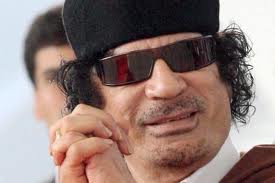
Gaddafi 'agreed to fund Nicolas Sarkozy's 2007 poll campaign'

April 28, 2012

gaddafi

Paris, April 28: Muammar Gaddafi's regime agreed to fund French President Nicolas Sarkozy's 2007 election campaign to the tune of 50 million euros, a news website reported Saturday, publishing what it said was documentary evidence.

The 2006 document in Arabic, which website Mediapart said was signed by Gaddafi's foreign intelligence chief Mussa Kussa, referred to an "agreement in principle to support the campaign for the candidate for the presidential elections, Nicolas Sarkozy, for a sum equivalent to 50 million euros."

The left-wing investigative website made similar assertions on March 12, based on testimony by a former doctor of a French arms dealer alleged to have arranged the campaign donation, which Sarkozy slammed as "grotesque."

"If he had financed it, I wasn't very grateful," Sarkozy said sarcastically in a television interview, in an apparent reference to the active role that France played in the Nato campaign that led to the strongman's ouster last year.

The latest report comes as Sarkozy trails Socialist rival Francois Hollande in opinion polls ahead of the run-off second round of presidential elections on May 6.

The green-bordered note published and translated by Mediapart said the agreement followed a meeting on October 6, 2006, attended by Gaddafi's spy chief Abdullah Senussi, the head of Tripoli's African investment fund Bashir Saleh, close Sarkozy associate Brice Hortefeux and arms dealer Ziad Takieddine.

A lawyer for Takieddine denied to Mediapart that her client was present but said, "he believes this document is credible, given the date and the persons named."

The latest report by Mediapart, a respected source seen as opposed to Sarkozy's right-wing government, strengthens long-running allegations that French political camps have benefited financially from kickbacks on arms deals with foreign regimes. Gaddafi's son Seif al-Islam last year claimed that Libya financed Sarkozy's campaign, after Paris abandoned its improving ties with Libya and threw its weight behind the rebellion that eventually deposed and killed the dictator.

"Sarkozy must first give back the money he took from Libya to finance his electoral campaign. We funded it and we have all the details and are ready to reveal everything," Seif told the Euronews network.

When asked about Seif's comments during the March 12 interview on France's TF1 television, Sarkozy replied: "I am sorry to see you in the role of a spokeswoman for Gaddafi's son, frankly I've known you in better roles."

"It's grotesque and I am sorry that I am being interrogated about declarations of Gaddafi or his son on an important channel like TF1," Sarkozy said.

"When one quotes Mr. Gaddafi, who is dead, his son, who has blood on his hands, that is a regime of dictators, assassins, whose credibility is zero... frankly, I think we have sunk low enough in the political debate."

The report published by Mediapart in March, which also referred to "BH" -- understood to be Hortefeux, who later became Sarkozy's interior minister -- was written by private operative Jean-Charles Brisard.

Takieddine is already under investigation for his alleged role in the funding of Edouard Balladur's failed 1995 presidential campaign for which Sarkozy was spokesman.

Investigators suspect Balladur's camp collected kickbacks on a deal to sell submarines to Pakistan and that a Karachi bombing that killed 11 French engineers was carried out by Pakistani agents in revenge after promised bribes went unpaid.

Sarkozy has always denied any wrongdoing in the 1995 campaign finance arrangements.


Comments

Add new comment

  • Coastaldigest.com reserves the right to delete or block any comments.
  • Coastaldigset.com is not responsible for its readers’ comments.
  • Comments that are abusive, incendiary or irrelevant are strictly prohibited.
  • Please use a genuine email ID and provide your name to avoid reject.
News Network
May 7,2020

Islamabad, May 7: Pakistan's COVID-19 cases have crossed 24,000 after 1,523 new infections were detected, while the death toll has jumped to 564 with 38 more people succumbing to the coronavirus, health officials said on Thursday.

Even as the country is seeing an increase in the number of coronavirus cases and fatalities, Prime Minister Imran Khan will discuss the easing of lockdown restrictions with his top aides on Thursday.

The Ministry of National Health Services said that out of the 24,073 total cases, Punjab reported 9,077, Sindh 8,640, Khyber-Pakhtunkhwa 3,712, Balochistan 1,495, Islamabad 521, Gilgit-Baltistan 388 and Pakistan-occupied Kashmir 76 cases.

After 38 more deaths on Wednesday, the total coronavirus patient death toll jumped to 564. Another 6,464 have recovered. A total of 1,523 new patients were added in a single day, the ministry.

So far, 244,778 tests have been conducted, including 12,196 in the last 24 hours, it said.

Prime Minister Khan will chair the National Coordination Committee (NCC) meeting on easing the lockdown restrictions in the country. The meeting will be attended by all chief ministers.

The issue was debated in the National Command and Operation Centre (NCOC) on Wednesday and in the Cabinet on Tuesday.

Planning Minister Asad Umar said that different proposals to allow certain businesses to open were prepared and will be presented before the Prime Minister for a final decision.

Earlier, Khan, undeterred by the mounting number of deaths and the new cases, announced that he was against a lockdown as it hits the poor people badly.

Comments

Add new comment

  • Coastaldigest.com reserves the right to delete or block any comments.
  • Coastaldigset.com is not responsible for its readers’ comments.
  • Comments that are abusive, incendiary or irrelevant are strictly prohibited.
  • Please use a genuine email ID and provide your name to avoid reject.
News Network
March 28,2020

Berlin, Mar 28: The number of confirmed coronavirus infections worldwide topped 600,000 on Saturday as new cases stacked up quickly in Europe and the United States and officials dug in for a long fight against the pandemic.

The latest landmark came only two days after the world passed half a million infections, according to a tally by John Hopkins University, showing that much work remains to be done to slow the spread of the virus. It showed more than 602,000 cases and a total of over 27,000 deaths.

While the U.S. now leads the world in reported infections — with more than 104,000 cases — five countries exceed its roughly 1,700 deaths: Italy, Spain, China, Iran and France.

“We cannot completely prevent infections at this stage, but we can and must in the immediate future achieve fewer new infections per day, a slower spread,” German Chancellor Angela Merkel, who is in quarantine at home after her doctor tested positive for the virus, told her compatriots in an audio message. “That will decide whether our health system can stand up to the virus.”

The virus already has put health systems in Italy, Spain and France under extreme strain. Lockdowns of varying severity have been introduced across Europe. Merkel's chief of staff, Helge Braun, said that Germany — where authorities closed nonessential shops and banned gatherings of more than two in public — won't relax its restrictions before April 20.

As the epicenter has shifted westward, the situation has calmed in China, where some restrictions on people's lives have now been lifted. Six subway lines restored limited service in Wuhan, where the virus first emerged in December, after the city had its official coronavirus risk evaluation downgraded from high to medium on Friday. Five districts of the city of 11 million people had other restrictions on travel loosened after their risk factor was downgraded to low.

For most people, the coronavirus causes mild or moderate symptoms, such as fever and cough that clear up in two to three weeks. But for others, especially older adults and people with existing health problems, the virus can cause more severe illness, including pneumonia, and lead to death.

More than 130,000 people have recovered, according to Johns Hopkins' tally.

In one way or another, the effects of the COVID-19 outbreak have been felt by the powerful and the poor alike.

On Friday, British Prime Minister Boris Johnson became the first leader of a major country to test positive for the virus. He said he would continue to work from self-quarantine.

Countries are still scrambling bring home some citizens stranded abroad by border closures and a near-shutdown of flights. On Saturday, 174 foreign tourists and four Nepali nationals on the foothills of Mount Everest were flown out days after being stranded on the only airstrip serving the world's highest mountain.

In neighboring India, authorities sent a fleet of buses to the outskirts of the capital to meet an exodus of migrant workers desperately trying to reach their home villages during the world's largest lockdown.

Thousands of people, mostly young male day laborers but also families, had fled their New Delhi homes after Prime Minister Narendra Modi announced a 21-day lockdown that began on Wednesday and effectively put millions of Indians who live off daily earnings out of work.

In a possibly hopeful sign, the U.S. Food and Drug Administration cleared a new rapid test from Abbott Laboratories, which the company says can detect the coronavirus in about 5 minutes. Medical device maker Abbott announced the emergency clearance of its cartridge-based test Friday night, saying the test delivers a negative result in 13 minutes when the virus is not detected.

While New York remained the worst-hit city in the U.S., Americans braced for worsening conditions elsewhere, with worrisome infection numbers being reported in New Orleans, Chicago and Detroit.

New Orleans’ sprawling Ernest N. Morial Convention Center, along the Mississippi River, was being converted into a massive hospital as officials prepared for thousands more patients than they could accommodate.

In New York, where there are more than 44,000 cases statewide, the number of people hospitalized with COVID-19 passed 6,000 on Friday, double what it had been three days earlier.

Gov. Andrew Cuomo called for 4,000 more temporary beds across New York City, where the Jacob K. Javits Convention Center has already been converted into a hospital.

The struggle to defeat the virus will take “weeks and weeks and weeks,” Cuomo told members of the National Guard working at the Javits Center.

President Donald Trump invoked the Defense Production Act on Friday, ordering General Motors to begin manufacturing ventilators. Trump had previously rejected Cuomo's pleas for tens of thousands more of the machines and the governor's calls to implement the Korean War-era production law.

Trump signed a $2.2 trillion stimulus package, after the House approved the sweeping measure by voice vote. Lawmakers in both parties lined up behind the law to send checks to millions of Americans, boost unemployment benefits, help businesses and toss a life preserver to an overwhelmed health care system.

Dr. John Brooks of the U.S. Centers for Disease Control and Prevention warned Americans remained “in the acceleration phase” of the pandemic and that all corners of the country were at risk.

"There is no geographic part of the United States that is spared from this," he said.

Comments

Add new comment

  • Coastaldigest.com reserves the right to delete or block any comments.
  • Coastaldigset.com is not responsible for its readers’ comments.
  • Comments that are abusive, incendiary or irrelevant are strictly prohibited.
  • Please use a genuine email ID and provide your name to avoid reject.
Arab News
February 9,2020

London, Feb 9: A US court has rejected a Turkish attempt to dismiss civil cases brought by protesters who were violently attacked in Washington by Recep Tayyip Erdogan’s security officers.

The incident took place in May 2017 during a visit to the US by the Turkish president. About a dozen bodyguards beat-up a group demonstrating outside the Turkish ambassador’s residence in Washington.

The attack, which was caught on video, left nine people injured and further strained US relations with Turkey.

While criminal charges against the security guards were dropped within a year, around the same time Turkey released a US pastor, the victims pressed ahead with a civil case.

On Thursday, a federal court denied Turkey’s request to have the two cases thrown out on the grounds that it should have sovereign immunity from legal proceedings.

US District Judge Colleen Kollar-Kotelly said the protesters had not posed a threat and were merely gathered on a sidewalk outside the residence at Sheridan Circle when Erdogan’s security burst through a police line and attacked them.

“The Turkish security forces did not have the discretion to violently physically attack the protesters, with the degree and nature of force which was used, when the protesters were standing, protesting on a public sidewalk,” she said. “And, Turkish security forces did not have the discretion to continue violently physically attacking the protesters after the protesters had fallen to the ground or otherwise attempted to flee.”

The judge said Turkey “has not met its burden of persuasion to show that it is immune from suit in these cases.”

The ruling was welcomed by the victims of the attack, which Erdogan stopped to watch as he made his way from his car to inside the residence.

Comments

Add new comment

  • Coastaldigest.com reserves the right to delete or block any comments.
  • Coastaldigset.com is not responsible for its readers’ comments.
  • Comments that are abusive, incendiary or irrelevant are strictly prohibited.
  • Please use a genuine email ID and provide your name to avoid reject.