


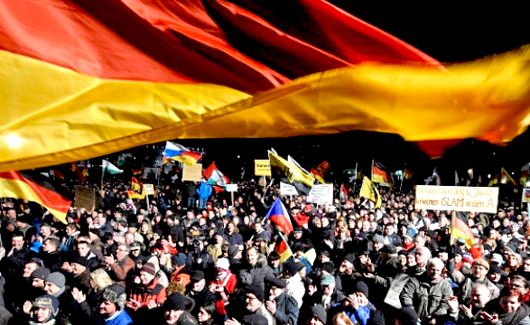
Germany bans anti-Islamic rally over terror threat

January 19, 2015

Anti-Islamic rally

Berlin, Jan 19: German authorities have banned a rally by the anti-Islamic PEGIDA movement in the eastern city of Dresden today, saying they have "concrete" information that Islamist militants plan to attack the weekly demonstrations.

The federal and state police agencies had received information that radical Islamists were planning to mix with demonstrators and attack one of the leaders of the right¬wing Patriotic Europeans Against Islamisation of the West (PEGIDA), which has been organising the Dresden rallies since September.

"In our assessment of the situation, we believe that there is a concrete threat of a terror attack," Dresden's police commissioner Dieter Kroll said yesterday.

Informations received by the authorities indicated that one of the PEGIDA leaders and the people around him were being targeted for a terror attack, Kroll said in a statement.

Kroll, however, said there were no specific information about the suspected terrorists or the nature of the attacks they were planning.

The anti¬Islam rally in Dresden to protest against the "Islamisation of Germany" and the government's asylum policy have been drawing a number of supporters in spite of appeals to the public by Chancellor Angela Merkel and other leaders to stay away from it.

Police estimated that a record number of over 25,000 people attended the rally last Monday and its organisers were expecting a much bigger crowd today.

According to police, the suspected attackers have been asked in a message in Arabic sent from a Twitter account to "mix with the demonstrators to carry out an attack on one of the organisers of the PEGIDA demonstrations."

Besides the anti¬Islam demonstration, a counter¬rally planned by opponents of PEGIDA in Dresden today also has been banned.

Germany's intelligence agencies have received warnings from their partner services abroad that Islamist militants were planning attacks on the central railway stations in Berlin and in Dresden as well as on the PEGIDA demonstrations.

Their warnings were based on information gained by intercepting telephone and e¬mail communications between suspected radical Islamists known to the authorities and international terror networks, media reports earlier said.

The latest terror warnings come close on the heels of the arrests of two Turkish men during a raid at eleven houses in different parts of Berlin on Friday.

The Turks were charged with planning a major terror attack in Syria, supporting Islamic State terror group by recruiting fighters, and organising and financing their travel to Syria.

The state prosecutor in Berlin said it has no information that the two men were planning any terror attacks in Germany nor they were linked to the terror attacks in Paris, which killed 17 people in three days.

Comments

Add new comment

  • Coastaldigest.com reserves the right to delete or block any comments.
  • Coastaldigset.com is not responsible for its readers’ comments.
  • Comments that are abusive, incendiary or irrelevant are strictly prohibited.
  • Please use a genuine email ID and provide your name to avoid reject.
News Network
May 5,2020

May 5: Global coronavirus deaths reached 250,000 on Monday after recorded infections topped 3.5 million, a news agency tally of official government data showed, although the rate of fatalities has slowed.

North America and European countries accounted for most of the new deaths and cases reported in recent days, but numbers were rising from smaller bases in Latin America, Africa and Russia.

Globally, there were 3,062 new deaths and 61,923 new cases over the past 24 hours, taking total cases to 3.58 million.

That easily exceeds the estimated 140,000 deaths worldwide in 2018 caused by measles, and compares with around 3 million to 5 million cases of severe illness caused annually by seasonal influenza, according to the World Health Organization (WHO).

While the current trajectory of COVID-19 falls far short of the 1918 Spanish flu, which infected an estimated 500 million people, killing at least 10% of patients, experts worry the available data is underplaying the true impact of the pandemic.

The concerns come as several countries begin to ease strict lockdowns that have been credited with helping contain the spread of the virus.

"We could easily have a second or a third wave because a lot of places aren't immune," Peter Collignon, an infectious diseases physician and microbiologist at Canberra Hospital, told Reuters. He noted the world was well short of herd immunity, which requires around 60% of the population to have recovered from the disease.

The first death linked to COVID-19 was reported on Jan. 10 in Wuhan, China after the coronavirus first emerged there in December. Global fatalities grew at a rate of 1-2% in recent days, down from 14% on March 21, according to the Reuters data.

DEATH RATE ANOMALIES

Mortality rates from recorded infections vary greatly from country to country.

Collignon said any country with a mortality rate of more than 2% almost certainly had underreported case numbers. Health experts fear those ratios could worsen in regions and countries less prepared to deal with the health crisis.

"If your mortality rate is higher than 2%, you've missed a lot of cases," he said, noting that countries overwhelmed by the outbreak were less likely to conduct testing in the community and record deaths outside of hospitals.

In the United States, around half the country's state governors partially reopened their economies over the weekend, while others, including New York Governor Andrew Cuomo, declared the move was premature.

In Britain, Prime Minister Boris Johnson, who battled COVID-19 last month, has said the country was over the peak but it was still too early to relax lockdown measures.

Even in countries where the suppression of the disease has been considered successful, such as Australia and New Zealand which have recorded low daily rates of new infections for weeks, officials have been cautious.

Australian Prime Minister Scott Morrison has predicated a full lifting of curbs on widespread public adoption of a mobile phone tracking app and increased testing levels.

Comments

Add new comment

  • Coastaldigest.com reserves the right to delete or block any comments.
  • Coastaldigset.com is not responsible for its readers’ comments.
  • Comments that are abusive, incendiary or irrelevant are strictly prohibited.
  • Please use a genuine email ID and provide your name to avoid reject.
Agencies
June 27,2020

Washington, Jun 27: Facebook has said that it will flag all "newsworthy" posts from politicians that break its rules, including those from President Donald Trump.

Separately, Facebook's stock dropped more than 8 per cent, erasing roughly USD 50 billion from its market valuation, after the European company behind brands such as Ben & Jerry's and Dove announced it would boycott Facebook ads through the end of the year over the amount of hate speech and divisive rhetoric on its platform.

Later in the day, Coca-Cola also announced it joined the boycott for at least 30 days.

CEO Mark Zuckerberg had previously refused to take action against Trump posts suggesting that mail-in ballots will lead to voter fraud, saying that people deserved to hear unfiltered statements from political leaders.

Twitter, by contrast, slapped a "get the facts" label on them.

Until Friday, Trump's posts with identical wording to those labelled on Twitter remained untouched on Facebook, sparking criticism from Trump's opponents as well as current and former Facebook employees.

Now, Facebook is all but certain to face off with the president the next time he posts something the company deems to be violating its rules.

"The policies we're implementing today are designed to address the reality of the challenges our country is facing and how they're showing up across our community," Zuckerberg wrote on his Facebook page announcing the changes.

Zuckerberg said the social network is taking additional steps to counter election-related misinformation.

In particular, the social network will begin adding new labels to all posts about voting that will direct users to authoritative information from state and local election officials.

Facebook is also banning false claims intended to discourage voting, such as stories about federal agents checking legal status at polling places.

The company also said it is increasing its enforcement capacity to remove false claims about local polling conditions in the 72 hours before the US election.

Ethan Zuckerman, director of the Massachusetts Institute of Technology's Center for Civic Media, said the changes are a "reminder of how powerful Facebook may be in terms of spreading disinformation during the upcoming election".

He said the voting labels will depend on how good Facebook's artificial intelligence is at identifying posts to label.

"If every post that mentions voting links, people will start ignoring those links. If they're targeted to posts that say things like 'Police will be checking warrants and unpaid traffic tickets at polls' a classic voter suppression disinfo tactic and clearly mark posts as disinfo, they might be useful," he said.

But Zuckerman noted that Facebook "has a history of trying hard not to alienate right-leaning users, and given how tightly President Trump has aligned himself with voter-suppressing misinfo, it seems likely that Facebook will err on the side of non-intrusive and ignorable labels, which would minimize impact of the campaign."

Earlier in the day, shares of Facebook and Twitter dropped sharply after consumer-product maker Unilever announced a new ad boycott on Facebook, Twitter and Instagram through at least the end of the year.

The European company said it took the move to protest the amount of hate speech online.

Unilever said the polarised atmosphere in the United States ahead of November's presidential election placed responsibility on brands to act.

In addition to the decline in Facebook shares, Twitter ended the day more than 7 per cent lower.

Unilever, which is based in the Netherlands and Britain, joins a raft of other advertisers pulling back from online platforms.

Facebook in particular has been the target of an escalating movement to withhold advertising dollars to pressure it to do more to prevent racist and violent content from being shared on its platform.

"We have decided that starting now through at least the end of the year, we will not run brand advertising in social media newsfeed platforms Facebook, Instagram and Twitter in the U.S.," Unilever said.

"Continuing to advertise on these platforms at this time would not add value to people and society."

Facebook did not immediately respond to a request for comment. On Thursday, Verizon joined others in the Facebook boycott.

Unilever "has enough influence to persuade other brand advertisers to follow its lead," said eMarketer analyst Nicole Perrin.

She noted that Unilever pulled back spending "for longer, on more platforms (including Twitter) and for more expansive reasons" in particular, by citing problems with "divisiveness" as well as hate speech.

Sarah Personette, vice president of global client solutions at Twitter, said the company's "mission is to serve the public conversation and ensure Twitter is a place where people can make human connections, seek and receive authentic and credible information, and express themselves freely and safely."

She added that Twitter is "respectful of our partners' decisions and will continue to work and communicate closely with them during this time."

Comments

Add new comment

  • Coastaldigest.com reserves the right to delete or block any comments.
  • Coastaldigset.com is not responsible for its readers’ comments.
  • Comments that are abusive, incendiary or irrelevant are strictly prohibited.
  • Please use a genuine email ID and provide your name to avoid reject.
News Network
May 8,2020

May 8: Thousands of migrants have been stranded “all over the world” where they face a heightened risk of COVID-19 infection, the head of the UN migration agency International Organization for Migration (IOM) has said.

IOM Director-General António Vitorino said that more onerous health-related travel restrictions might discriminate disproportionately against migrant workers in future.

“Health is the new wealth,” Vitorino said, citing proposals by some countries to introduce the so-called immunity passports and use mobile phone apps designed to prevent the spread of the new coronavirus.

“In lots of countries in the world, we already have a system of screening checks to identify the health of migrants, above all malaria, tuberculosis… HIV-AIDS, and now I believe that there will be increased demands in health controls for regular migrants,” he said on Thursday.

Travel restrictions to try to limit the spread of the pandemic has left people on the move more vulnerable than ever and unable to work to support themselves, Vitorino told journalists via videoconference.

“There are thousands of stranded migrants all over the world.

 “In South-East Asia, in East Africa, in Latin America, because of the closing of the borders and with the travel restrictions, lots of migrants who were on the move; some of them wanted to return precisely because of the pandemic,” he said.

They are blocked, some in large groups, some in small, in the border areas, in very difficult conditions without access to minimal care, especially health screening, Vitorino said.

“We have been asking the governments to allow the humanitarian workers and the health workers to have access to (them),” he said.

Turning to Venezuelan migrants, who are believed to number around five million amidst a worsening economic crisis in the country, the IOM chief said “thousands… have lost their jobs in countries like Ecuador and Colombia and are returning back to Venezuela in large crowds without any health screening and being quarantined when they go back”.

In a statement, the IOM highlighted the plight of migrants left stranded in the desert in west, central and eastern Africa, either after having been deported without the due process, or abandoned by the smugglers.

The IOM’s immediate priorities for migrants include ensuring that they have access to healthcare and other basic social welfare assistance in their host country.

Among the UN agency’s other immediate concerns is preventing the spread of new coronavirus infection in more than 1,100 camps that it manages across the world.

They include the Cox’s Bazar complex in Bangladesh, home to around one million mainly ethnic Rohingya from Myanmar, the majority having fled persecution.

So far, no cases of infection have been reported there, the IOM chief said, adding that preventative measures have been communicated to the hundreds of thousands of camp residents, while medical capacity has been boosted.

Beyond the immediate health threat of COVID-19 infection, migrants also face growing stigmatization from which they need protection, Vitorino said.

Allowing hate speech and xenophobic narratives to thrive unchallenged also threatens to undermine the public health response to COVID-19, he said, before noting that migrant workers make up a significant percentage of the health sector in many developed countries including the UK, the US and Switzerland.

Populist narratives targeting migrants as carriers of disease could also destabilise national security through social upheaval and countries’ post-COVID economic recovery by removing critical workers in agriculture and service industries, he said.

Remittances have already seen a 30 per cent drop during the pandemic, Vitorino said, citing the World Bank data, meaning that some USD 20 billion has not been sent home to families in countries where up to 15 per cent of their gross domestic product comes from pay packets earned abroad.

Vitorino, in a plea, urged to give the health of migrants as much attention as that of the host populations in all countries.

“It is quite clear that health is the new wealth and that health concerns will be introduced in the mobility systems - not just for migration - but as a whole; where travelling for business or professional reasons, health will be the new gamechanger in town.

“If the current pandemic leads to a two or even three-tier mobility system, then we will have to try to solve the problem – the problem of the pandemic - but at the same time we have created a new problem of deepening the inequalities,” he said.

Comments

Add new comment

  • Coastaldigest.com reserves the right to delete or block any comments.
  • Coastaldigset.com is not responsible for its readers’ comments.
  • Comments that are abusive, incendiary or irrelevant are strictly prohibited.
  • Please use a genuine email ID and provide your name to avoid reject.