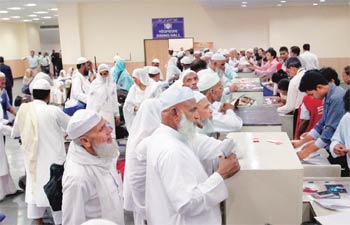
Haj made affordable

June 13, 2014

Jeddah, Jun 13: Domestic Haj companies have forged an alliance to provide 10,000 local pilgrims the opportunity to perform Haj this year for SR2,750.

HajThe price for a low-cost Haj will range between SR2,750 and SR5,000 while those wanting extra services have to pay SR9,800 and more. Pilgrims opting for low-cost services will be given tents in different parts of Mina, said Saad Al-Qurashi, chairman of the Haj and Umrah Committee at the Makkah Chamber of Commerce and Industry.

Pilgrims who want to stay close to the Jamarat have to pay SR5,000 for A1 category, SR4,800 for A2, SR4,400 for B and SR4,150 for C. Pilgrims who applied for D1 category, located between King Abdul Aziz Bridge and the Muzdalifah border, have to pay SR3,600 while those staying in tents closer to Muzdalifah will pay SR2,750.

“As many as 41,000 domestic pilgrims will benefit from low-cost Haj services this year,” said Al-Qurashi.

Speaking with Arab News, he said 70 percent of these pilgrims would be selected by the Haj Ministry, while the rest would go through Haj service providers. Some 106 companies have signed a code of ethics to provide Haj services at low prices.

He said the package price covers all services including food, accommodation, transport and Mashair Railway charges. “There are 204 licensed companies to serve domestic pilgrims,” he said, adding that many of them have received their tents in Mina and other holy places from the ministry.

“The early allocation of tents will play a big role in reducing charges,” Al-Qurashi said. He estimated the total number of domestic pilgrims this year at 150,000 after a 50 percent cut in their number due to ongoing Haram expansion projects.

“This is the first time Mina tents are distributed among service providers before Ramadan,” he said and commended Haj Minister Bandar Hajjar for the initiative. He urged other government departments to follow the ministry’s example by quickly issuing visas for seasonal workers and easing procedures to rent buses from abroad.

Comments

Add new comment

  • Coastaldigest.com reserves the right to delete or block any comments.
  • Coastaldigset.com is not responsible for its readers’ comments.
  • Comments that are abusive, incendiary or irrelevant are strictly prohibited.
  • Please use a genuine email ID and provide your name to avoid reject.
News Network
April 24,2020

Riyadh, Apr 24: As many as eleven Indian nationals have died due to COVID-19 in Saudi Arabia.

"As per information available with the Embassy as of April 22, eleven Indian nationals (four in Madinah, three in Makkah, two in Jeddah, one in Riyadh and one in Dammam) have passed away due to COVID-19 in Saudi Arabia," the Embassy of India in Saudi Arabia said in a press release on Wednesday.

It urged the Indian community to remain calm and avoid spreading of rumours amid the COVID-19 crisis.

"The Embassy also reiterates the need for the community to remain calm and avoid spreading of rumours that may create panic. It is important that social media is not used to disseminate false messages and spread hatred along communal lines that can vitiate the atmosphere," the Embassy said.

"As stated by Prime Minister Narendra Modi, COVID-19 does not see race, religion, colour, caste, creed, language or borders before striking, and our response and conduct should attach primacy to unity and brotherhood," it said.

Moreover, several measures on the supply of food, medicines and other emergency assistance to Indians in need are being implemented across the Kingdom.

Earlier, Indian Ambassador to Saudi Arabia, Ausaf Sayeed on April 22 had interacted with Indian community volunteers from the smaller towns all across the Kingdom to discuss the impact of the COVID-19 situation, and evaluate the implementation of various measures to ensure the welfare of Indian nationals.

Comments

Add new comment

  • Coastaldigest.com reserves the right to delete or block any comments.
  • Coastaldigset.com is not responsible for its readers’ comments.
  • Comments that are abusive, incendiary or irrelevant are strictly prohibited.
  • Please use a genuine email ID and provide your name to avoid reject.
Arab News
March 9,2020

Dubai, Mar 9: The eyes of the world will be on the oil markets when the big trading hubs in Europe and North America open following the end of the deal between Saudi Arabia and Russia that has helped to sustain crude at relatively high levels for the past three years.

There were big falls on Friday when ministers from the Organization of the Petroleum Exporting Countries (OPEC) failed to get a deal with non-OPEC members — the so-called OPEC+ — to extend output agreements. Brent oil was down nearly 10 percent at $45.27 going into the western weekend.

Saudi Aramco took immediate action to cut prices after the OPEC+ collapse, offering big discounts for crude deliveries from next month, when the current output restrictions end.

According to a notification sent to customers by Saudi Aramco, seen by Arab News, the Kingdom’s oil giant will cut between $4 and $8 per barrel, with the biggest discounts being offered to buyers in northwest Europe and the US.

Roger Diwan, an oil analyst at consultancy IHS Market, said: “We are likely to see the lowest oil prices of the past 20 years in the next quarter.”

West Texas Intermediate, the US oil benchmark, fell to $28.27 in November 2001.

The move raises the possibility of a “crude war” between the three biggest oil blocs — the US, Russia and the Arabian Gulf. Some analysts believe the American shale industry is more vulnerable to low prices than either the Russians or the Saudis.

Robin Mills, head of the Qamar consultancy, told Arab News: “I don’t think this was premeditated but Saudi Arabia has clearly swung quickly into action to put the Russians under pressure. But the Russians, with low debt and a flexible exchange rate, can cope with a few months of low prices.”

The boom in US shale has made the country the biggest oil producer in the world, but with high financing costs. Lower global prices would put a lot of shale companies out of business.

On the other hand, American motorists, and President Donald Trump, would be pleased to see lower fuel prices in an election year.

In Moscow, one prominent financier with ties to the Kingdom played down the long-term significance of the Vienna fallout.

Kirill Dmitriev, chief executive of the Russian Direct Investment Fund, told Arab News: “Saudi Arabia is our strategic partner, and cooperation between our two countries will continue in all areas. We will also continue to work within the framework of the Russia-Saudi Economic Council.”

One Russian official, who asked not to be named, added: “There is a good relationship between Alexander Novak, Russian energy minister, and his Saudi counterpart Prince Abdul Aziz bin Salman, and I am sure they will continue talking to each other less formally.”

Comments

Add new comment

  • Coastaldigest.com reserves the right to delete or block any comments.
  • Coastaldigset.com is not responsible for its readers’ comments.
  • Comments that are abusive, incendiary or irrelevant are strictly prohibited.
  • Please use a genuine email ID and provide your name to avoid reject.
Arab News
March 21,2020

Jeddah, Mar 21: Saudi government ministers on Friday announced a war chest of more than SR120 billion ($32 billion) to fight the “unprecedented” health and economic challenges facing the country as a result of the killer coronavirus pandemic.

During a press conference in Riyadh, finance minister and acting minister of economy and planning, Mohammed Al-Jadaan, unveiled a SR70 billion stimulus package to support the private sector, especially small- and medium-sized enterprises (SMEs) and businesses worst-hit by the virus outbreak.

And the Saudi Arabian Monetary Authority (SAMA) has also sidelined SR50 billion to help the Kingdom’s banking sector, financial institutions and SMEs.

Al-Jadaan said the government had introduced tough measures to protect the country’s citizens while immediately putting in place a financial safety net. He added that the Kingdom was moving decisively to address the global COVID-19 disease crisis and cushion the financial and economic impact of the outbreak on the country.

The SR70 billion package of initiatives revealed by the minister will include exemptions and postponement of some government dues to help provide liquidity for private-sector companies.

Minister of Health Dr. Tawfig Al-Rabiah noted the raft of precautionary measures that had been introduced by the Kingdom in cooperation with the private sector and government agencies to combat the spread of the coronavirus, highlighting the important contribution of the data communication services sector.

He reassured the Saudi public that the Kingdom would continue to do whatever was required to tackle the crisis.

“This pandemic has a lot of challenges. It’s difficult to make presumptions at this moment as we’ve seen; many developed countries did not expect the rate of transmission of this virus.

“We see that the reality of the situation is different from what many expected. The virus is still being studied and though we know the means of transmission, it is transmitted at a very fast rate, having spread to many countries faster than expected.

“We see that many countries have not taken the strong precautionary measures from the beginning of the crisis which led to the vast spread of the virus in these countries,” Al-Rabiah said.

He pointed out that social distancing would help slow the spread.

Al-Jadaan said the Saudi government had the financial and economic capacity to deal with the situation. “We have large reserves and large investments, but we do not want to withdraw from the reserves more than what was already announced in the budget. We do not want to liquidate any of the government’s investments so we will borrow.

“We have approval from the government after the finance committee raised its recommendations to increase the proportion of the domestic product borrowing from 30 percent to 50 percent. We do not expect to exceed 50 percent from now until the end of 2022,” he added.

The government would use all the tools available to it to finance the private sector, especially SMEs, and ensure its ongoing stability.

The finance minister said that at this stage it was difficult to predict the economic impact of the pandemic on the private sector, but he emphasized that international coordination, most notably through G20 countries and health organizations, was ongoing.

On recorded cases of the COVID-19 disease in the Kingdom, Al-Rabiah said: “Many of the confirmed cases are without symptoms, this is due to the precautionary measures being considered.

“As soon as a case is confirmed, we contact and examine anyone who was in direct contact with the patient. This epidemiological investigation, is conducted on a large scale to investigate any case that was in contact with the patient.”

Al-Jadaan also announced the formation of a committee made up of the ministers of finance, economy and planning, commerce, and industry and mineral resources, along with the vice chairman of the board of the Saudi National Development Fund, and its governor.

The committee will be responsible for identifying and reviewing incentives, facilities, and other initiatives led by the fund.

Committees had also been established, said Al-Jadaan, to study the impact and repercussions of the coronavirus crisis on all sectors and regions, and look at ways of overcoming them through subsidies or stimulus packages.


Comments

Add new comment

  • Coastaldigest.com reserves the right to delete or block any comments.
  • Coastaldigset.com is not responsible for its readers’ comments.
  • Comments that are abusive, incendiary or irrelevant are strictly prohibited.
  • Please use a genuine email ID and provide your name to avoid reject.