



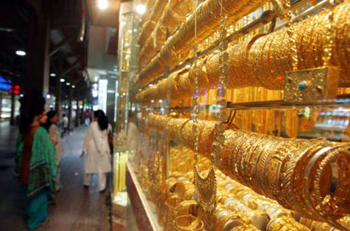
Dubai's jewellers see better value in 18K push

January 2, 2013

HL

Dubai, Jan 2: Seeking to put the sparkle back into the gold trade after a less than stellar showing in the second half of 2012, Dubai’s jewellers are set to put their marketing muscle behind 18-carat jewellery for the first time. They believe such a move would help considerably improve offtake of jewellery among Western and Chinese shoppers, particularly tourists during the peak holiday season and during DSF.

It also signals a not so subtle shift on the part of Dubai’s jewellery trade which has until now focussed exclusively on 22-carat jewellery and demand from Indian and Pakistani residents and those on visit.

“18K is the most popular caratage in jewellery internationally, especially in Europe; hence it will be appealing to tourists from there,” said Abdul Salam KP, group executive director at Malabar Gold and Diamonds. “It obviously has the advantage of a lower price compared to 22K and offers more design variety as it is acceptable internationally and easier to make in complicated designs.”

On pricing, there is a fairly significant gap between the carats. Yesterday, a gram of 22K was going for Dh180.94 ($49.26) in Dubai, while its 18K counterpart had a less sheen in value terms at Dh147.99 ($40.29) a gram. Moreover, the making charges on 18K are said to be considerably lower.

Apart from the Western tourist, jewellery chains are keeping an equally keen look out for Chinese shoppers. They were quite conspicuous jewellery buyers during DSF 2011, but less so last year. Retailers are hoping for a marked improvement in the upcoming one and expect the 18K push will win them over.

“The Chinese tourist prefer 18K gold jewellery as well as 24K gold bars,” said John Paul Joy Alukkas, executive director, Joyalukkas Group. “The preference for the former is because they can use it more as a day to day rather than special occasion jewellery. The gold bars are with an investment perspective.”

Dubai’s gold trade definitely needs a volume boost and if 18K can provide that, retailers will not mind much. Demand had taken a dent last year after the steady upturn in gold prices through 2011 stalled and went through a bit of volatility.

But a key factor for the subdued demand had to do with events in India, where customs authorities dusted off a long dormant 1967 gold import duty and started applying it vigorously since the second quarter of 2012. This effectively meant that the price differential buying gold jewellery in Dubai as opposed to doing the same in India came down significantly. It also meant that any Indian expat here taking gold back to India would be hit with steep duties. As a case in point, a woman passenger wearing a gold chain weighing 40-gram would have to shell out Rs4,100 as duty on arrival at an Indian airport.

“Implementation of the recent revision in customs duty for gold and the related hassles for passengers has affected the mindset of NRI passengers in a big way,” said Sunny Chittilappilly, chairman of Dubai Gold and Jewellery Group. “As a result gold buying in the Gulf reduced to an extent and demand for 22K Indian jewellery was affected during the high purchase season close to summer.”

Several depositions, both individual and at the industry level, have been made to the Indian authorities for a repeal or a relook at the 1967 provisions. Dubai’s jewellers believe something will come out of the collective action.

In the meantime, they hope the 18K push and DSF 2013 — in which 13 kilos of gold can be won daily - will cut them some slack.

Comments

Add new comment

  • Coastaldigest.com reserves the right to delete or block any comments.
  • Coastaldigset.com is not responsible for its readers’ comments.
  • Comments that are abusive, incendiary or irrelevant are strictly prohibited.
  • Please use a genuine email ID and provide your name to avoid reject.
Agencies
June 24,2020

New Delhi, Jun 24: Expanding the testing criterion for coronavirus, the Indian Council of Medical Research has said it should be made widely available to all symptomatic individuals across the country.

"Since test, track and treat' is the only way to prevent spread of infection and save lives, it is imperative that testing should be made widely available to all symptomatic individuals in every part of the country and contact tracing mechanisms for containment of infection are further strengthened," it said in an advisory on 'Newer Additional Strategies for COVID-19 Testing' on Tuesday.

In its revised testing strategy for COVID-19 issued on May 18, the Indian Council of Medical Research (ICMR) had advised testing for all symptomatic Influenza-like illness (ILI) among returnees and migrants within seven days of illness.

All hospitalised patients who develop ILI symptoms, symptomatic individuals living within hotspots or containment zones and healthcare and frontline workers involved in containment and mitigation of coronavirus were also advised testing.

The apex health research body has also advised authorities to enable all government and private hospitals, offices and public sector units to perform antibody-based COVID-19 testing for surveillance to help allay fears and anxiety of healthcare workers and office employees.

The earlier advisories on rapid antibody testing advisories had focused on areas reporting clusters (containment zones), large migration gatherings/evacuees centers and testing of symptomatic ILI individuals at facility level.

Besides, the ICMR on Tuesday also recommended deployment of rapid antigen detection tests for COVID-19 in combination with RT-PCR tests in all containment zones, all central and state government medical colleges and government hospitals, all private hospitals approved by the National Accreditation Board for Hospitals and Healthcare (NABH), all NABL-accredited and ICMR approved private labs, for COVID-19 testing.

All hospitals, laboratories and state governments intending to perform the point-of-care antigen tests need to register with ICMR to obtain the login credentials for data entry.

"ICMR advises all state governments, public and private institutions concerned to take required steps to scale up testing for COVID-19 by deploying combination of various tests as advised," the advisory added.

Comments

Add new comment

  • Coastaldigest.com reserves the right to delete or block any comments.
  • Coastaldigset.com is not responsible for its readers’ comments.
  • Comments that are abusive, incendiary or irrelevant are strictly prohibited.
  • Please use a genuine email ID and provide your name to avoid reject.
Agencies
July 15,2020

The first COVID-19 vaccine tested in the US revved up people's immune systems just the way scientists had hoped, researchers reported Tuesday -- as the shots are poised to begin key final testing.

No matter how you slice this, this is good news, Dr. Anthony Fauci, the U.S. government's top infectious disease expert, told The Associated Press.

The experimental vaccine, developed by Fauci's colleagues at the National Institutes of Health and Moderna Inc., will start its most important step around July 27: A 30,000-person study to prove if the shots really are strong enough to protect against the coronavirus.

But Tuesday, researchers reported anxiously awaited findings from the first 45 volunteers who rolled up their sleeves back in March. Sure enough, the vaccine provided a hoped-for immune boost.

Those early volunteers developed what are called neutralizing antibodies in their bloodstream -- molecules key to blocking infection -- at levels comparable to those found in people who survived COVID-19, the research team reported in the New England Journal of Medicine.

This is an essential building block that is needed to move forward with the trials that could actually determine whether the vaccine does protect against infection, said Dr. Lisa Jackson of the Kaiser Permanente Washington Research Institute in Seattle, who led the study.

There's no guarantee but the government hopes to have results around the end of the year -- record-setting speed for developing a vaccine.

The vaccine requires two doses, a month apart.

There were no serious side effects. But more than half the study participants reported flu-like reactions to the shots that aren't uncommon with other vaccines -- fatigue, headache, chills, fever and pain at the injection site. For three participants given the highest dose, those reactions were more severe; that dose isn't being pursued.

Some of those reactions are similar to coronavirus symptoms but they're temporary, lasting about a day and occur right after vaccination, researchers noted.

Small price to pay for protection against COVID, said Dr. William Schaffner of Vanderbilt University Medical Center, a vaccine expert who wasn't involved with the study.

He called the early results a good first step, and is optimistic that final testing could deliver answers about whether it's really safe and effective by the beginning of next year.

It would be wonderful. But that assumes everything's working right on schedule, Schaffner cautioned.

Moderna's share price jumped nearly 15 percent in trading after US markets closed. Shares of the company, based in Cambridge, Massachusetts, have nearly quadrupled this year.

Tuesday's results only included younger adults. The first-step testing later was expanded to include dozens of older adults, the age group most at risk from COVID-19.

Those results aren't public yet but regulators are evaluating them. Fauci said final testing will include older adults, as well as people with chronic health conditions that make them more vulnerable to the virus and Black and Latino populations likewise affected.

Nearly two dozen possible COVID-19 vaccines are in various stages of testing around the world. Candidates from China and Britain's Oxford University also are entering final testing stages.

The 30,000-person study will mark the world's largest study of a potential COVID-19 vaccine so far. And the NIH-developed shot isn't the only one set for such massive U.S. testing, crucial to spot rare side effects. The government plans similar large studies of the Oxford candidate and another by Johnson & Johnson; separately, Pfizer Inc. is planning its own huge study.

Already, people can start signing up to volunteer for the different studies.

People think this is a race for one winner. Me, I'm cheering every one of them on, said Fauci, who directs NIH's National Institute of Allergy and Infectious Diseases.

We need multiple vaccines. We need vaccines for the world, not only for our own country. Around the world, governments are investing in stockpiles of hundreds of millions of doses of the different candidates, in hopes of speedily starting inoculations if any are proven to work.

Comments

Add new comment

  • Coastaldigest.com reserves the right to delete or block any comments.
  • Coastaldigset.com is not responsible for its readers’ comments.
  • Comments that are abusive, incendiary or irrelevant are strictly prohibited.
  • Please use a genuine email ID and provide your name to avoid reject.
Agencies
January 12,2020

Washington D.C., Jan 12: Disruption in one night's sleep can lead to getting Alzheimer's disease, a recent study has stated.

The interruption in the sound sleep for a single night aggravates the level of tau protein in any young male's body, thus gives rise to the chances of developing the disease.

According to CNN, the report was published on Wednesday in neurology, the medical journal of the American Academy of Neurology.

"Our study focuses on the fact that even in young, healthy individuals, missing one night of sleep increases the level of tau in blood suggesting that over time, such sleep deprivation could possibly have detrimental effects," says study author Dr Jonathan Cedernaes, a neurologist at Uppsala University in Sweden.

As defined by the Alzheimer's Association, tau is the name of a protein that helps in stabilizing the internal structure of the brain's nerve cells. An abnormal build-up of tau protein in the body can end up in causing interior cells to fall apart and eventually developing Alzheimer's.

"When you get more of that deep sleep and you get the REM sleep in the normal amounts, that improves clearance of abnormal proteins which we think is good," said Mayo Clinic neurologist Dr Donn Dexter, not the study author but a fellow of the American Academy of Neurology.

Earlier studies have also shown that getting deprived of sleep can allow higher tau development and accumulation. Thus that poor sleep can hasten the development of cognitive issues.

Researchers caution that the study is small and inconclusive, and acknowledged they were not able to determine what the increased levels might mean.

"This study raises more questions than answers," agreed Dexter on a concluding note, sharing, "What this is telling us is that we have to dig more deeply. Despite something we do for a third of our lives, we know so little about sleep and we're learning every day, particularly when it comes to sleep and dementia."

Comments

Add new comment

  • Coastaldigest.com reserves the right to delete or block any comments.
  • Coastaldigset.com is not responsible for its readers’ comments.
  • Comments that are abusive, incendiary or irrelevant are strictly prohibited.
  • Please use a genuine email ID and provide your name to avoid reject.