


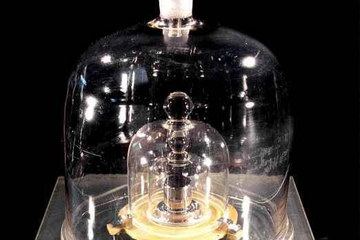
The kilogram has put on weight

January 8, 2013

kilogram

London:Jan 8: The official kilogram - a cylinder-shaped hunk of metal - that defines the fundamental unit of mass, has itself gained weight, scientists say.

Scientists at Newscastle University have found that due to surface contamination the original kilogram is likely to be tens of microgrammes heavier than it was when the first standard was set in 1875.

As a result, each country that has one of these standard masses has a slightly different definition of the kilogram, which could throw off science experiments that require very precise weight measurements or international trade in highly restricted items that are restricted by weight, such as radioactive materials.

The original kilogram - known as the International Prototype Kilogram or the IPK - is the standard against which all other measurements of mass are set.

Stored in the International Bureau of Weights and Measures in Paris, 40 official replicas of the IPK were made in 1884 and distributed around the world in order to standardise mass.

Now Professor Peter Cumpson and Dr Naoko Sano have used cutting-edge X-ray Photoelectron Spectroscopy to analyse surfaces similar to the standard kilogram to assess the build-up of hydrocarbons – and how to remove them.

Ozone and ultraviolet light could be used to clean the kilograms without damaging them, LiveScience reported.

“Statute decrees the IPK is the kilogram,” explained research lead Peter Cumpson, Professor of MicroElectroMechanical Systems at Newcastle University.

“It doesn’t really matter what it weighs as long as we are all working to the same exact standard. The problem is there are slight differences. Around the world, the IPK and its 40 replicas are all growing at different rates, diverging from the original,” Cumpson said.

“We’re only talking about a very small change – less than 100 microgrammes – so, unfortunately, we can’t all take a couple of kilograms off our weight and pretend the Christmas over-indulgence never happened,” Cumpson added.

“But mass is such a fundamental unit that even this very small change is significant and the impact of a slight variation on a global scale is absolutely huge. There are cases of international trade in high-value materials or waste where every last microgramme must be accounted for,” he said.

“What we have done at Newcastle is effectively give these surfaces a suntan. By exposing the surface to a mixture of UV and ozone we can remove the carbonaceous contamination and potentially bring prototype kilograms back to their ideal weight,” he added.

Work is underway internationally in several national measurement institutes to find an alternative to the IPK — a standardised value for the kilogram that is not based on a matchbox—sized piece of metal.

The study was published in the journal of Metrologia.

Comments

Add new comment

  • Coastaldigest.com reserves the right to delete or block any comments.
  • Coastaldigset.com is not responsible for its readers’ comments.
  • Comments that are abusive, incendiary or irrelevant are strictly prohibited.
  • Please use a genuine email ID and provide your name to avoid reject.
Agencies
February 24,2020

Singapore, Feb 24: Last week Singapore's Ministry of Trade and Industry revised their 2020 GDP growth projections downwards to -0.5 to 1.5 per cent, confirming fears of economic fallout from the coronavirus COVID-19. Just three days earlier, while visiting Changi Airport, the Prime Minister told the media that the country is bracing for a significant hit on the economy and the possibility of a recession.

In the budget announcement on February 18, various measures to help affected companies were announced.

This included a jobs support scheme to help companies retain workers that will see the government offset 8 per cent of wages up to SGD3,600(USD2,600) per worker, per month, for a three-month period. Companies will also get a 25 per cent rebate on their taxes for the year capped at SGD15,000 (USD10,800) per company.

There will be additional support for sectors directly affected by the virus outbreak such as tourism, aviation and retail. Qualifying companies will be given property tax rebates and can apply for temporary bridging loans to ease cash flow. Rebates will be offered on aircraft landing and parking charges as well as rental rebates for shops and cargo agents at Changi Airport.

Overall, the economic package will cost Singapore some USD 4.6 billion, well in excess of the USD 500 million some analysts had predicted. The resulting spending plan including the virus economic package will see a budget deficit of SGD 10.9 billion or 2.1 per cent of GDP, the highest since the Asian financial crisis of 1997.

It is hoped that with financial support, companies in Singapore will not only be able to ride through the current rough patch but be able to position themselves better to take off once the economic crisis brought upon by the contagion is over.

Which then are the Singapore companies that can potentially ride out the current storm and emerge stronger?

Aviation and hospitality firms are among those most impacted by the virus outbreak and Singapore Airlines (SIA) comes to mind. SIA is a well-run company but has seen its share price fall about 5.2 percent since the beginning of the year. In the short term, revenue and profits will no doubt be affected but it will recover in the long run.

Hospitality sector companies like Ascott Residence whose main sponsor is Capitaland, Southeast Asia's largest landlord, and CDL Hospitality, have seen 1.5 and 5.5 percent (respectively) shaved off their share prices since the start of the year.

In reporting financial results for the quarter which ended in December on February 14, Alibaba CEO Daniel Zhang said that due to the virus, they are seeing large changes in buying patterns. With widespread home confinement, there is a growing demand for delivery services including online food and grocery delivery, as well as office apps and streaming entertainment.

Similarly, in Singapore, with more people staying and working from home, the three main food delivery services, Grab Food, Foodpanda and Deliveroo, are doing roaring business. All three are privately held.

In late January, as the scale of the outbreak became more apparent, investors began pouring money into health-product firms in Asia that they think will benefit from the virus outbreak.

Bloomberg reported that when Chinese pharmaceutical companies like Da An Gene Co, Xilong Scientific and Shanghai Kehua Bio-Engineering said they have developed kits for detecting the virus, their stocks soared to hit the 10 per cent daily limit. Firms manufacturing protection gear and air-cleaning equipment climbed more than 10 per cent in Japan, while Malaysian rubber gloves producers climbed at least 5 per cent.

Naturally, many would view that pharmaceutical companies that have the technology and expertise to develop drugs to treat patients with the virus or are able to develop a vaccine, would stand to benefit from the coronavirus outbreak.

Firms like and Johnson & Johnson, Pfizer, MSD, GlaxoSmithKline (GSK) and Sanofi are the pharmaceutical behemoths that dominate the global vaccine market.

However, industry experts speaking to the BBC warned that a pot of gold is not necessarily waiting for any company that successfully develops a vaccine. Although the global vaccine market is expected to grow to USD60 billion this year, it is costly and time-consuming to develop and pass it through for use by the general public.

It is also unclear if Indian pharmaceutical firms will be able to benefit from the demand for medicines that can treat or prevent the virus.

India is the world's largest manufacturer of generic drugs and it supplies 20 percent of the world's drugs by volume. However, it sources 70 percent of its raw material from China. If supplies are disrupted beyond a month to a month and a half, they may see a slow-down in production. According to a CNN report, the companies that are most impacted by material shortages are GSK India, Pfizer (PFE) and Cipla. Other companies like Aurobindo Pharma, Cadila Healthcare and Sun Pharma are said to be carefully monitoring the situation.

Comments

Add new comment

  • Coastaldigest.com reserves the right to delete or block any comments.
  • Coastaldigset.com is not responsible for its readers’ comments.
  • Comments that are abusive, incendiary or irrelevant are strictly prohibited.
  • Please use a genuine email ID and provide your name to avoid reject.
Agencies
June 24,2020

New Delhi, Jun 24: Expanding the testing criterion for coronavirus, the Indian Council of Medical Research has said it should be made widely available to all symptomatic individuals across the country.

"Since test, track and treat' is the only way to prevent spread of infection and save lives, it is imperative that testing should be made widely available to all symptomatic individuals in every part of the country and contact tracing mechanisms for containment of infection are further strengthened," it said in an advisory on 'Newer Additional Strategies for COVID-19 Testing' on Tuesday.

In its revised testing strategy for COVID-19 issued on May 18, the Indian Council of Medical Research (ICMR) had advised testing for all symptomatic Influenza-like illness (ILI) among returnees and migrants within seven days of illness.

All hospitalised patients who develop ILI symptoms, symptomatic individuals living within hotspots or containment zones and healthcare and frontline workers involved in containment and mitigation of coronavirus were also advised testing.

The apex health research body has also advised authorities to enable all government and private hospitals, offices and public sector units to perform antibody-based COVID-19 testing for surveillance to help allay fears and anxiety of healthcare workers and office employees.

The earlier advisories on rapid antibody testing advisories had focused on areas reporting clusters (containment zones), large migration gatherings/evacuees centers and testing of symptomatic ILI individuals at facility level.

Besides, the ICMR on Tuesday also recommended deployment of rapid antigen detection tests for COVID-19 in combination with RT-PCR tests in all containment zones, all central and state government medical colleges and government hospitals, all private hospitals approved by the National Accreditation Board for Hospitals and Healthcare (NABH), all NABL-accredited and ICMR approved private labs, for COVID-19 testing.

All hospitals, laboratories and state governments intending to perform the point-of-care antigen tests need to register with ICMR to obtain the login credentials for data entry.

"ICMR advises all state governments, public and private institutions concerned to take required steps to scale up testing for COVID-19 by deploying combination of various tests as advised," the advisory added.

Comments

Add new comment

  • Coastaldigest.com reserves the right to delete or block any comments.
  • Coastaldigset.com is not responsible for its readers’ comments.
  • Comments that are abusive, incendiary or irrelevant are strictly prohibited.
  • Please use a genuine email ID and provide your name to avoid reject.
Agencies
June 10,2020

Early treatment with the antiviral drug remdesivir has been found to reduce viral load and prevent lung disease in macaques infected with SARS-CoV-2 that causes COVID-19, according to a study.

The findings, published in the journal Nature on Tuesday, support the early use of remdesivir treatment in patients with COVID-19 to prevent progression to pneumonia.

Researchers from the National Institutes of Health in the US noted that remdesivir has broad antiviral activity and has been shown to be effective against infections with SARS-CoV and MERS-CoV in animal models.

The drug is being tested in human clinical trials for the treatment of COVID-19, they said.

Researcher Emmie de Wit and colleagues investigated the effects of remdesivir treatment in rhesus macaques, a recently established model of SARS-CoV-2 infection.

Two sets of six macaques were inoculated with SARS-CoV-2.

One group was treated with remdesivir 12 hours later -- close to the peak of virus reproduction in the lungs -- and these macaques received treatment every 24 hours until six days after inoculation.

In contrast to the control group, the researchers found that macaques that received remdesivir did not show signs of respiratory disease, and had reduced damage to the lungs.

Viral loads in the lower respiratory tract were also reduced in the treated animals; viral levels were around 100 times lower in the lower-respiratory tract of remdesivir-treated macaques 12 hours after the first dose, they said.

The researchers said that infectious virus could no longer be detected in the treatment group three days after initial infection, but was still detectable in four out of six control animals.

Despite this virus reduction in the lower respiratory tract, no reduction in virus shedding was observed, which indicates that clinical improvement may not equate to a lack of infectiousness, they said.

Dosing of remdesivir in the rhesus macaques is equivalent to that used in humans, the researchers noted.

They cautioned that it is difficult to directly translate the timing of treatment used in corresponding disease stages in humans, because rhesus macaques normally develop only mild disease.

However, researchers said the results indicate that remdesivir treatment of COVID-19 should be initiated as early as possible to achieve the maximum treatment effect.

Comments

Add new comment

  • Coastaldigest.com reserves the right to delete or block any comments.
  • Coastaldigset.com is not responsible for its readers’ comments.
  • Comments that are abusive, incendiary or irrelevant are strictly prohibited.
  • Please use a genuine email ID and provide your name to avoid reject.