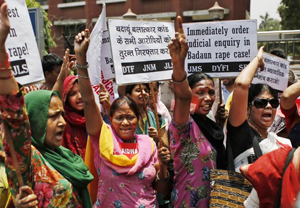
India is third in rape cases, second in murder in the world

July 23, 2014

New Delhi, July 23: India figures third among the top 10 countries where highest number of rapes have taken place in 2010 while in cases of murder, the country comes second in 2012, Rajya Sabha was informed on Wednesday.rapes in india

Minister of State for Home Kiren Rijiju said according to UN Crime Trends Survey 2010, the U.S. recorded 85,593 cases of rape in that year followed by Brazil with 41,180 rape cases.

A total of 22,172 rape cases were registered in India in 2010, he said.

The UN data said in the U.S., 27.3 rape cases were reported per lakh population, followed by 21.09 in Brazil and in case of India, there were 1.8 cases of rape per lakh population.

The United Kingdom has reported 15,892 cases of rape in 2010 (28.8 cases of rape in per lakh population) and in Mexico, there were 14,993 cases of rape (13.2 cases of rape in per lakh population).

France has reported 10,108 cases of rape, which is 16.2 cases of rape in per lakh population.

There were 7,724 cases of rape in Germany, 5,960 cases of rape in Sweden (63.5 cases of rape in every lakh population), 4,907 cases of rape in Russian Federation, 4,718 cases of rape in Philippines and 3,157 cases of rape in Colombia.

Among the murder cases, the UN report said the highest number of murder had taken place in Brazil (50,108) in 2012, followed by India (43,335).

A total of 33,817 cases of murder had taken place in Nigeria, 26,037 cases in Mexico, 18,586 cases in Congo, 16,259 in South Africa, 14,670 in Colombia and 13,846 cases of murder in Pakistan in 2012, the Minister said quoting the Global Study on Homicide, UNODC 2013.

Comments

Add new comment

  • Coastaldigest.com reserves the right to delete or block any comments.
  • Coastaldigset.com is not responsible for its readers’ comments.
  • Comments that are abusive, incendiary or irrelevant are strictly prohibited.
  • Please use a genuine email ID and provide your name to avoid reject.
News Network
March 21,2020

Mar 21: India’s economy, already in the grip of a slowdown, is in for more pain after Prime Minister Narendra Modi appealed to citizens to stay at and work from home to curb the coronavirus outbreak.

The services sector, which accounts for about 55% of India’s gross domestic product, is poised to be the worst hit after Modi, in a late evening address on Thursday, urged citizens to go on a self-imposed curfew for a day and private companies to allow employees to work from home for longer. In the country’s vast informal sector, social-distancing measures could mean a dent to productivity and consumption because of job or pay losses.

“The impact of a partial lock-down or social distancing will be significant,” said Rahul Bajoria, a senior economist at Barclays Plc in Mumbai. “If there’s a widespread community outbreak, GDP could fall as low as 3.5% in the year starting April 1.”

Shrinking output may limit growth in an economy that’s already set to expand at an 11-year low of 5% in the current year to March 31. Before the virus outbreak, India had forecast growth to recover to 6%-6.5% in the next fiscal year. S&P Global Ratings and Fitch Ratings have already slashed their growth forecast by 50 basis points.

“The current social-distancing measures will severely impact airlines, hotels, malls, multiplexes, restaurants and retailers,” according to analysts at Crisil Ltd., the local unit of S&P Global. “Lower footfalls and occupancies, decline in business volume and sub-optimal operating efficiencies will impact cash flows of companies in these sectors,” wrote the analysts led by Chief Economist Dharmakirti Joshi.

The government will try to announce a relief package for virus-affected sectors as early as possible, Finance Minister Nirmala Sitharaman said Friday.

In a televised address, Modi advised all citizens to stay at home for a day on March 22, as he sought to stem the spread of the coronavirus -- cases of which are relatively low in India at about 200, compared with more than 200,000 infected people globally. His government also barred incoming flights for a week from that day, joining a growing list of countries effectively sealing their borders.

What Bloomberg’s Economists Say

We had only earlier this week lowered our GDP outlook to consider the direct impact of the local outbreak as confirmed virus cases exceeded 100 as of March 15 and the federal and state governments announced social distancing measures that have already started to crimp economic activity. We are now revising down our GDP estimate for 4Q fiscal 2020 to 3.3%, from our 3.5%.

-- Abhishek Gupta, India economist

For more, click here

“Consumption being the biggest component of GDP, a lock-down is bound to have a big impact on the economy,” said Devendra Kumar Pant, chief economist at India Ratings and Research, the local unit of Fitch. “Modeling uncertainty in any system will be very difficult, but one can say the slowdown could deepen or prolong further.”

Work From Home

While companies, including billionaire Mukesh Ambani-controlled Reliance Industries Ltd., are asking employees to work from home, the option isn’t feasible in India’s vast informal sector.

“The option to work remotely simply won’t exist for most,” said Shilan Shah, an economist with Capital Economics Pte. in Singapore.

As many households don’t have savings buffers, the government would probably have to back this up with large-scale cash handouts that reach the poorest, he said.

Work from home is posing implementation challenges for the manufacturing sector where workers are required to be physically present at the production sites. The services sector, such as banking and information technology, also needs employees to be present in offices as confidential data is used, according to industry group Federation of Indian Chambers of Commerce and Industry.


Comments

Add new comment

  • Coastaldigest.com reserves the right to delete or block any comments.
  • Coastaldigset.com is not responsible for its readers’ comments.
  • Comments that are abusive, incendiary or irrelevant are strictly prohibited.
  • Please use a genuine email ID and provide your name to avoid reject.
News Network
February 2,2020

Lucknow, Feb 2: In an early morning firing at Lucknow's Hazratganj, the city centre, Vishva Hindu Mahasabha state president Ranjit Bachchan was killed while he was out on a morning walk on Sunday.

Ranjit Bachchan was taking a stroll in Hazratganj in the morning when bike-borne assailants opened fire on him and killed him on the spot. The Mahasabha leader was shot in the head multiple times.

The incident took place near the CDRI building in Lucknow's Hazratganj.

In the firing, Ranjit Bachchan's brother also suffered bullet injuries. He has been rushed to the trauma centre. Ranjit Bachchan was a resident of Gorakhpur.

The early morning shootout in the Uttar Pradesh capital's central area has caused tension in the area.

Dinesh Singh, DCP Central Lucknow, said, "The body has been identified as of Ranjit Bachchan, who had gone out on morning walk when some unknown assailant shot him. A police team has been formed and further investigation is being carried out."

Before being associated with the Mahasabha, Ranjit Bachchan was a Samajwadi Party member and was often spotted with former UP chief minister Akhilesh Yadav.

The Samajwadi Party has hit out at the Yogi Adityanath government over the law and order situation in the state and demanded immediate resignation of the government.

Comments

Add new comment

  • Coastaldigest.com reserves the right to delete or block any comments.
  • Coastaldigset.com is not responsible for its readers’ comments.
  • Comments that are abusive, incendiary or irrelevant are strictly prohibited.
  • Please use a genuine email ID and provide your name to avoid reject.
News Network
January 22,2020

Jan 22: India's ranking in the latest global Democracy Index has dropped 10 places to the 51st spot out of 167 owing to violent protests and threats to civil liberties challenging freedoms across the country.

Prime Minister Narendra Modi's government has been criticized by rights groups and western governments after shutting off the internet and mobile phone networks and detaining opposition politicians in Kashmir.

Modi’s government has also responded harshly to ongoing protests against a controversial, religion-based citizenship law. Muslims have said their neighborhoods have been targeted, while the central government has attempted to ban protests and urged TV news channels not to broadcast “anti-national” content. Some leaders in Modi’s ruling party called for “revenge” against protesters. India’s score in 2019 was its worst ranking since the EIU’s records began in 2006, and has fallen gradually since Modi was elected in 2014.

The Economist Intelligence Unit’s 2019 Democracy Index, which provides an annual comparative analysis of political systems across 165 countries and two territories, said the past year was the bleakest for democracies since the research firm began compiling the list in 2006.

“The 2019 result is even worse than that recorded in 2010, in the wake of the global economic and financial crisis,” the research group said in releasing the report on Wednesday.

The average global score slipped to 5.44 out of a possible 10 -- from 5.48 in 2018 -- driven mainly by “sharp regressions” in Latin America, Sub-Saharan Africa, the Middle East and North Africa. Apart from coup-prone Thailand, which improved its score after holding an election last year, there were also notable declines in Asia after a tumultuous period of protests and new measures restricting freedom across the region’s democracies.

Asia Declines

Hong Kong, meanwhile, fell three places to rank 75th out of 167 as more than seven months of violent and disruptive protests rocked the Asian financial hub. An aggressive police response early in the unrest, when protests were mostly peaceful, led to a “marked decline in confidence in government -- the main factor behind the decline in the territory’s score in our 2019 index,” the group said.

In Singapore, which ranked alongside Hong Kong at 75th, a new “fake news” law led to a deteriorating score on civil liberties.

“The government claims that the law was enacted simply to prevent the dissemination of false news, but it threatens freedom of expression in Singapore, as it can be used to curtail political debate and silence critics of the government,” EIU analysts said.

China’s score fell to just 2.26 in the EIU’s ranking, placing it near the bottom of the list at 153, as discrimination against minorities, repression and surveillance of the population intensified. Still, in China “the majority of the population is unconvinced that democracy would benefit the economy, and support for democratic ideals is absent,” the EIU said.

Comments

Add new comment

  • Coastaldigest.com reserves the right to delete or block any comments.
  • Coastaldigset.com is not responsible for its readers’ comments.
  • Comments that are abusive, incendiary or irrelevant are strictly prohibited.
  • Please use a genuine email ID and provide your name to avoid reject.