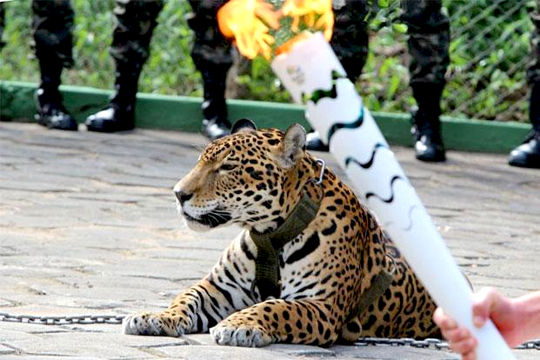
Juma the jaguar becomes a tragic casualty of the Olympics

June 22, 2016

Jun 22: On Monday, less than a month after a gorilla was killed in the Cincinnati zoo because a child had slipped into its enclosure, an Amazonian jaguar was killed after the Olympic torch-bearing ceremony in Brazil.

jaguar

While news reports are surfacing now, there has been no media stir, or social media ire like there was with the Cincinnati zoo incident. The 17-year-old female jaguar Juma was raised in a military-run zoo in Manaus and was part of the ceremonial Olympic torch-bearing procession.

The jaguar, which is the symbol of the Amazon, derives its name from the Native American yaguar, meaninghe who kills with one leap'. Juma, along with another jaguar, were chained and exhibited throughout the ceremony. The jaguar become restless when she was forced to pose for multiple-angle shots with a man holding the torch, managing to unshackle herself.

Once free, Juma was shot with four tranquilizer darts but despite that, she attacked a soldier. To save him and the rest of the rescue team, she was killed with a single gunshot.

“Wild animals held captive and forced to do things that are frightening, sometimes painful, and always unnatural are ticking time bombs,” says Brittany Peet, director of captive animal law enforcement at People for the Ethical Treatment of Animals (PETA).

As per the Amazonas state government environmental authority, Juma's participation in the event was illegal, Reuters reported. “No request was made to authorize the participation of the jaguarJuma' in the event of the Olympic torch.”

The jaguar is a near-extinct species. Only 15,000 of them are left on earth.

“We made a mistake in permitting the Olympic torch, a symbol of peace and unity, to be exhibited alongside a chained wild animal. This image goes against our beliefs and our values,” the Olympic committee's statement post the incident read.

It is little consolation for yet another meaningless and brutal killing.

Comments

Add new comment

  • Coastaldigest.com reserves the right to delete or block any comments.
  • Coastaldigset.com is not responsible for its readers’ comments.
  • Comments that are abusive, incendiary or irrelevant are strictly prohibited.
  • Please use a genuine email ID and provide your name to avoid reject.
Agencies
February 5,2020

San Francisco, Feb 5: After a German artist, Simon Weckert, demonstrated how he "hacked" Google Maps with 99 smartphones and a wagon to create "virtual traffic jams" on the streets of Berlin, Google responded to the incident saying it "appreciates" creative use of maps.

Admitting that it has not quite cracked travelling by wagon, the tech giant also hinted that it might use cases like this to improve how its maps work.

"We appreciate seeing creative uses of Google Maps like this as it helps us make maps work better over time," 9to5Google quoted a Google spokesperson as saying.

In a YouTube video, Weckert showed that he put 99 smartphones with Google Maps onto a small wagon cart and then wheeled that cart around various streets in Berlin, including outside the Google office, Android Authority reported on Monday.

The smartphones "apparently fooled Google Maps" into thinking that there was a high concentration of users on those streets.

Because the second-hand phones were in a cart, Maps was further tricked into believing that the traffic was slow-moving.

As a result, the navigation app started showing virtual traffic jams by turning green streets to red in the online navigational tool, showcasing how digital technology can have a real impact on the real world.

"Traffic data in Google Maps is refreshed continuously thanks to information from a variety of sources, including aggregated anonymised data from people who have location services turned on and contributions from the Google Maps community," the Google spokesperson said.

"We've launched the ability to distinguish between cars and motorcycles in several countries including India, Indonesia and Egypt, though we haven't quite cracked travelling by wagon," the statement added. After a German artist, Simon Weckert, demonstrated how he "hacked" Google Maps with 99 smartphones and a wagon to create "virtual traffic jams" on the streets of Berlin, Google responded to the incident saying it "appreciates" creative use of maps.

Admitting that it has not quite cracked travelling by wagon, the tech giant also hinted that it might use cases like this to improve how its maps work.

"We appreciate seeing creative uses of Google Maps like this as it helps us make maps work better over time," 9to5Google quoted a Google spokesperson as saying.

In a YouTube video, Weckert showed that he put 99 smartphones with Google Maps onto a small wagon cart and then wheeled that cart around various streets in Berlin, including outside the Google office, Android Authority reported on Monday.

The smartphones "apparently fooled Google Maps" into thinking that there was a high concentration of users on those streets.

Because the second-hand phones were in a cart, Maps was further tricked into believing that the traffic was slow-moving.

As a result, the navigation app started showing virtual traffic jams by turning green streets to red in the online navigational tool, showcasing how digital technology can have a real impact on the real world.

"Traffic data in Google Maps is refreshed continuously thanks to information from a variety of sources, including aggregated anonymised data from people who have location services turned on and contributions from the Google Maps community," the Google spokesperson said.

"We've launched the ability to distinguish between cars and motorcycles in several countries including India, Indonesia and Egypt, though we haven't quite cracked travelling by wagon," the statement added.

Comments

Add new comment

  • Coastaldigest.com reserves the right to delete or block any comments.
  • Coastaldigset.com is not responsible for its readers’ comments.
  • Comments that are abusive, incendiary or irrelevant are strictly prohibited.
  • Please use a genuine email ID and provide your name to avoid reject.
Agencies
June 26,2020

Facebook will introduce a new notification screen on its platform that will warn users if the article they are about to share is over 90 days old, the company announced on Thursday.

“We’re starting to globally roll out a notification screen that will let people know when news articles they are about to share are more than 90 days old,” Facebook wrote in a blog post.

The social media platform had previously introduced a context button in 2018 that provides information about the sources of articles in the News Feed. Building upon that, the new feature will inform users about the timeliness of the article.

“To ensure people have the context they need to make informed decisions about what to share on Facebook, the notification screen will appear when people click the share button on articles older than 90 days, but will allow people to continue sharing if they decide an article is still relevant,” Facebook said.

The social media giant stated that timeliness is important in understanding the context of an article and curbing the spread of misinformation on the platform.

“News publishers, in particular, have expressed concerns about older stories being shared on social media as current news, which can misconstrue the state of current events. Some news publishers have already taken steps to address this on their own websites by prominently labelling older articles to prevent outdated news from being used in misleading ways,” Facebook added.

Apart from this, the platform will also be testing a similar notification screen for information related to the global Covid-19 pandemic. The notification screen will provide information about the source of the link shared in a post if the link is related to information on Covid-19. It will also direct people to its previously introduced Covid-19 information centre for “authoritative” health information, it said.

Comments

Add new comment

  • Coastaldigest.com reserves the right to delete or block any comments.
  • Coastaldigset.com is not responsible for its readers’ comments.
  • Comments that are abusive, incendiary or irrelevant are strictly prohibited.
  • Please use a genuine email ID and provide your name to avoid reject.
News Network
May 30,2020

May 30: Patients undergoing surgery after contracting the novel coronavirus are at an increased risk of postoperative death, according to a new study published in The Lancet journal which may lead to better treatment guidelines for COVID-19.

In the study, the scientists, including those from the University of Birmingham in the UK, examined data from 1,128 patients from 235 hospitals from a total of 24 countries.

Among COVID-19 patients who underwent surgery, they said the death rates approach those of the sickest patients admitted to intensive care after contracting the virus.

The scientists noted that SARS-CoV-2 infected patients who undergo surgery, experience substantially worse postoperative outcomes than would be expected for similar patients who do not have the infection.

According to the study, the 30-day mortality among these patients was nearly 24 per cent.

The researchers noted that mortality was disproportionately high across all subgroups, including those who underwent elective surgery (18.9 per cent), and emergency surgery (25.6 per cent).

Those who underwent minor surgery, such as appendicectomy or hernia repair (16.3 per cent), and major surgery such as hip surgery or for colon cancer also had higher mortality rates (26.9 per cent), the study said.

According to the study, the mortality rates were higher in men versus women, and in patients aged 70 years or over versus those aged under 70 years.

The scientists said in addition to age and sex, risk factors for postoperative death also included having severe pre-existing medical problems, undergoing cancer surgery, undergoing major procedures, and undergoing emergency surgery.

"We would normally expect mortality for patients having minor or elective surgery to be under 1 per cent, but our study suggests that in SARS-CoV-2 patients these mortality rates are much higher in both minor surgery (16.3%) and elective surgery (18.9%)," said study co-author Aneel Bhangu from the University of Birmingham.

Bhangu said these mortality rates are greater than those reported for even the highest-risk patients before the pandemic.

Citing an example from the 2019 UK National Emergency Laparotomy Audit report, he said the 30-day mortality was 16.9 per cent in the highest-risk patients.

Based on an earlier study across 58 countries, Bhangu said the 30-day mortality was 14.9 per cent in patients undergoing high-risk emergency surgery.

"We recommend that thresholds for surgery during the SARS-CoV-2 pandemic should be raised compared to normal practice," he said.

"For example, men aged 70 years and over undergoing emergency surgery are at particularly high risk of mortality, so these patients may benefit from their procedures being postponed," Bhangu added.

The study also noted that patients undergoing surgery are a vulnerable group at risk of SARS-CoV-2 exposure in hospital.

It noted that the patients may also be particularly susceptible to subsequent pulmonary complications, due to inflammatory and immunosuppressive responses to surgery and mechanical ventilation.

The scientists found that overall in the 30 days following surgery 51 per cent of patients developed a pneumonia, acute respiratory distress syndrome, or required unexpected ventilation.

Nearly 82 per cent of the patients who died had experienced pulmonary complications, the researchers said.

"Worldwide an estimated 28.4 million elective operations were cancelled due to disruption caused by COVID-19," said co-author Dmitri Nepogodiev from the University of Birmingham.

"Our data suggests that it was the right decision to postpone operations at a time when patients were at risk of being infected with SARS-CoV-2 in hospital," Nepogodiev said.

According to the researchers, there's now an urgent need for investment by governments and health providers in to measures which ensure that as surgery restarts patient safety is prioritised.

They said this includes the provision of adequate personal protective equipment (PPE), establishment of pathways for rapid preoperative SARS-CoV-2 testing, and consideration of the role of dedicated 'cold' surgical centres.


Comments

Add new comment

  • Coastaldigest.com reserves the right to delete or block any comments.
  • Coastaldigset.com is not responsible for its readers’ comments.
  • Comments that are abusive, incendiary or irrelevant are strictly prohibited.
  • Please use a genuine email ID and provide your name to avoid reject.