


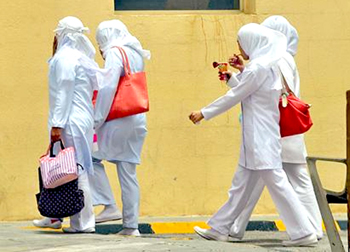
MERS cases drop in KSA; alarm over medics becoming carriers

May 19, 2014

MERS cases dropNew York, May 19: The biggest risk that Middle East Respiratory Syndrome (MERS) will become a global epidemic, ironically, may lie with globe-trotting health care workers.

“This is how MERS might spread around the world,” said infectious disease expert Dr. Amesh Adalja of the University of Pittsburgh Medical Center.

It can take five to 14 days for someone infected with MERS to show symptoms, more than enough time for a contagious person to fly to the other side of the world without being detectable.

Health care workers “are at extremely high risk of contracting MERS compared to the general public,” Adalja said.

The threat has attracted new attention with the confirmation of the first two MERS cases in the United States. Both are health care workers who fell ill shortly after leaving their work in Saudi hospitals and boarding planes bound west.

About one-third of the MERS cases treated in hospitals in Jeddah were health care workers, according to the World Health Organization (WHO).

The Ministry of Health's counted 529 MERS infections since September 2012, of which 168 patients died as of May 17, 2014.

Despite the risk, few of the health care workers now in, or planning to go to, Saudi Arabia are having second thoughts about working there, according to nurses, doctors and recruiters interviewed by Reuters.

Michelle Tatro, 28, leaves next week for the kingdom, where she will work as an open-heart-surgery nurse. Tatro, who typically does 13-week stints at hospitals around the United States, said her family had sent her articles about MERS, but she wasn’t worried.

“I was so glad to get this job,” she told Reuters. “Travel is my number one passion.”

So far, international health authorities have not publicly expressed concern about the flow of expatriate medical workers to and from Saudi Arabia.

“There is not much public health authorities or border agents can do,” said infectious disease expert Dr. Michael Osterholm of the University of Minnesota. “Sure, they can ask people, ‘did you work in a health care facility in Saudi Arabia,’ but if the answer is yes, then what?“

Health care workers are best placed to understand the MERS risk, Osterholm said, and “there should be a heightened awareness among them of possible MERS symptoms.”

Neither the Centers for Disease Control and Prevention nor the Department of Homeland Security responded to questions about whether they were considering monitoring health care workers returning to the United States.

Soaring demand

In the last few years, the number of expatriates working in Saudi Arabia has soared, said Suleiman Arabie, managing director of Houston, Texas-based recruiting firm SA International, with thousands now working in the kingdom.

The Saudi government is building hundreds of hospitals and offering private companies interest-free loans to help build new facilities.

About 15 percent of physicians working in the Kingdom are American or European, and some 40 percent of nurses are Filipino or Malaysian, according to estimates by recruiters and people who have worked in hospitals there.

The majority of US-trained medical staff are on one- or two-year contracts, which results in significant churn as workers rotate in and out of Saudi medical facilities.

Arabie’s firm is trying to fill positions at two dozen medical facilities in Saudi Arabia for pulmonologists, a director of nursing, a chief of physiotherapy and scores more.

Doctors in lucrative, in-demand specialties such as cardiology and oncology can make $1 million for a two-year contract, recruiters said.

Nurses’ pay depends on their home country, with those from the United States and Canada earning around $60,000 a year while those from the Philippines get about $12,000, recruiters said. That typically comes with free transportation home, housing, and 10 weeks of paid vacation each year. For Americans, any income under about $100,000 earned abroad is tax-free, adding to the appeal of a Saudi posting.

Undaunted

One Filipino nurse, who spoke anonymously so as not to hurt her job prospects, told Reuters that she was “willing to go to Saudi Arabia because I don’t get enough pay here.” In a private hospital in Manila, she made 800 pesos (about $18) a day.

“I know the risks abroad but I’d rather take it than stay here,” she said. “I am not worried about MERS virus. I know how to take care of myself and I have the proper training.”

None of Arabie’s potential candidates “have expressed any concern” about MERS. Only one of the hundreds of professionals placed by Toronto-based medical staffing firm Helen Ziegler & Associates Inc. decided to return to the United States because of MERS, it said, and one decided not to accept a job in Jeddah she had been hired for.

Recruitment agencies in Manila have also continued to send nurses to the kingdom since the MERS outbreak, said Hans Leo Cacdac, the head of the Philippine Overseas Employment Administration. The government advises that returning workers be screened for MERS, Labor and Employment Secretary Rosalinda Baldoz said this week.

Expat health care workers now working in Saudi Arabia feel confident local authorities are taking the necessary steps to combat the spread of MERS in hospitals.

“Just today they came and put up giant posters in our hospital on MERS,” said Dr. Taher Kagalwala, a pediatrician originally from Mumbai who works at Al Moweh General Hospital in a town about 120 miles from Taif city in western Saudi Arabia.

“I have not heard of or seen any health care workers looking to leave their jobs or return to their countries because of the MERS panic. If it was happening, there would have been gossip very soon.”

Comments

Add new comment

  • Coastaldigest.com reserves the right to delete or block any comments.
  • Coastaldigset.com is not responsible for its readers’ comments.
  • Comments that are abusive, incendiary or irrelevant are strictly prohibited.
  • Please use a genuine email ID and provide your name to avoid reject.
Gulf News
May 29,2020

Dubai: There aren’t that many job vacancies right now – but be prepared for a 15-20 per cent cut in salary expectations even for those positions that are still open. Businesses in the UAE are definitely not in a generous mood when it comes to hiring, with salary cuts now part of the new normal.

And they are definitely not willing to take on new hires without extracting some cost benefit from them. “We have seen major [salary] cuts across the board in hospitality, real estate, professional services and in retail,” said Vijay Gandhi, regional head at Korn Ferry Digital, the recruitment consultancy.

“And once the headcount correction is complete in [the local] financial services and energy sector, we may see more cuts in rewards and benefits in these categories as well.”

The salary cuts are slowly extending their way into the healthcare sector as well – just about every non-COVID-19 facing medical category is coming across cuts in the number of working hours and, by extension, their take home packages.

By end of June, more businesses and sectors in the UAE will have a better understanding of their short-term revenue prospects. By then, they will also have a better reading on what their staff strength should be – and whether there should be more trimming of the workforce. Or whether they should consider a few hires as well.

A long summer
So, realistically, it could be September before such decisions need to be taken. The coming weeks will then prove to be laden with anxiety for those who are expecting to land a job option after being laid off at their current employers.

There are multiple instances of recruitment decisions having been made in February/March, and then the companies rescinding those offers to the chosen candidates citing the business uncertainty.

“The decision to hire is taking longer – so job creation is now 4-6 weeks from interview and selection compared to 4-6 days in the past,” said Gandhi.

The lucky ones
Recently, free zones and other entities had made it easier for personnel on the visa of one entity being able to smoothly transfer to another if they are likely to be made redundant. “We are seeing more flexibility being offered by the authorities given the circumstances, and the visa transfer process is happening,” said Gandhi.

“But in the vast majority of cases, businesses are going to wait and watch before normal hiring activity starts. Organizations will look to hire from September.”

A few hires are still happening
Even in the business turmoil set off by COVID-19, a few categories are still offering jobs. At the entry level, logistics services personnel and drivers with experience remain in demand.

Not just “routine jobs, there have been confirmations in more technical roles such as procurement and operations in healthcare and e-commerce,” said Gandhi. “Employers should keep an eye for good talent and have the talent acquisition team actively looking for good profiles.

“As such, organizations are not only looking at “right sizing” in numbers but also “future proofing” on what kind of skilled talent will help them in the post-COVID-19 world.”

But for the candidates, the present will be about waiting around for the call to come.

Comments

Add new comment

  • Coastaldigest.com reserves the right to delete or block any comments.
  • Coastaldigset.com is not responsible for its readers’ comments.
  • Comments that are abusive, incendiary or irrelevant are strictly prohibited.
  • Please use a genuine email ID and provide your name to avoid reject.
Agencies
May 2,2020

Doha, May 2: Twenty-three staff at a hospital in Qatar were injured when tents being used to boost capacity in response to coronavirus collapsed in a fierce storm, local media reported Friday.

Winds of up to 72 kilometres per hour (45 miles per hour) caused two temporary tent annexes at Hazm Mebaireek General Hospital in Qatar's Industrial Area to collapse on Thursday, the Gulf Times reported.

No patients were hurt and most injuries to staff at the facility, 20 kilometres south west of central Doha, were minor, the daily added, citing the health ministry.

During the gale-force winds on Thursday, a Qatar Airways Boeing 787 on the ground was blown into a nearby Airbus A350 at Doha's Hamad airport causing minor damage but no injuries, the airline said in a statement.

Ten@ten989

عاصفة رعدية ورياح قوية تهدم المستشفى الميداني في قطر وأضرار أخرى في منطقة

#انهيار_المستشفي_الميداني

32

4:14 AM - May 1, 2020

Twitter Ads info and privacy

22 people are talking about this

The Industrial Area is a gritty, densely-populated district that is home to mostly migrant labourers and has been the epicentre of Qatar's outbreak. 

Tens of thousands of residents were quarantined in the area after cases of the novel coronavirus were confirmed among the community in mid-March.

Qatar -- home to hundreds of thousands of foreign labourers working on projects linked to the 2022 World Cup -- has reported 12 deaths and 14,096 cases of the Covid-19 respiratory disease.

The hospital's executive director Hussein Ishaq said the incident was being treated "very seriously" and that an investigation had been launched.

Hospital staff had "helped ensure that no patients were injured and were safely transferred to other hospitals", he said, quoted in the Gulf Times.

Comments

Add new comment

  • Coastaldigest.com reserves the right to delete or block any comments.
  • Coastaldigset.com is not responsible for its readers’ comments.
  • Comments that are abusive, incendiary or irrelevant are strictly prohibited.
  • Please use a genuine email ID and provide your name to avoid reject.
News Network
March 18,2020

Dubai, Mar 18: Emirates, one of the world's biggest international airlines, has asked pilots to take unpaid leave to help it mitigate the impact of the coronavirus pandemic that has shattered demand for global travel.

"To this end you are strongly encouraged to make use of this opportunity to volunteer for additional paid and unpaid leave," the airline said in an internal email to pilots, seen by Reuters.

Emirates earlier this month asked some staff to take unpaid leave, although at that time it was not available to pilots.

Comments

Add new comment

  • Coastaldigest.com reserves the right to delete or block any comments.
  • Coastaldigset.com is not responsible for its readers’ comments.
  • Comments that are abusive, incendiary or irrelevant are strictly prohibited.
  • Please use a genuine email ID and provide your name to avoid reject.