


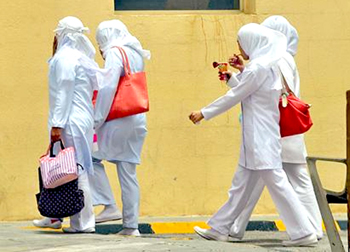
MERS cases drop in KSA; alarm over medics becoming carriers

May 19, 2014

MERS cases dropNew York, May 19: The biggest risk that Middle East Respiratory Syndrome (MERS) will become a global epidemic, ironically, may lie with globe-trotting health care workers.

“This is how MERS might spread around the world,” said infectious disease expert Dr. Amesh Adalja of the University of Pittsburgh Medical Center.

It can take five to 14 days for someone infected with MERS to show symptoms, more than enough time for a contagious person to fly to the other side of the world without being detectable.

Health care workers “are at extremely high risk of contracting MERS compared to the general public,” Adalja said.

The threat has attracted new attention with the confirmation of the first two MERS cases in the United States. Both are health care workers who fell ill shortly after leaving their work in Saudi hospitals and boarding planes bound west.

About one-third of the MERS cases treated in hospitals in Jeddah were health care workers, according to the World Health Organization (WHO).

The Ministry of Health's counted 529 MERS infections since September 2012, of which 168 patients died as of May 17, 2014.

Despite the risk, few of the health care workers now in, or planning to go to, Saudi Arabia are having second thoughts about working there, according to nurses, doctors and recruiters interviewed by Reuters.

Michelle Tatro, 28, leaves next week for the kingdom, where she will work as an open-heart-surgery nurse. Tatro, who typically does 13-week stints at hospitals around the United States, said her family had sent her articles about MERS, but she wasn’t worried.

“I was so glad to get this job,” she told Reuters. “Travel is my number one passion.”

So far, international health authorities have not publicly expressed concern about the flow of expatriate medical workers to and from Saudi Arabia.

“There is not much public health authorities or border agents can do,” said infectious disease expert Dr. Michael Osterholm of the University of Minnesota. “Sure, they can ask people, ‘did you work in a health care facility in Saudi Arabia,’ but if the answer is yes, then what?“

Health care workers are best placed to understand the MERS risk, Osterholm said, and “there should be a heightened awareness among them of possible MERS symptoms.”

Neither the Centers for Disease Control and Prevention nor the Department of Homeland Security responded to questions about whether they were considering monitoring health care workers returning to the United States.

Soaring demand

In the last few years, the number of expatriates working in Saudi Arabia has soared, said Suleiman Arabie, managing director of Houston, Texas-based recruiting firm SA International, with thousands now working in the kingdom.

The Saudi government is building hundreds of hospitals and offering private companies interest-free loans to help build new facilities.

About 15 percent of physicians working in the Kingdom are American or European, and some 40 percent of nurses are Filipino or Malaysian, according to estimates by recruiters and people who have worked in hospitals there.

The majority of US-trained medical staff are on one- or two-year contracts, which results in significant churn as workers rotate in and out of Saudi medical facilities.

Arabie’s firm is trying to fill positions at two dozen medical facilities in Saudi Arabia for pulmonologists, a director of nursing, a chief of physiotherapy and scores more.

Doctors in lucrative, in-demand specialties such as cardiology and oncology can make $1 million for a two-year contract, recruiters said.

Nurses’ pay depends on their home country, with those from the United States and Canada earning around $60,000 a year while those from the Philippines get about $12,000, recruiters said. That typically comes with free transportation home, housing, and 10 weeks of paid vacation each year. For Americans, any income under about $100,000 earned abroad is tax-free, adding to the appeal of a Saudi posting.

Undaunted

One Filipino nurse, who spoke anonymously so as not to hurt her job prospects, told Reuters that she was “willing to go to Saudi Arabia because I don’t get enough pay here.” In a private hospital in Manila, she made 800 pesos (about $18) a day.

“I know the risks abroad but I’d rather take it than stay here,” she said. “I am not worried about MERS virus. I know how to take care of myself and I have the proper training.”

None of Arabie’s potential candidates “have expressed any concern” about MERS. Only one of the hundreds of professionals placed by Toronto-based medical staffing firm Helen Ziegler & Associates Inc. decided to return to the United States because of MERS, it said, and one decided not to accept a job in Jeddah she had been hired for.

Recruitment agencies in Manila have also continued to send nurses to the kingdom since the MERS outbreak, said Hans Leo Cacdac, the head of the Philippine Overseas Employment Administration. The government advises that returning workers be screened for MERS, Labor and Employment Secretary Rosalinda Baldoz said this week.

Expat health care workers now working in Saudi Arabia feel confident local authorities are taking the necessary steps to combat the spread of MERS in hospitals.

“Just today they came and put up giant posters in our hospital on MERS,” said Dr. Taher Kagalwala, a pediatrician originally from Mumbai who works at Al Moweh General Hospital in a town about 120 miles from Taif city in western Saudi Arabia.

“I have not heard of or seen any health care workers looking to leave their jobs or return to their countries because of the MERS panic. If it was happening, there would have been gossip very soon.”

Comments

Add new comment

  • Coastaldigest.com reserves the right to delete or block any comments.
  • Coastaldigset.com is not responsible for its readers’ comments.
  • Comments that are abusive, incendiary or irrelevant are strictly prohibited.
  • Please use a genuine email ID and provide your name to avoid reject.
Agencies
August 2,2020

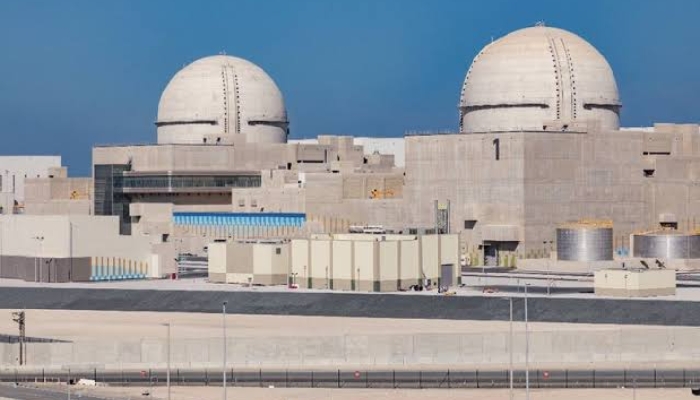
Dubai, Aug 2: The United Arab Emirates (UAE) announced on Saturday that it has started operations in the first of four reactors at the Barakah nuclear power station - the first nuclear power plant in the Arab world.

Emirates Nuclear Energy Corporation (ENEC), which is building and operating the plant with Korea Electric Power Corporation (KEPCO) said in a press release that its subsidiary Nawah Energy Company "has successfully started up Unit 1 of the Barakah Nuclear Energy Plant, located in the Al Dhafrah Region of Abu Dhabi".

That signals that Unit 1, which had fuel rods loaded in March, has achieved "criticality" - a sustained fission chain reaction.

"The start-up of Unit 1 marks the first time that the reactor safely produces heat, which is used to create steam, turning a turbine to generate electricity," said ENEC.

Barakah, which was originally scheduled to open in 2017, has been dogged by delays and is billions of dollars over budget. It has also raised myriad concerns among nuclear energy veterans who are concerned about the potential risks Barakah could visit upon the Arabian Peninsula, from an environmental catastrophe to a nuclear arms race.

Paul Dorfman, an honorary senior research fellow at the Energy Institute, University College London and founder and chair of the Nuclear Consulting Group, has criticised the Barakah reactors' "cheap and cheerful" design that he says cuts corners on safety.

Dorfman authored a report (PDF) last year detailing key safety features Barakah's reactors lack, such as a "core catcher" to literally stop the core of a reactor from breaching the containment building in the event of a meltdown. The reactors are also missing so-called Generation III Defence-In-Depth reinforcements to the containment building to shield against a radiological release resulting from a missile or fighter jet attack.

Both of these engineering features are standard on new reactors built in Europe, says Dorfman.

There have been at least 13 aerial attacks on nuclear facilities in the Middle East - more than any other region on earth.

The vulnerability of critical infrastructure in the Arabian Peninsula was further laid bare last year after Saudi Arabia's oil facilities at Abqaiq and Khurais were attacked by 18 drones and seven cruise missiles - an assault that temporarily knocked out more than half of the kingdom's oil production.

On Saturday, Dorfman reiterated his concern that there is no regional protocol in place to determine liability should an accident or incident at Barakah result in radioactive contamination spreading from the UAE to its neighbours. 

"Given Barakah has started up, because of all the well-rehearsed nuclear safety and security problems, it may be critically important that the Gulf states collectively evolve a Nuclear Accident Liability Convention, so that if anything does go wrong, victim states may have some sort of redress," Dorfman told Al Jazeera. 

The UAE has substantial oil and gas reserves, but it has made huge investments in developing alternative energy sources, including nuclear and solar.

Experts though have questioned why the UAE - which is bathed in sunlight and wind - has pushed ahead with nuclear energy - a far more expensive and riskier option than renewable energy sources.

When the UAE first announced Barakah in 2009, nuclear power was cheaper than solar and wind. But by 2012 - when the Emirates started breaking ground to build the reactors - solar and wind costs had plummeted dramatically.

Between 2009 and 2019, utility-scale average solar photovoltaic costs fell 89 percent and wind fell 43 percent, while nuclear jumped 26 percent, according to an analysis by the financial advisory and asset manager Lazard.

There are also concerns about the potential for Barakah to foment nuclear proliferation in the Middle East - a region rife with geopolitical fault lines and well-documented history of nuclear secrecy.

The UAE has sought to distance itself from the region's bad behaviour by agreeing not to enrich its own uranium or reprocess spent fuel. It has also signed up to the United Nation's nuclear watchdog's Additional Protocol, significantly enhancing inspection capabilities, and secured a 123 Agreement with the United States that allows bilateral civilian nuclear cooperation.

Comments

Add new comment

  • Coastaldigest.com reserves the right to delete or block any comments.
  • Coastaldigset.com is not responsible for its readers’ comments.
  • Comments that are abusive, incendiary or irrelevant are strictly prohibited.
  • Please use a genuine email ID and provide your name to avoid reject.
News Network
May 1,2020

Dubai, May 1: Saudi Arabia has reported 1,344 new coronavirus cases in the last 24 hours, bringing the total number of infections in the country to 24,097, the Ministry of Health announced on Friday.

The ministry also announced 7 more deaths and 392 new recoveries, raising the total number of fatalities and recoveries to 169 and 3,55 respectively.

Out of the 1,344 new cases reported today, 282 were confirmed in Riyadh, 237 in Madinah, 207 in Makkah, 171 in Jubail and 124 in Jeddah in addition to 114 infections in Dammam.

Authorities continue to urge people to stay at home unless necessary despite having relaxed some restrictions and curfews at the start of Ramadan.

Citizens and residents are allowed to go out for necessary needs between 9 a.m. and 5 p.m. but must adhere to precautionary measures such as wearing a face mask and maintaining social distancing practices.

Comments

Add new comment

  • Coastaldigest.com reserves the right to delete or block any comments.
  • Coastaldigset.com is not responsible for its readers’ comments.
  • Comments that are abusive, incendiary or irrelevant are strictly prohibited.
  • Please use a genuine email ID and provide your name to avoid reject.
Agencies
July 28,2020

Dubai, Jul 28: Abu Dhabi Commercial Bank (ADCB) (ADCB.AD) is letting go hundreds of employees, sources said, the latest in a round of lay-offs by regional banks as pressure mounts to cut costs amid lower oil prices and the coronavirus crisis.

The UAE’s third-biggest lender is laying off 400 employees, two sources familiar with the matter said, after it had committed to not cutting staff because of the crisis.

In a statement, a spokesman said ADCB had pursued efficiency over the last decade by managing out its lowest underachievers after regular reviews, while ensuring talent was deployed in high-growth areas, such as digital banking.

“A certain number of redundancies are therefore expected every year in the normal course of business,” the bank spokesman added.

The sources said the cuts would involve ADCB’s consumer business and several in top management were among those being let go. One source said the bank was looking to close 20 branches.

In March, ADCB had declared, “No employee will be made redundant during 2020 as a result of the COVID-19 pandemic.”

UAE banks have been hit by government measures to rein in the spread of the virus, forcing many businesses to shut temporarily.

Last week, Dubai’s largest bank, Emirates NBD, reported a slump of 58% in profits. In June, sources told Reuters the bank started a new round of hundreds of lay-offs.

In May, ADCB reported a fall of 84% in first-quarter net profit as it took impairments of $292 million on debt exposure to troubled hospital operator NMC Health and payments group Finablr.

It was a major lender, with an exposure of about $981 million, to NMC Health, which went into administration this year after months of turmoil following questions over financial reporting.

Comments

Add new comment

  • Coastaldigest.com reserves the right to delete or block any comments.
  • Coastaldigset.com is not responsible for its readers’ comments.
  • Comments that are abusive, incendiary or irrelevant are strictly prohibited.
  • Please use a genuine email ID and provide your name to avoid reject.