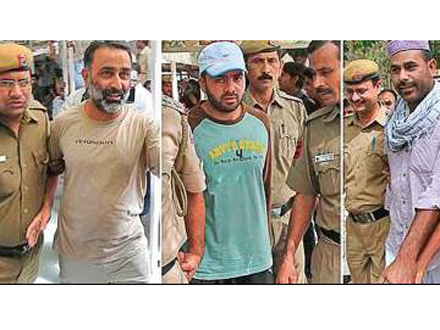
Acquitted man's mother narrates ordeal

[email protected] (Greaterkashmir.com)
November 23, 2012

kash

In a corner of a dimly-lit room, Padsha Begum, 65—whose son was Thursday acquitted after 17 years by Delhi High Court in the 1996 Lajpat Nagar blast case—is on a prayer mat with both joy and sorrow reflecting on her face. Her daughter Nighat is reciting some verses from the holy Qur'an loudly.

The acquittal of Begum's son Mirza Nissar Hussian has infused a new lease of life to this Srinagar family that has been living in deep distress for the past 17 years.

Begum says she offered special thanksgiving prayer after hearing about Hussain's acquittal. And so did Nighat.

On Thursday Delhi High Court acquitted two convicts who were given death penalty in the 1996 Lajpat Nagar Market bomb blasts. Mirza Nissar Hussain is one among them.

“Thanks to Almighty Allah. My son will be home after 17 years. Truth has ultimately prevailed,” Begum says. “His acquittal has proven that he was not guilty of what he was framed for. How can an 8th standard student carry out a blast and kill people? We will see our innocent son after 17 years for no fault of his.”

Hussain's sister says, “My another brother Iftikhar, who was also arrested in 1996 in connection with the blasts, was released after 14 years in 2010. By then our family had literally collapsed. While our father had already passed away, two of my brothers were put in jail for no fault. We will see the face of another brother after 17 years. It has been a very tough time.”

Nighat says the family has nothing to celebrate as of now as “Nissar is being implicated in some other case relating to Jaipur blasts.” “What kind of justice is this?” she asks. “If my brother was proven innocent in a case for which he spent 17 years in jail, it is paranoia that they are implicating him in some other case.”

Comments

Add new comment

  • Coastaldigest.com reserves the right to delete or block any comments.
  • Coastaldigset.com is not responsible for its readers’ comments.
  • Comments that are abusive, incendiary or irrelevant are strictly prohibited.
  • Please use a genuine email ID and provide your name to avoid reject.
Agencies
June 8,2020

Washington DC, Jun 8: Astronomers acting on a hunch have likely resolved a mystery about young, still-forming stars and regions rich in organic molecules closely surrounding some of them.

They used the National Science Foundation's Karl G Jansky Very Large Array (VLA) to reveal one such region that previously had eluded detection and that revelation answered a longstanding question.

The regions around the young protostars contain complex organic molecules which can further combine into prebiotic molecules that are the first steps on the road to life.

The regions, dubbed "hot corinos" by astronomers, are typically about the size of our solar system and are much warmer than their surroundings, though still quite cold by terrestrial standards.

The first hot corino was discovered in 2003 and only about a dozen have been found so far. Most of these are in binary systems, with two protostars forming simultaneously.

Astronomers have been puzzled by the fact that, in some of these binary systems, they found evidence for a hot corino around one of the protostars but not the other.

"Since the two stars are forming from the same molecular cloud and at the same time, it seemed strange that one would be surrounded by a dense region of complex organic molecules and the other wouldn't," said Cecilia Ceccarelli, of the Institute for Planetary Sciences and Astrophysics at the University of Grenoble (IPAG) in France.

The complex organic molecules were found by detecting specific radio frequencies, called spectral lines, emitted by the molecules. Those characteristic radio frequencies serve as "fingerprints" to identify the chemicals.

The astronomers noted that all the chemicals found in hot corinos had been found by detecting these "fingerprints" at radio frequencies corresponding to wavelengths of only a few millimetres.

"We know that dust blocks those wavelengths, so we decided to look for evidence of these chemicals at longer wavelengths that can easily pass through dust," said Claire Chandler of the National Radio Astronomy Observatory, and principal investigator on the project.

"It struck us that dust might be what was preventing us from detecting the molecules in one of the twin protostars," added Chandler.

The astronomers used the VLA to observe a pair of protostars called IRAS 4A, in a star-forming region about 1,000 light-years from Earth. They observed the pair at wavelengths of centimetres.

At those wavelengths, they sought radio emissions from methanol, CH3OH (wood alcohol, not for drinking). This was a pair in which one protostar clearly had a hot corino and the other did not, as seen using the much shorter wavelengths.

The result confirmed their hunch. "With the VLA, both protostars showed strong evidence of methanol surrounding them. This means that both protostars have hot corinos. The reason we did not see the one at shorter wavelengths was because of dust," said Marta de Simone, a graduate student at IPAG who led the data analysis for this object.

The astronomers cautioned that while both hot corinos now are known to contain methanol, there still may be some chemical differences between them. That, they said, can be settled by looking for other molecules at wavelengths not obscured by dust.

"This result tells us that using centimetre radio wavelengths is necessary to properly study hot corinos," Claudio Codella of Arcetri Astrophysical Observatory in Florence, Italy, said.

"In the future, planned new telescopes such as the next-generation VLA and SKA, will be very important to understanding these objects," added Codella.


Comments

Add new comment

  • Coastaldigest.com reserves the right to delete or block any comments.
  • Coastaldigset.com is not responsible for its readers’ comments.
  • Comments that are abusive, incendiary or irrelevant are strictly prohibited.
  • Please use a genuine email ID and provide your name to avoid reject.
Agencies
June 7,2020

New Delhi, Jun 7: The Government of India (GoI) must strengthen the laws to protect animals, said People for the Ethical Treatment of Animals (PETA) India CEO Dr Manilal Valliyate on Sunday, following an elephant's death in Kerala and cow injured due to ingestion of explosives in Himachal Pradesh.

"Such incidents are not just restricted to certain regions but are happening all across the country. PETA receives more than 100 similar cases every day. People send in their complaints to us, not just for cows and elephants but for so many other animals as well," he said.

The PETA chief urged the GoI to strengthen the laws established to protect animals.

"As per the current laws set out against animal cruelty, the perpetrator would only be charged Rs 50,000 as a fine. That is equivalent to no punishment at all," added PETA India CEO.

He expressed his anguish against municipal agencies as well, saying that they are not doing "serious" work. He also highlighted how cows are left on the roads to wander, after milking them, to feed on garbage, in several parts of the country.

"These injustices against animals through explosives has been going on for quite a while. But for the first time, it has received such public attention," he said.

After a pregnant elephant was fed cracker-filled pineapple and her eventual death on May 27 in Kerala's Palakkad district, a pregnant cow sustained fatal injuries on May 25 due to accidental ingestion of explosives in Dadh village of Bilaspur district of Himachal Pradesh.

One person has been arrested in the Dadh village for allegedly hurting the cow.

Comments

Add new comment

  • Coastaldigest.com reserves the right to delete or block any comments.
  • Coastaldigset.com is not responsible for its readers’ comments.
  • Comments that are abusive, incendiary or irrelevant are strictly prohibited.
  • Please use a genuine email ID and provide your name to avoid reject.
Agencies
May 19,2020

Cybersecurity researchers on Monday warned of a Trojan malware campaign which is targeting India's co-operative banks using COVID-19 as a bait.

Seqrite, the enterprise arm of IT security firm Quick Heal Technologies, detected the new wave of Adwind Java Remote Access Trojan (RAT) campaign.

Researchers at Seqrite warned that if attackers are successful, they can take over the victim's device to steal sensitive data like SWIFT logins and customer details and move laterally to launch large scale cyberattacks and financial frauds.

According to the researchers, the Java RAT campaign starts with a spear-phishing email which claims to have originated from either the Reserve Bank of India or a nationalised bank.

The content of the email refers to COVID-19 guidelines or a financial transaction, with detailed information in an attachment, which is a zip file containing a JAR based malware.

Upon further investigation, researchers at Seqrite found that the JAR based malware is a Remote Access Trojan that can run on any machine which has Java runtime enabled and hence it can impact a variety of endpoints, irrespective of their base operating system.

Once the RAT is installed, the attacker can take over the victim's device, send commands from a remote machine, and spread laterally in the network.

In addition, this malware can also log keystrokes, capture screenshots, download additional payloads, and extract sensitive user information, Seqrite said, adding that such attack campaigns can effectively jeopardise the privacy and security of sensitive data at the co-operative banks and result in large scale attacks and financial frauds.

To prevent such attacks, users need to exercise ample caution and avoid opening attachments and clicking on web links in unsolicited emails.

Banks should also keep their operating systems updated and have a full-fledged security solution installed on all the devices, Seqrite advised.

Comments

Add new comment

  • Coastaldigest.com reserves the right to delete or block any comments.
  • Coastaldigset.com is not responsible for its readers’ comments.
  • Comments that are abusive, incendiary or irrelevant are strictly prohibited.
  • Please use a genuine email ID and provide your name to avoid reject.