



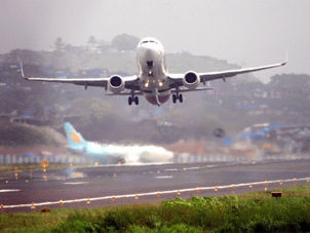
Jet Airways enters into code share agreements with Air France, KLM

June 18, 2013

Jet_AirwaysNew Delhi, Jun 18: Jet Airways and European carriers Air France and Royal Dutch Airlines (KLM) have entered into a code share agreement to provide seamless connectivity to passengers for destinations in India and Europe.

As per the agreement, Air France (AF) and KLM can place their own codes (AF) and (KL) on Jet Airways domestic flights for providing connectivity to three major Indian cities beyond South Indian city of Bengaluru, Delhi and Mumbai.

Code share is a commercial agreement between two or more airlines that share the same flight, with all the partnering airlines able to sell seats on that particular flight.

"Customers travelling from Europe to India on Air France flights will now be able to connect seamlessly with one ticket to Chennai via Bengaluru, Delhi and Mumbai, and to Kolkata, Hyderabad via Mumbai and Bengaluru.

"Likewise, KLM would place its marketing code (KL) on Jet's domestic flights to four major cities in India beyond Delhi, allowing passengers travelling from Europe to India to connect seamlessly to South Indian cities of Bengaluru, Chennai, Hyderabad and Western Coastal Indian city of Mumbai via Delhi," a joint statement issued by Jet and AF-KLM said.

The tickets are open for sale from Monday for passengers wanting to travel from June 19.

"We are delighted with this enhancement in our relationship with both Air France and KLM...The code share arrangements will allow our guests the convenience of enhanced connectivity from across Air France and KLM's networks via their European gateways in Paris and Amsterdam to key destinations throughout India," Chief Commercial Officer of Jet Airways, Sudheer Raghavan said.

Referring to the agreement, Dominique Patry, Air France's Vice-President, International Affairs and Alliances, said, "we are strengthening our presence in a key market following the code sharing agreement with Jet Airways."

Pieter Elbers, MD and Chief Operating Officer of KLM, said KLM is pleased with this important step in expanding the cooperation between Jet Airways and KLM.

"Being able to serve our customers an expanded network in India with four important domestic code share destinations is considered as key strategic value to our company," he said.

Air France-KLM have 27 weekly long-haul flights between Europe and India, while Jet Airways operates to 72 places in India and abroad including Abu Dhabi, Bahrain, Bangkok, Brussels, Dubai, Hong Kong, Jeddah, London, New York (Newark), Singapore and Toronto.

Comments

Add new comment

  • Coastaldigest.com reserves the right to delete or block any comments.
  • Coastaldigset.com is not responsible for its readers’ comments.
  • Comments that are abusive, incendiary or irrelevant are strictly prohibited.
  • Please use a genuine email ID and provide your name to avoid reject.
Agencies
February 26,2020

New Delhi, Feb 26: With the government pushing for the disinvestment of Air India, industrial conglomerate Adani Group may emerge as one of the bidders for the debt-laden national carrier, sources said.

According to highly placed sources, the Group has held internal rounds of deliberations on whether or not to submit an Expression of Interest (EoI) and the discussions are still in the preliminary stage.

If the company actually submits an EoI, it would be a major move towards further diversification of the company which has business interests across sectors right from edible oil, food to mining and minerals. 

It also entered into airport operations and maintenance business and won bids for privatisation of six airports, Ahmedabad, Lucknow, Jaipur, Guwahati, Thiruvananthapuram and Mangaluru in 2019. 

On being contacted by IANS, the company did not comment on the matter.

Air India is one of the most important divestment proposals for the current fiscal to reach the huge Rs 2.1 lakh crore target.

The government in January restarted the divestment process of the airline and invited bids for selling 100 per cent of its equity in the state-owned airline, including Air India's 100 per cent shareholding in AI Express Ltd. and 50 per cent in Air India SATS Airport Services Private Ltd.

After its unsuccessful bid to sell Air India in 2018, the government this time has decided to offload its entire stake. In 2018, it had offered to sell its 76 per cent stake in the airline.

Of the total debt of Rs 60,074 crore as of March 31, 2019, the buyer would be required to absorb Rs 23,286 crore.

Air India, along with its subsidiary Air India Express, has a total operational fleet of 146 aeroplanes.

Further, the disinvestment department has extended the last date for submission of written queries on the Performance Information Memorandum and Share Purchase Agreement to March 6.

The last date for submission of written queries on PIM and SPA was originally set for February 11, following which the Department of Investment and Public Asset Management (DIPAM) on February 21 issued 20 clarifications on the queries raised and expected.

Any delay in the tentatively rolled out timeline would also delay DIPAM's plan to identify the pre-qualified bidders by March 31 and the financial bids invitation as well. It is expected to take more than two months after the selection of the pre-qualified bidders to complete Air India's sale.

Comments

Add new comment

  • Coastaldigest.com reserves the right to delete or block any comments.
  • Coastaldigset.com is not responsible for its readers’ comments.
  • Comments that are abusive, incendiary or irrelevant are strictly prohibited.
  • Please use a genuine email ID and provide your name to avoid reject.
News Network
May 30,2020

May 30: Patients undergoing surgery after contracting the novel coronavirus are at an increased risk of postoperative death, according to a new study published in The Lancet journal which may lead to better treatment guidelines for COVID-19.

In the study, the scientists, including those from the University of Birmingham in the UK, examined data from 1,128 patients from 235 hospitals from a total of 24 countries.

Among COVID-19 patients who underwent surgery, they said the death rates approach those of the sickest patients admitted to intensive care after contracting the virus.

The scientists noted that SARS-CoV-2 infected patients who undergo surgery, experience substantially worse postoperative outcomes than would be expected for similar patients who do not have the infection.

According to the study, the 30-day mortality among these patients was nearly 24 per cent.

The researchers noted that mortality was disproportionately high across all subgroups, including those who underwent elective surgery (18.9 per cent), and emergency surgery (25.6 per cent).

Those who underwent minor surgery, such as appendicectomy or hernia repair (16.3 per cent), and major surgery such as hip surgery or for colon cancer also had higher mortality rates (26.9 per cent), the study said.

According to the study, the mortality rates were higher in men versus women, and in patients aged 70 years or over versus those aged under 70 years.

The scientists said in addition to age and sex, risk factors for postoperative death also included having severe pre-existing medical problems, undergoing cancer surgery, undergoing major procedures, and undergoing emergency surgery.

"We would normally expect mortality for patients having minor or elective surgery to be under 1 per cent, but our study suggests that in SARS-CoV-2 patients these mortality rates are much higher in both minor surgery (16.3%) and elective surgery (18.9%)," said study co-author Aneel Bhangu from the University of Birmingham.

Bhangu said these mortality rates are greater than those reported for even the highest-risk patients before the pandemic.

Citing an example from the 2019 UK National Emergency Laparotomy Audit report, he said the 30-day mortality was 16.9 per cent in the highest-risk patients.

Based on an earlier study across 58 countries, Bhangu said the 30-day mortality was 14.9 per cent in patients undergoing high-risk emergency surgery.

"We recommend that thresholds for surgery during the SARS-CoV-2 pandemic should be raised compared to normal practice," he said.

"For example, men aged 70 years and over undergoing emergency surgery are at particularly high risk of mortality, so these patients may benefit from their procedures being postponed," Bhangu added.

The study also noted that patients undergoing surgery are a vulnerable group at risk of SARS-CoV-2 exposure in hospital.

It noted that the patients may also be particularly susceptible to subsequent pulmonary complications, due to inflammatory and immunosuppressive responses to surgery and mechanical ventilation.

The scientists found that overall in the 30 days following surgery 51 per cent of patients developed a pneumonia, acute respiratory distress syndrome, or required unexpected ventilation.

Nearly 82 per cent of the patients who died had experienced pulmonary complications, the researchers said.

"Worldwide an estimated 28.4 million elective operations were cancelled due to disruption caused by COVID-19," said co-author Dmitri Nepogodiev from the University of Birmingham.

"Our data suggests that it was the right decision to postpone operations at a time when patients were at risk of being infected with SARS-CoV-2 in hospital," Nepogodiev said.

According to the researchers, there's now an urgent need for investment by governments and health providers in to measures which ensure that as surgery restarts patient safety is prioritised.

They said this includes the provision of adequate personal protective equipment (PPE), establishment of pathways for rapid preoperative SARS-CoV-2 testing, and consideration of the role of dedicated 'cold' surgical centres.

Comments

Add new comment

  • Coastaldigest.com reserves the right to delete or block any comments.
  • Coastaldigset.com is not responsible for its readers’ comments.
  • Comments that are abusive, incendiary or irrelevant are strictly prohibited.
  • Please use a genuine email ID and provide your name to avoid reject.
Agencies
June 29,2020

New Delhi, Jun 29: Witnessing azure skies and breathable air for the last three months, Delhi on Monday recorded deterioration in its air quality, with particulate matter with diameter of 2.5 and 10 microns -- too small to be filtered out of the human body -- standing at 52 and 297 micrograms per cubic respectively.

Gufran Beig, Project Director of System of Air Quality Weather Forecasting and Research (SAFAR), said that the sudden spike in air pollution is due to a mild dust storm blowing from Rajasthan.

"Since the wind direction is changing and moist air is coming in, the air quality in Delhi will become better by tomorrow," Beig told IANS.

Central Pollution Control Board (CPCB) data showed that the overall air quality near Delhi Technical University (DTU) area stood at 326 micrograms per cubic, followed by 308 at Narela and 307 at Mundka.

Out of 36 stations, the AQI in as many as 30 stations was above 200 micrograms per cubic till 1 pm on Monday.

The System of Air Quality Weather Forecasting and Research categorises air quality in the 0-50 range as good, 51-100 as satisfactory, 101-200 as moderate, 201-300 as poor, 301-400 as very poor, and above 400 as severe.

According to SAFAR's website, "PM 10 (coarser dust particle) is the lead pollutant. AQI is likely to improve to moderate category by tomorrow, and further improvement is expected by July 1."

Researchers indicated that PM 10 and PM 2.5 will be 170 and 47 micrograms per cubic on Tuesday.

With no vehicles plying on the roads or industries shut due to the lockdown since March 25, Delhi's air quality had improved drastically.

According to a study conducted by the Indian Institute of Technology (IIT), Delhi, if the low levels of air pollution reached during the lockdown period are maintained, India's annual death toll could reduce by 6.5 lakh.

Comments

Add new comment

  • Coastaldigest.com reserves the right to delete or block any comments.
  • Coastaldigset.com is not responsible for its readers’ comments.
  • Comments that are abusive, incendiary or irrelevant are strictly prohibited.
  • Please use a genuine email ID and provide your name to avoid reject.