Mother Teresa declared saint by Pope Francis

September 4, 2016

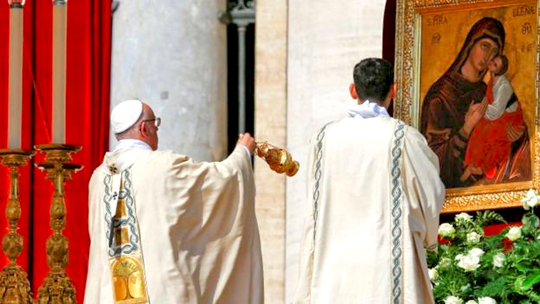
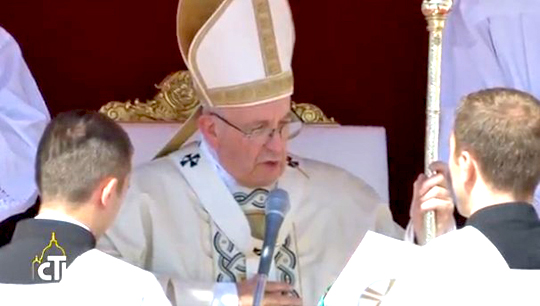
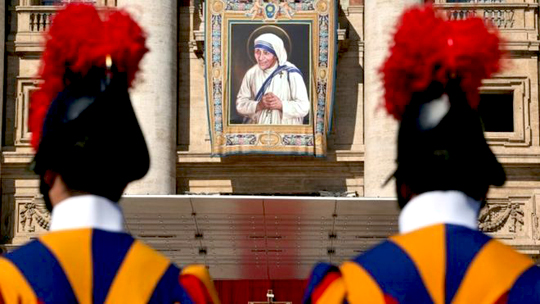
Vatican City, Sep 4: Pope Francis on Sunday declared revered nun Mother Teresa a saint in a canonization mass at St Peter's square.

"For the honour of the Blessed Trinity... we declare and define Blessed Teresa of Calcutta (Kolkata) to be a Saint and we enroll her among the Saints, decreeing that she is to be venerated as such by the whole Church," the pontiff said in Latin.
teresav 5

For Francis, Mother Teresa put into action his ideal of the church as a merciful "field hospital" for the poorest of the poor, those suffering both material and spiritual poverty.

The elevation of one of the icons of 20th Century Christianity came a day before the 19th anniversary of her death in Kolkata, where she spent nearly four decades working with the dying and the destitute.

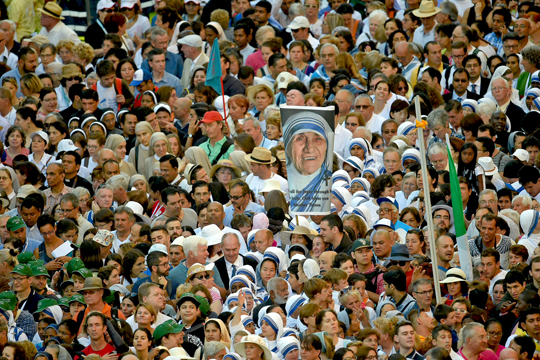
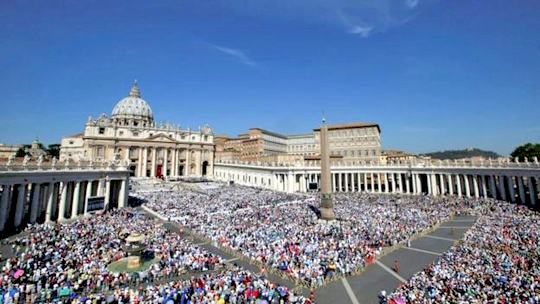
Tens of thousands of pilgrims — rich and poor, powerful and homeless — filled St. Peter's Square on Sunday for the canonization of Mother Teresa, the tiny nun who cared for the world's most destitute and became an icon of a Catholic Church that goes to the peripheries to find lost souls.

Throughout the night, pilgrims prayed at vigils in area churches and flocked before dawn to the Vatican to try to get a good spot for the Mass being celebrated under a searing hot sun and blue skies.

"Her heart, she gave it to the world," said Charlotte Samba, a 52-year-old mother of three who travelled with a church group from Gabon for the Mass. "Mercy, forgiveness, good works: It is the heart of a mother for the poor."

One group of 40 Indian nationals traveled from Macerata, Italy to honor a woman given India's highest civilian and humanitarian awards for her work in the slums of Kolkata. Another group of 100 drove from Kosovo toting a banner that read: "Mother Teresa: Pray for Us."

In addition, 13 heads of state and government led official delegations while 1,500 homeless people invited by Pope Francis had VIP seats and were going to be treated by the pope to a Neapolitan pizza lunch in the Vatican auditorium afterward.

While Francis is clearly keen to hold Mother Teresa up as a model for her joyful dedication to society's outcasts, he is also recognizing holiness in a nun who lived most of her adult life in spiritual agony sensing that God had abandoned her.

According to correspondence that came to light after she died in 1997, Mother Teresa experienced what the church calls a "dark night of the soul" — a period of spiritual doubt, despair and loneliness that many of the great mystics experienced. In Mother Teresa's case, it lasted for nearly 50 years — an almost unheard of trial.

For the Rev. Brian Kolodiejchuk, the Canadian priest who spearheaded Mother Teresa's saint-making campaign, the revelations were further confirmation of Mother Teresa's heroic saintliness. He said that by canonizing her, Francis is recognizing that Mother Teresa not only shared the material poverty of the poor but the spiritual poverty of those who feel "unloved, unwanted, uncared for."

"What she described as the greatest poverty in the world today (of feeling unloved) she herself was living in relationship with Jesus," he said in an interview on the eve of the canonization.

Francis has in many ways modeled his papacy on Mother Teresa's simple lifestyle and selfless service to the poor: He eschewed the Apostolic Palace for a hotel room, he has made welcoming migrants and the poor a hallmark and has fiercely denounced today's "throwaway" culture that discards the unborn, the sick and the elderly with ease.

Sunday's festivities honoring Mother Teresa weren't limited to Rome: In Kolkata, where Mother Teresa spent a lifetime dedicated to the poor, a special Sunday Mass was held at the order's Mother House. Volunteers and admirers converged on Mother House to watch the canonization ceremony, which was being broadcast on giant TV screens in Kolkata and elsewhere.

Sisters of Charity volunteers planned to distribute food to the poor nearby after the ceremony, and community meals were being served across Catholic parishes in India on Sunday — a symbolic reference to Mother Teresa's lifetime of service to humanity, said the Rev. Savarimuthu Sankar of the archdiocese of New Delhi.

"Let the example of Mother Teresa inspire all of us to dedicate ourselves to the welfare of mankind," said Indian President Pranab Mukherjee.

Ceremonies were also expected in Skopje, Macedonia, where Mother Teresa was born, and also in Albania and Kosovo, where people of her same ethnic Albanian background live.

Born Agnes Gonxhe Bojaxhiu on August 26, 1910, Mother Teresa came to India in 1929 as a sister of the Loreto order. In 1946, she received what she described as a "call within a call" to found a new order dedicated to caring for the most unloved and unwanted, the "poorest of the poor."
teresav 1

teresav 2

teresav 3

teresav 4

Comments

TRUE INDIAN
 - 
Sunday, 4 Sep 2016

Rss and sanghis exposed. Saint mother theresa and sita mata both used to wear hijab.

And hindus also put hijab on sita matas idols too.

MSS
 - 
Sunday, 4 Sep 2016

Recognizing sainthood is OK.

First of religion does not need innovation. Because the religion means to way of life as per the command of GOD(1 single God).

But why in the name of TRINITY, when there is only 1 God and none others have the capability of God. Jesus himself said, don't worship me. Then no question of duality of trinity. In trinity the other 2 for Christians are, Holy Spirirt and Jesus. Christians associated these 2 with the real God.
Both the 2 are most respected, but they don't at all equal to God.
Trinity is the invention of people, it is not by the God.

Therefore trinity does not deserve worship. They deserve definitely a worship. But one and only who deserve for worship is the God, who is the GOD for all religions.

Add new comment

  • Coastaldigest.com reserves the right to delete or block any comments.
  • Coastaldigset.com is not responsible for its readers’ comments.
  • Comments that are abusive, incendiary or irrelevant are strictly prohibited.
  • Please use a genuine email ID and provide your name to avoid reject.
Wafa Sultana
April 4,2020

Over the last couple of days when the world was occupied with unifying efforts to fight the deadly Covid19 pandemic, sections of Indian media provided viewers a familiar scapegoat – the Indian Muslims – who are often stereotyped as a community being constantly at loggerheads with the citizenry and the State. Biased media channels were quick to resort to blaming the entire Muslim community for the spread of the disease in the country, thanks to an ill-timed Tablighi Jamaat gathering at its international headquarters in Delhi’s Nizamuddin. Unsurprisingly, the opprobrium was also marked by a sudden spike in WhatsApp forwards of videos with people wearing skullcaps licking spoons and performing Sufi breathing rituals, suggesting some sort of wild conspiracy on the part of the community to spread the virus.  Some media channels were quick to formulate, hypothesize and provide loose definitions of a newly discovered form of Jihad i.e. ‘Corona Jihad ’ thereby vilifying the Islamic faith and its followers.

While the investigation on the culpability of the organizers of the Nizamuddin event is still ongoing, there is enough information to suggest that the meeting was held before any lockdown was in force, and the problem began when there was no way of getting people out once the curfew was announced. Be that as it may, there is little doubt that organizing a meet of such a scale when there is a global pandemic smacks of gross misjudgment, and definitely the organizers should be held accountable if laws or public orders were defied. Attendees who attempt to defy quarantine measures must be dealt with strictly. However, what is alarming is that the focus and narrative have now shifted from the unfortunate event at Nizamuddin to the Tablighi Jamaat itself.

For those not familiar with the Tablighi Jamaat, the organization was founded in 1926 in Mewat by scholar Maulana Mohammad Ilyas. The Jamaat’s main objective was to get Muslim youth to learn and practice pristine Islam shorn of external influences. This is achieved through individuals dedicating time for moral and spiritual upliftment secluded from the rest of the world for a brief period of time. There is no formal membership process. More senior and experienced participants typically travel from one mosque to other delivering talks on religious topics, inviting local youth to attend and then volunteer for a spiritual retreat for a fixed number of days to a mosque in a nearby town or village to present the message to their co-religionists. Contrary to ongoing Islamophobic rhetoric, the movement does not actively proselytize. The focus is rather on getting Muslims to learn the teachings and practices of Islam.  This grassroots India-based movement has now grown to almost all countries with substantial Muslim populations. Its annual meets, or ‘ijtemas’ are among the largest Islamic congregations in the world after the annual Haj. One of the reasons for its popularity and wide network in the subcontinent and wordwide is the fact that it has eschewed the need for scholarly intervention, focusing on peer learning of fundamental beliefs and practice rather than high-falutin ideological debates. The Tablighi Jamaat also distinguishes itself from other Islamic movements through its strictly apolitical nature, with a focus on individual self-improvement rather than political mobilization. Hardships and difficulty in the world are expected to be face through ‘sabr’ (patience) and ‘dua’ (supplication),  than through quest for political power or influence. In terms of ideology, it is very much based on mainstream Sunni Islamic principles derived from the Deobandi school.

So, why is all this background important in the current context? While biased media entities have expectedly brought out their Islamophobic paraphernalia out for full display, more neutral commentators have tried to paint the Tablighi Jamaat as a fringe group and have tried to distance it from 'mainstream Muslims'. While the intent is no doubt innocent, this is a trap we must not fall into. This narrative, unfortunately, is also gaining ground due to apathy some Muslims have for the group, accusing it of being “disconnected from the realities of the world”. Unlike other Muslim organizations and movements, the Tablighi Jamat, by virtue of its political indifference, does not boast of high-profile advocates and savvy spokespersons who can defend it in mainstream or social media.  The use of adjectives such as 'outdated' and 'orthodox' by liberal columnists to describe the Jamaat feeds into the malignant attempt to change the narrative from the control of the spread of the pandemic due to the Nizamuddin gathering to 'raison d'etre' of the organization itself.

A large mainstream religious group like the Tablighi Jamaat with nearly a hundred-year history, normally considered to be peaceful, apolitical and minding its own business is now suddenly being villainized owing to unfortunate circumstances. Biased media reactions filled with disgust and hate seem to feed the Indian public conscience with a danngerous misconception - to be a nominal Muslim is okay but being a practicing one is not.  For those committed to the truth and fighting the spread of Islamophobia, the temptation to throw the entire Tablighi Jamaat under the bus must be resisted.

The writer is a lawyer and research scholar at Qatar University. Her research interests include Islamic law and politics.

Comments

zahoorahmed
 - 
Saturday, 4 Apr 2020

great article! provides a great perspective on tableeg jamat

Add new comment

  • Coastaldigest.com reserves the right to delete or block any comments.
  • Coastaldigset.com is not responsible for its readers’ comments.
  • Comments that are abusive, incendiary or irrelevant are strictly prohibited.
  • Please use a genuine email ID and provide your name to avoid reject.
News Network
July 2,2020

Bengaluru, Jul 2: As many as 3,363 students from Covid-19 containment zones have appeared for SSLC examinations in different parts of Karnataka till yesterday. On the first day of exam, i.e., on June 25, only 998 students these zones had written the exam.

In the past few days the number of containment zones has increased across the state in general and Bengaluru in particular. In all, 32 students could not appear for the exam as they turned positive.

While on June 25, the number of students who were found unwell during the check up at exam centre was 201, it was 613 on Wednesday. Students who are sick and those from the containment zones take the exam in a different room.

The social science exam on Wednesday saw an attendance percentage of 97.96 (7.68 lakh). This was against 98.78% last year. There were 7.45 lakh fresh candidates, 20,000 private candidates and 593 from outside the state.

Five students in Yadgir district were given question papers based on the old syllabus for maths exam on June 27. Their answerscripts will be evaluated separately and action will be taken against the officials.

Malpractices assisted by schools by switching off CCTV cameras were reported in Ballari and Koppal. “We’ve completed all the core subjects. Now only languages are left. We’ll complete them too in a safe environment,” said S Suresh Kumar, primary and secondary education minister.

Comments

Add new comment

  • Coastaldigest.com reserves the right to delete or block any comments.
  • Coastaldigset.com is not responsible for its readers’ comments.
  • Comments that are abusive, incendiary or irrelevant are strictly prohibited.
  • Please use a genuine email ID and provide your name to avoid reject.
News Network
February 3,2020

New Delhi, Feb 3: Congress leader BK Hariprasad on Monday condemned BJP MP Anantkumar Hegde's remark on Mahatma Gandhi and termed him as "son" of Nathuram Godse, the assassin of the freedom fighter.

"Only sons of Nathuram Godse can make such comments on Mahatma Gandhi," Hariprasad said.

Hedge had attacked Mahatma Gandhi by calling the freedom struggle led by him a "drama" and also questioned as to how "such people" come to be called 'Mahatma' in India.

"None of these so-called leaders were beaten up by the cops even once. Their independence movement was one big drama. It was staged by these leaders with the approval of the British. It was not a genuine fight. It was an adjustment freedom struggle," he had said.

The Trinamool Congress also lent its support to Congress as its leader Saugata Roy said people like Anant Hegde cause shame to the nation. "We are a supporter of Gandhi and they (BJP) are Nathuram Godse supporters. People of this country should see how BJP MPs are as they insult father of the nation," he added.

BJP leaders too found it difficult to defend Hegde on the controversial remarks.

Senior leader Jagdambika pal was cautious in his defence and said, "The whole world knows about Gandhi and it may be his personal opinion."

Whereas senior BJP leaders avoid commenting on Hegde, Union Minister Ashwani Choubey said that Hegde should not have made the comment and added that Gandhi is a well-respected figure in the nation.

Another BJP MP from Haryana Sanjay Bhatia also tried to shy away from making a direct comment and instead said," Congress did not implement what Gandhi preached. It is Prime Minister Narendra Modi who implemented Gandhi's teachings in letter and spirit."

Comments

Add new comment

  • Coastaldigest.com reserves the right to delete or block any comments.
  • Coastaldigset.com is not responsible for its readers’ comments.
  • Comments that are abusive, incendiary or irrelevant are strictly prohibited.
  • Please use a genuine email ID and provide your name to avoid reject.