


No illegal tinted glass in cars from May 4: Supreme Court

April 28, 2012

Tint_Out

New Delhi, April 28: From May 4, if your car has black film on the front and rear windscreens that blocks light by more than 30% and the tint on the side window panes is more than 50%, then you could be in contempt of court in addition to being prosecuted as per the rules provided under the Motor Vehicles Act.

A bench of Chief Justice S H Kapadia and Justices A K Patnaik and Swatanter Kumar went by the limits prescribed in the MV Act and said anything beyond the visual light transmission (VLT) limit of 70% for the front and rear windshields and 50% for the side windows would be punishable.

The decision came on a PIL filed by Avishek Goenka, who had complained that cars with black film on window panes were being increasingly used for crimes, including sexual assault of women. He said though there was no express restraint on use of black film under the MV Act, it prescribed VLT limits.

Writing the judgment for the bench, Justice Kumar said, "On the plain reading of the rule, it is clear that cars must have safety glass having VLT at the time of manufacturing... In other words, the rule not impliedly but specifically prohibits alteration of such VLT by any means."

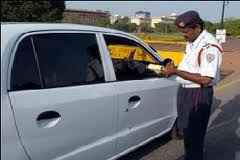
It's illegal, but tinted glass windows in cars in the city are a common sight. However, after the Supreme Court banned use of tinted glass beyond the permissible limit, such defaulters are going to have a tough time. Traffic police now intends to intensify the drive against use of tinted glass in vehicles.

There has been a traffic police drive against tinted car windows since last year. However, there has been a lull in the prosecutions this year, with only 9,279 such prosecutions till April 15 this year. Last year, for the same period, there had been as many as 30,582 prosecutions. Cops claim that better compliance has resulted in lower prosecutions.At present, car owners who are found not following the permitted percentage set for tinted glass have to either hand in their registration certificate or their driving licence along with the usual Rs 100 challan slapped on defaulters. "A notice is also issued to them by traffic police and the defaulter has to report to the area traffic inspector where the violation was recorded within 72 hours for inspection of the vehicle.

If the directions are not followed, the matter will be forwarded to the court," said joint commissioner of police (traffic) Satyendra Garg. As per the permissible limit there should be at least 70% transparency in the film on the front and rear windows while 50% transparency is required on the side windows."Usually, since the fine is just a meagre Rs 100, which is nothing compared to the money spent on films (ranging from Rs 700 to Rs 14,000 for the more fancy ones that protect from UV rays), it is not much of a deterrent to defaulters who continue to travel in the tinted vehicles. We hope that the stricter action will make the defaulters mindful of the rules," said a senior traffic police officer.Last year, as many as 45,649 vehicles with tinted glass were booked. "Significantly, a majority of these were repeat offenders, showing that despite being caught, Delhiites are mostly unmindful of the rules," said a senior traffic officer. This year, in a drive started on March 27, about 2,064 offenders have been booked till April 26.

Of them, 999 vehicle owners were made to remove the tinted film on the spot.The "Rules of Road Regulations, 1989" framed by the central government under Section 118 of the Motor Vehicles Act state that, "A driver of a motor vehicle and every other person using the road shall obey every direction given, whether by signal or otherwise, by a police officer or any authorized person for the time being in charge of the regulation of traffic." Under the rule, even a traffic constable has the power to issue notice to the defaulter, said traffic police. Tinted glass in vehicles has been a major source of concern for women's security as well as criminal activities. Delhi Police had earlier sent a proposal to the Union home ministry to amend the Motor Vehicles Act to enhance fines on use of tinted glass. The amendment is expected to increase the fine to a minimum of Rs 500. Tinted car windows have helped criminals especially in cases of rape and murder.

Comments

Add new comment

  • Coastaldigest.com reserves the right to delete or block any comments.
  • Coastaldigset.com is not responsible for its readers’ comments.
  • Comments that are abusive, incendiary or irrelevant are strictly prohibited.
  • Please use a genuine email ID and provide your name to avoid reject.
News Network
January 27,2020

Jehanabad, Jan 27: The police here carried out a raid at the ancestral house of anti-CAA activist Sharjeel Imam, who has been slapped with a sedition case in the national capital for alleged inflammatory speeches he gave at Shaheen Bagh and the Jamia Milia Islamia, a senior official said on Monday.

According to Superintendent of Police, Jehanabad, Manish Kumar, Imams house in Kako police station area was raided late on Sunday night following "help sought by central agencies" which are investigating the cases lodged against the JNU research scholar.

Imam was not found at his house but two of his relatives and their driver were detained for interrogation and let off thereafter, the SP said.

A graduate in computer science from IIT-Mumbai, Sharjeel Imam had shifted to Delhi for pursuing research at the Centre for Historical Studies, JNU.

He was slapped with a sedition case after his alleged speeches went viral on the social media wherein he was heard speaking about Assam's possible secession from the country in the wake of the Citienship (Amendment) Act (CAA).

Earlier, he had been booked on similar charges at a police station in Aligarh for a speech he delivered on the AMU campus.

Besides, a case under the stringent anti-terror law UAPA has been registered against him at Assam.

Imams late father Akbar Imam was a local JD(U) leader who had unsuccessfully contested an assembly election in his lifetime.

Reacting to the developments, his distraught mother Afshan Rahim told the media, "My son is innocent. He is a bright young man and not a thief or a pickpocket. I swear in the name of God that I do not know about his whereabouts. But I can guarantee that upon learning about the cases, he will appear before the investigating agencies and fully cooperate in the probe."

She said that it has been a long time since she met her son though she had a telephonic conversation with him a few weeks ago.

"He was obviously disturbed by the CAA and fears of the National Register of Citiznes (NRC) about being implemented across the country which, he said, would affect not just Muslims but all poor people," she said.

In fact, after 15 days of Shaheen Bagh protest, he had asked the agitators there to withdraw and watch the situation for a month, and then decide on the further course of action, she said. "But they refused to relent. He was calling for a 'chakkajam' (road blockade). He is just a kid and not capable of instigating people for secession," she added.

Comments

Add new comment

  • Coastaldigest.com reserves the right to delete or block any comments.
  • Coastaldigset.com is not responsible for its readers’ comments.
  • Comments that are abusive, incendiary or irrelevant are strictly prohibited.
  • Please use a genuine email ID and provide your name to avoid reject.
News Network
January 17,2020

New Delhi, Jan 17: Deputy Chief Minister Manish Sisodia does not have any car on his name, according to information shared in the poll affidavit filed by him for Delhi elections.

In the affidavit, it is also shown that while his self-acquired immovable property remained roughly the same as in 2015. His wife's self-acquired immovable property is worth roughly about Rs 65 lakh, as per his latest affidavit.

In the papers submitted during the nomination for 2015 Delhi polls, the senior AAP leader had declared that he owned a Maruti Swift car of make 2013.

However, in his 2020 affidavit, he has mentioned "nil" in the column for motor vehicles and other means of transport.

In the affidavit submitted on Thursday, his moveable assets were declared worth Rs 4,74,888 for 2018-19, as against Rs 4,92,624 for 2013-14.

In 2015, Sisodia had informed in his affidavit that he had bought a property in Vasundhara, Ghaziabad, worth Rs 5.07 lakh in April 2001. The approximate current market value of self-acquired property in 2015 was Rs 12 lakh.

In his current affidavit, the AAP leader has mentioned the same property. However, the approximate current market value of self-acquired property in 2020 has increased to Rs 21 lakh.

In his affidavit for the 2015 polls, Sisodia had also said that his wife had purchased a property in March 2008 costing Rs 8.70 lakh. At that time, the approximate value of her self-acquired property was Rs 20 lakh.

Comments

Add new comment

  • Coastaldigest.com reserves the right to delete or block any comments.
  • Coastaldigset.com is not responsible for its readers’ comments.
  • Comments that are abusive, incendiary or irrelevant are strictly prohibited.
  • Please use a genuine email ID and provide your name to avoid reject.
News Network
May 7,2020

May 7: India is projected to record the highest number of births in the 9 months since COVID-19 was declared a pandemic in March, with more than 20 million babies expected to be born in the country between March and December, according to top UN body.

The United Nations Children's Fund (UNICEF) warned that pregnant mothers and babies born during the pandemic across the world were threatened by strained health systems and disruptions in services.

An estimated 116 million babies will be born under the shadow of COVID-19 pandemic, UNICEF said on Wednesday, ahead of Mother's Day, observed on May 10.

These babies are projected to be born up to 40 weeks after COVID-19 was recognised as a pandemic on March 11.

The highest numbers of births in the 9 months since the pandemic was declared are expected to occur in India, where 20.1 million babies are projected to be born between March 11 and December 16. Other countries with the expected highest numbers of births during this period are China (13.5 million), Nigeria (6.4 million), Pakistan (5 million) and Indonesia (4 million), it said.

"Most of these countries had high neonatal mortality rates even before the pandemic and may see these levels increase with COVID-19 conditions," UNICEF said.

It is estimated that there will be 24.1 million births in India for the January-December 2020 period.

UNICEF warned that COVID-19 containment measures can disrupt life-saving health services such as childbirth care, putting millions of pregnant mothers and their babies at great risk.

Even wealthier countries are affected by this crisis. In the US, the sixth-highest country in terms of the expected number of births, over 3.3 million babies are projected to be born between March 11 and December 16.

"New mothers and newborns will be greeted by harsh realities," UNICEF said, adding they include global containment measures such as lockdowns and curfews; health centres overwhelmed with response efforts; supply and equipment shortages; and a lack of sufficient skilled birth attendants as health workers, including midwives, are redeployed to treat COVID-19 patients.

"Millions of mothers all over the world embarked on a journey of parenthood in the world as it was. They now must prepare to bring a life into the world as it has become – a world where expecting mothers are afraid to go to health centres for fear of getting infected, or missing out on emergency care due to strained health services and lockdowns," UNICEF Executive Director Henrietta Fore said.

"It is hard to imagine how much the coronavirus pandemic has recast motherhood" Fore said.

UNICEF said its analysis was based on data from World Population Prospects 2019 of the UN Population Division.

An average full-term pregnancy typically lasts a complete 9 months, or 39 to 40 weeks. For the purposes of this estimate, the number of births for a 40-week period in 2020 was calculated.

The 40-week period of March 11 to December 16 is used in this estimate based upon the WHO's March 11 assessment that COVID-19 can be characterised as a pandemic.

UNICEF warned that although evidence suggests that pregnant mothers are not more affected by COVID-19 than others, countries need to ensure they still have access to antenatal, delivery and postnatal services.

Similarly, sick newborns need emergency services as they are at high risk of death. New families require support to start breastfeeding, and to get medicines, vaccines and nutrition to keep their babies healthy, it said.

"This is a particularly poignant Mother's Day, as many families have been forced apart during the coronavirus pandemic, but it is also a time for unity, a time to bring everyone together in solidarity. We can help save lives by making sure that every pregnant mother receives the support she needs to give birth safely in the months to come," Fore said.

Issuing an urgent appeal to governments and health care providers to save lives in the coming months, UNICEF said efforts must be made to help pregnant women receive antenatal checkups, skilled delivery care, postnatal care services, and care related to COVID-19 as needed.

Ensure health workers are provided with the necessary personal protective equipment and get priority testing and vaccination once a COVID-19 vaccine becomes available so that can deliver high quality care to all pregnant women and newborn babies during the pandemic, it said.

While it is not yet known whether the virus is transmitted from a mother to her baby during pregnancy and delivery, UNICEF advised all pregnant women to follow precautions to protect themselves from exposure to the virus.

Closely monitor themselves for symptoms of COVID-19 and seek advice from the nearest designated facility if they have concerns or experience symptoms. Pregnant women should also take the same precautions to avoid COVID -19 infection as other people: practice physical distancing, avoid physical gatherings and use online health services, it said.

UNICEF said even before COVID-19 pandemic, an estimated 2.8 million pregnant women and newborns died every year, or 1 every 11 seconds, mostly of preventable causes.

The agency called for immediate investment in health workers with the right training, who are equipped with the right medicines to ensure every mother and newborn is cared for by a safe pair of hands to prevent and treat complications during pregnancy, delivery and birth.

Comments

Add new comment

  • Coastaldigest.com reserves the right to delete or block any comments.
  • Coastaldigset.com is not responsible for its readers’ comments.
  • Comments that are abusive, incendiary or irrelevant are strictly prohibited.
  • Please use a genuine email ID and provide your name to avoid reject.