



Standard and poor? SCs, STs in Kerala, Tamil Nadu better off than others

May 6, 2012
TH14_census_NET_jpg_950870f
New Delhi, May 6: New census data on asset ownership among different social groups has shown that a far higher proportion of scheduled castes and higher still of scheduled tribes do not own basic consumer durables like a phone or bicycle as compared to "others".

Three states however buck this trend; across caste groupings in Punjab, Kerala and Tamil Nadu, the rate of ownership of basic consumer durables is high. In fact, the asset ownership rate for scheduled castes in these three states is better than that of OBCs and upper castes in all other states.

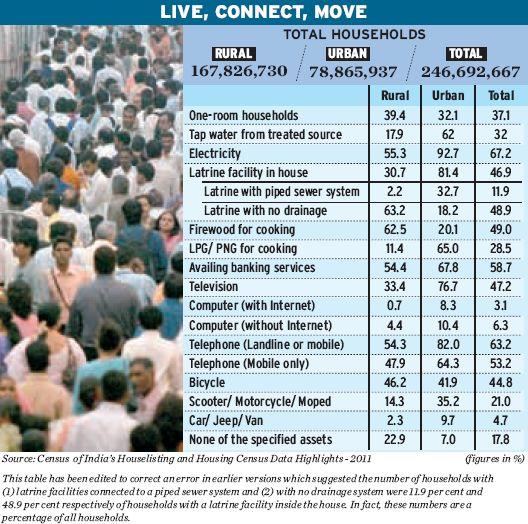
Newly released census 2011 data shows that while 17.8% of households across India do not own a phone, computer, TV, radio, bicycle or any vehicle, this proportion is 22.6% for scheduled castes, 37.3% for scheduled tribes and 14% for "others".

While more than half of "others" own a television, less than a quarter of scheduled tribes own a TV. Less than 2% of SC families own a TV, phone, computer and some mode of transportation, the usual signifiers of a "middle class" Indian family.

This new data fits in with the argument that economist and Indian Council of Social Science Research chairman Sukhadeo Thorat has been making. Thorat is critical of the view that economic liberalization has narrowed the gap between scheduled castes and others.

Yes, poverty is declining, but the rate of decline of poverty is much lower for the Scheduled Castes and Scheduled Tribes than for upper castes. There has undoubtedly been growth, but SCs and STs are not getting to participate equally in it," Thorat says.

There is considerable regional variation in the new census data.

Scheduled tribes are worst off in Madhya Pradesh, followed by in Rajasthan, Tripura and Maharashtra, where over 40% of STs do not own any basic consumer durable. Dalits are worst off in Bihar, Madhya Pradesh, Jharkhand and Orissa, where a third do not own any such asset. Unlike with the SCs, asset ownership for STs is worse than other social groups in all states.

While poverty among STs is fairly widespread across all states with a significant ST population, Kerala, Tamil Nadu and Punjab are the only states where the proportion of SCs who do not own basic assets is around 10% or lower, lowest of all in Tamil Nadu. Asset ownership among SCs in these three states is higher than that among "others" in all other states.

While part of the explanation for Tamil Nadu's status as the best state for dalit asset ownership might be that the previous state government ran a scheme giving free television sets to poor households, this is not the only explanation, as ownership of other consumer durables like phones and computers is also among the highest in TN. In comparison, in Bihar, where the state government ran a scheme to give all school-going girls a free cycle, less than half of all households own a bicycle.

Research by Institute of Applied Manpower Research director-general Santosh Mehrotra has shown that the human development indicators of SCs and OBCs in Kerala and Tamil Nadu are better than those of upper castes in Uttar Pradesh and Bihar. Moreover, all four states have a similar proportion of 'backward castes' in their population: so the key determinant of each of these states' human development situation is not its caste composition, but its politics and governance, Mehrotra says.

"A combination of social mobilization and good governance has lifted all boats in Kerala and Tamil Nadu," Mehrotra said. Social mobilization alone is not enough, Mehrotra adds, or the last twenty years in Uttar Pradesh would have led to tangible outcomes like improvement in health and nutrition, and not just intangibles like dignity and a sense of empowerment, as important as they are.

Comments

Add new comment

  • Coastaldigest.com reserves the right to delete or block any comments.
  • Coastaldigset.com is not responsible for its readers’ comments.
  • Comments that are abusive, incendiary or irrelevant are strictly prohibited.
  • Please use a genuine email ID and provide your name to avoid reject.
News Network
April 24,2020

Kozhikode, Apr 24: A four-month-old baby girl, who had tested positive for COVID-19 and suffering from congenital heart disease, died in a hospital here in Kerala early Friday after suffering a cardiac arrest, officials said.

This is the third COVID-19 death and the first infant fatality in the state where two elderly people had succumbed to the disease earlier.

The baby was admitted to the Medical College Hospital here on April 21 with history of fever, cough, breathing difficulties and seizure after being treated at two other hospitals and the end came at 6 am, a medical bulletin said.

State Health Minister K K Shailaja said doctors had made maximum efforts to save the life of the child, whose family belonged to Payyanad near Manjeri in Malappuram district.

"Preliminary information which we have is that there has been some primary contact", she told reporters in Thiruvananthapuram.

The protocol for COVID-19 cases would be followed for the baby's last rites, the Minister added.

As of Thursday, the total active COVID-19 cases in the state stood at 129.

The bulletin said on arrival at the hospital on Tuesday the baby was in shock and had respiratory failure.

"She was resuscitated, mechanically ventilated and appropriate antibiotics for pneumonia and supportive measures to correct shock were started", it said adding the baby, however, continued to remain sick.

"Even though there was no history of any high or low risk contact or any epidemiological links as the child comes from SARI (Sever Acute Respiratory infection) criteria, she was admitted to the COVID-ICU and swab was taken and she tested positive", the bulletin said.

Contact tracing of those who had come in contact with the child was in progress.

Mallapuram District Medical Officer (Health) Dr Sakeena K said the child was having severe health issues from its birth itself and was admitted to a private hospital in Manjeri near here with breathing problem.

As her condition worsened, the baby was shifted to another hospital and later to the medical college hospital.

"The baby was having chest deformity and Atrial Septal Defect by birth which developed into severe health issues, the official added.

Comments

Add new comment

  • Coastaldigest.com reserves the right to delete or block any comments.
  • Coastaldigset.com is not responsible for its readers’ comments.
  • Comments that are abusive, incendiary or irrelevant are strictly prohibited.
  • Please use a genuine email ID and provide your name to avoid reject.
Agencies
May 17,2020

New Delhi, May 17: Following the COVID-19-induced economic disruptions, up to 135 million jobs could be lost and 120 million people might be pushed back into poverty in India, all of which will have a hit on consumer income, spending and savings, says a report.

According to a new report by international management consulting firm Arthur D Little, the worst of COVID-19's impact will be felt by India's most vulnerable in terms of job loss, poverty increase and reduced per-capita income, which in turn will result in a steep decline in the Gross Domestic Product (GDP).

"Given the continued rise of COVID-19 cases, we believe that a W-shaped recovery is the most likely scenario for India. This implies a GDP contraction of 10.8 per cent in FY 2020-21 and GDP growth of 0.8 per cent in FY 2021-22," the report said.

India's COVID-19 tally has crossed 90,000 and the nationwide death toll has touched nearly 2,800 so far.

The report titled "India: Surmounting the economic challenges posed by COVID-19: A 10-point programme to revive and power India's post-COVID economy" said the 'collateral damage' of the forecasted GDP slowdown, will be felt most acutely in employment, poverty alleviation, per-capita income and overall nominal GDP.

"Unemployment may rise to 35 per cent from 7.6 per cent resulting in 136 million jobs lost and a total of 174 million unemployed. Poverty alleviation will receive a set-back, significantly changing the fortunes of many, putting 120 million people into poverty and 40 million into abject poverty," the report said.

"India is headed towards a W-shaped economic recovery with a potential GDP contraction of 10.8 per cent in FY21. An opportunity loss of USD 1 trillion is staring India in its face," said Barnik Chitran Maitra, lead author of the report and Managing Partner & CEO of Arthur D Little, India and South Asia.

Maitra further said "for its USD 5 trillion vision, a radical economic approach is needed, centred on an immediate stimulus and structural reforms. The Prime Minister's visionary 'Atma Nirbhar Bharat Abhiyan' is a good start to this new approach."

The report lauded the steps taken by the government and the Reserve Bank of India, but said a far more assertive approach may be required given the magnitude of the adverse economic output.

The report suggested a 10-point programme to accelerate the recovery which include strengthening the 'safety net' significantly for the most vulnerable, enable survival of small and medium businesses, restarting the rural economy and providing targeted assistance to at-risk sectors.

It further said the government should launch "Make in India 2.0" to capture global opportunities, build 'Modern India', accelerate Digital India and Innovation, strengthen global investment corridors with the US, UAE, Saudi Arabia, Japan and the UK, debottleneck land and labour and transform banking and financial markets in a bid to secure a sustainable economic future for 1.3 billion Indians. 

Comments

Add new comment

  • Coastaldigest.com reserves the right to delete or block any comments.
  • Coastaldigset.com is not responsible for its readers’ comments.
  • Comments that are abusive, incendiary or irrelevant are strictly prohibited.
  • Please use a genuine email ID and provide your name to avoid reject.
News Network
March 26,2020

Panaji, Mar 26: Three persons, all with travel history abroad, tested positive for coronavirus in Goa on Wednesday, health department officials said, as the tourist haven joined the states which have reported COVID-19 cases.

This is the first time the tourist state has reported coronavirus positive cases.

The Directorate of Health Services, in a late night press statement here, said three suspected cases of COVID-19 from Goa, whose test results were awaited, have turned out positive.

All three are male patients of ages 25, 29 and 55 years. They have travel history of returning to Goa from Spain, Australia and the USA, respectively, the officials said.

The condition of the trio, admitted in Goa Medical College and Hospital near here, is stable, the officials added.

Chief Minister Pramod Sawant said the state is providing the best healthcare facility to the diagnosed patients.

I have been informed by the state Directorate of Health services that three individuals have been tested positive for #COVID19 in Goa.

"We are providing the best healthcare facility to the diagnosed patients, he said.

Their condition is stable at present. e have also traced their contacts and are quarantining them, Sawant added.

Health Minister Vishwajit Rane said the government is taking all precautions and following guidelines related to the viral infection.

In view of the three positive coronavirus cases in Goa, we are following all guidelines laid down by the central government and taking all precautions with the support of chief minister Pramod Sawant, he said.

Our testing facility will be up and running in the next two days. Our team of doctors is doing its est to make sure we contain the spread of virus in the state, Rane added.

Comments

Add new comment

  • Coastaldigest.com reserves the right to delete or block any comments.
  • Coastaldigset.com is not responsible for its readers’ comments.
  • Comments that are abusive, incendiary or irrelevant are strictly prohibited.
  • Please use a genuine email ID and provide your name to avoid reject.