



Standard and poor? SCs, STs in Kerala, Tamil Nadu better off than others

May 6, 2012
TH14_census_NET_jpg_950870f
New Delhi, May 6: New census data on asset ownership among different social groups has shown that a far higher proportion of scheduled castes and higher still of scheduled tribes do not own basic consumer durables like a phone or bicycle as compared to "others".

Three states however buck this trend; across caste groupings in Punjab, Kerala and Tamil Nadu, the rate of ownership of basic consumer durables is high. In fact, the asset ownership rate for scheduled castes in these three states is better than that of OBCs and upper castes in all other states.

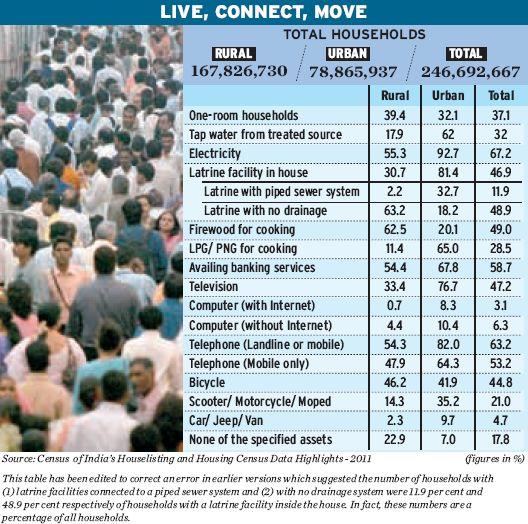
Newly released census 2011 data shows that while 17.8% of households across India do not own a phone, computer, TV, radio, bicycle or any vehicle, this proportion is 22.6% for scheduled castes, 37.3% for scheduled tribes and 14% for "others".

While more than half of "others" own a television, less than a quarter of scheduled tribes own a TV. Less than 2% of SC families own a TV, phone, computer and some mode of transportation, the usual signifiers of a "middle class" Indian family.

This new data fits in with the argument that economist and Indian Council of Social Science Research chairman Sukhadeo Thorat has been making. Thorat is critical of the view that economic liberalization has narrowed the gap between scheduled castes and others.

Yes, poverty is declining, but the rate of decline of poverty is much lower for the Scheduled Castes and Scheduled Tribes than for upper castes. There has undoubtedly been growth, but SCs and STs are not getting to participate equally in it," Thorat says.

There is considerable regional variation in the new census data.

Scheduled tribes are worst off in Madhya Pradesh, followed by in Rajasthan, Tripura and Maharashtra, where over 40% of STs do not own any basic consumer durable. Dalits are worst off in Bihar, Madhya Pradesh, Jharkhand and Orissa, where a third do not own any such asset. Unlike with the SCs, asset ownership for STs is worse than other social groups in all states.

While poverty among STs is fairly widespread across all states with a significant ST population, Kerala, Tamil Nadu and Punjab are the only states where the proportion of SCs who do not own basic assets is around 10% or lower, lowest of all in Tamil Nadu. Asset ownership among SCs in these three states is higher than that among "others" in all other states.

While part of the explanation for Tamil Nadu's status as the best state for dalit asset ownership might be that the previous state government ran a scheme giving free television sets to poor households, this is not the only explanation, as ownership of other consumer durables like phones and computers is also among the highest in TN. In comparison, in Bihar, where the state government ran a scheme to give all school-going girls a free cycle, less than half of all households own a bicycle.

Research by Institute of Applied Manpower Research director-general Santosh Mehrotra has shown that the human development indicators of SCs and OBCs in Kerala and Tamil Nadu are better than those of upper castes in Uttar Pradesh and Bihar. Moreover, all four states have a similar proportion of 'backward castes' in their population: so the key determinant of each of these states' human development situation is not its caste composition, but its politics and governance, Mehrotra says.

"A combination of social mobilization and good governance has lifted all boats in Kerala and Tamil Nadu," Mehrotra said. Social mobilization alone is not enough, Mehrotra adds, or the last twenty years in Uttar Pradesh would have led to tangible outcomes like improvement in health and nutrition, and not just intangibles like dignity and a sense of empowerment, as important as they are.

Comments

Add new comment

  • Coastaldigest.com reserves the right to delete or block any comments.
  • Coastaldigset.com is not responsible for its readers’ comments.
  • Comments that are abusive, incendiary or irrelevant are strictly prohibited.
  • Please use a genuine email ID and provide your name to avoid reject.
News Network
June 20,2020

New Delhi, Jun 20: The government-imposed upper and lower limits on airfares may be extended beyond August 24 depending upon how the situation turns out, Aviation Secretary P S Kharola said on Saturday.

The government resumed domestic passenger flights from May 25 after nearly two months of suspension to combat the coronavirus outbreak, but placed lower and upper limits on airfares depending upon the flight duration.

It had said on May 21 that these limits would be in place for a period of three months.

"Depending on how the situation turns out, the fare band may have to adjusted beyond that (August 24) also. But right now, it is only for three months," Kharola said at a press conference here.

International passenger flights continue to remain suspended in the country.

However, the government started Vande Bharat Mission on May 6 to help stranded people reach their destinations through special flights.

Aviation Minister Hardeep Singh Puri said at the conference that during phase 3 and phase 4 of the mission, private domestic airlines have been approved to operate 750 international flights to repatriate people stranded amid the coronavirus pandemic.

Comments

Add new comment

  • Coastaldigest.com reserves the right to delete or block any comments.
  • Coastaldigset.com is not responsible for its readers’ comments.
  • Comments that are abusive, incendiary or irrelevant are strictly prohibited.
  • Please use a genuine email ID and provide your name to avoid reject.
News Network
June 13,2020

Visakhapatnam, Jun 13: A four-month-old baby who was on ventilator treatment for 18 days for COVID-19 was on Friday evening discharged from hospital after testing negative.

"A tribal woman of East Godavari named Laxmi was infected with COVID-19 in May, later the doctors confirmed that her four-month-old baby was also infected," said District Collector, Vinay Chand.

"The baby was shifted to Visakhapatnam VIMS hospital on May 25. She was treated for 18 days on a ventilator. Doctors again conducted baby's COVID-19 test recently, following which the reports came negative. After a health check-up, VIMS doctors discharged the baby on Friday evening," he added.

Meanwhile, 14 new COVID-19 positive cases have been reported in Visakhapatnam district on Friday, taking the total number of cases to 252 including one fatality due to the virus.

Comments

Add new comment

  • Coastaldigest.com reserves the right to delete or block any comments.
  • Coastaldigset.com is not responsible for its readers’ comments.
  • Comments that are abusive, incendiary or irrelevant are strictly prohibited.
  • Please use a genuine email ID and provide your name to avoid reject.
News Network
June 26,2020

Jun 26: The Supreme Court on Friday permitted the Centre and the CBSE to cancel the remaining board examinations due to the COVID-19 pandemic and gave the go-ahead for the scheme to award marks to students for the cancelled papers scheduled to be held in July.

A bench of Justices A M Khanwilkar, Dinesh Maheshwari and Sanjiv Khanna permitted the CBSE to issue a notification for the cancellation of the examinations.

Solicitor General Tushar Mehta, appearing for the Centre and the CBSE, said that the assessment scheme would consider marks scored by students in the last three papers of the board exams.

Both CBSE and ICSE told the top court that the results of the class X and XII board exams can be declared by the middle of July.

The top court was hearing pleas seeking relief, including scrapping of remaining exams of Class 12 scheduled from July 1 to 15, in view of increasing number of COVID-19 cases. Similar relief was sought by the ICSE Board also.

Comments

Add new comment

  • Coastaldigest.com reserves the right to delete or block any comments.
  • Coastaldigset.com is not responsible for its readers’ comments.
  • Comments that are abusive, incendiary or irrelevant are strictly prohibited.
  • Please use a genuine email ID and provide your name to avoid reject.