


Standard and poor? SCs, STs in Kerala, Tamil Nadu better off than others

May 6, 2012
TH14_census_NET_jpg_950870f
New Delhi, May 6: New census data on asset ownership among different social groups has shown that a far higher proportion of scheduled castes and higher still of scheduled tribes do not own basic consumer durables like a phone or bicycle as compared to "others".

Three states however buck this trend; across caste groupings in Punjab, Kerala and Tamil Nadu, the rate of ownership of basic consumer durables is high. In fact, the asset ownership rate for scheduled castes in these three states is better than that of OBCs and upper castes in all other states.

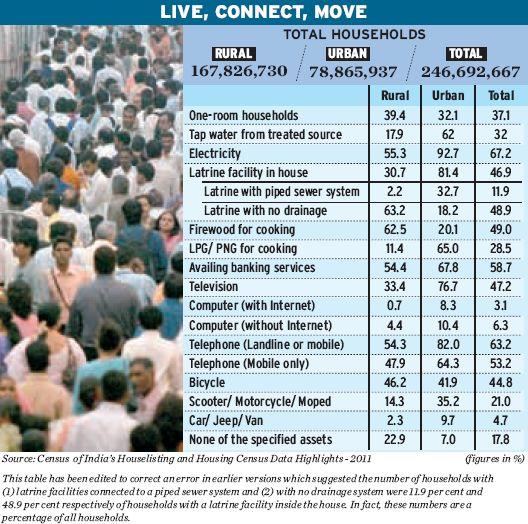
Newly released census 2011 data shows that while 17.8% of households across India do not own a phone, computer, TV, radio, bicycle or any vehicle, this proportion is 22.6% for scheduled castes, 37.3% for scheduled tribes and 14% for "others".

While more than half of "others" own a television, less than a quarter of scheduled tribes own a TV. Less than 2% of SC families own a TV, phone, computer and some mode of transportation, the usual signifiers of a "middle class" Indian family.

This new data fits in with the argument that economist and Indian Council of Social Science Research chairman Sukhadeo Thorat has been making. Thorat is critical of the view that economic liberalization has narrowed the gap between scheduled castes and others.

Yes, poverty is declining, but the rate of decline of poverty is much lower for the Scheduled Castes and Scheduled Tribes than for upper castes. There has undoubtedly been growth, but SCs and STs are not getting to participate equally in it," Thorat says.

There is considerable regional variation in the new census data.

Scheduled tribes are worst off in Madhya Pradesh, followed by in Rajasthan, Tripura and Maharashtra, where over 40% of STs do not own any basic consumer durable. Dalits are worst off in Bihar, Madhya Pradesh, Jharkhand and Orissa, where a third do not own any such asset. Unlike with the SCs, asset ownership for STs is worse than other social groups in all states.

While poverty among STs is fairly widespread across all states with a significant ST population, Kerala, Tamil Nadu and Punjab are the only states where the proportion of SCs who do not own basic assets is around 10% or lower, lowest of all in Tamil Nadu. Asset ownership among SCs in these three states is higher than that among "others" in all other states.

While part of the explanation for Tamil Nadu's status as the best state for dalit asset ownership might be that the previous state government ran a scheme giving free television sets to poor households, this is not the only explanation, as ownership of other consumer durables like phones and computers is also among the highest in TN. In comparison, in Bihar, where the state government ran a scheme to give all school-going girls a free cycle, less than half of all households own a bicycle.

Research by Institute of Applied Manpower Research director-general Santosh Mehrotra has shown that the human development indicators of SCs and OBCs in Kerala and Tamil Nadu are better than those of upper castes in Uttar Pradesh and Bihar. Moreover, all four states have a similar proportion of 'backward castes' in their population: so the key determinant of each of these states' human development situation is not its caste composition, but its politics and governance, Mehrotra says.

"A combination of social mobilization and good governance has lifted all boats in Kerala and Tamil Nadu," Mehrotra said. Social mobilization alone is not enough, Mehrotra adds, or the last twenty years in Uttar Pradesh would have led to tangible outcomes like improvement in health and nutrition, and not just intangibles like dignity and a sense of empowerment, as important as they are.

Comments

Add new comment

  • Coastaldigest.com reserves the right to delete or block any comments.
  • Coastaldigset.com is not responsible for its readers’ comments.
  • Comments that are abusive, incendiary or irrelevant are strictly prohibited.
  • Please use a genuine email ID and provide your name to avoid reject.
Agencies
March 25,2020

New Delhi, Mar 25: The Indian Rail Catering and Tourism Corporation (IRCTC) on Wednesday appealed to the people not to cancel their e-tickets on their own in case of trains being cancelled by the national transporter due to nation-wide lockdown to help curb the spread of novel coronavirus pandemic.

Clearing the doubts of the railway passengers, IRCTC spokesperson Siddharth Singh said, "Doubts have been raised regarding cancellation of e-tickets subsequent to the halting of railway passenger trains.

"It may be submitted that for trains cancelled by the railways in its complete run, refund on e-tickets is full and automatic. In this case, no cancellation exercise is required to be done on the part of the user," he said.

The IRCTC official said that if user cancels his e-ticket in situations of train cancellations, there are chances he may get "less refund". "Hence passengers are advised not to cancel e-tickets on their own for those trains which have been cancelled by the railways," he said.

He also said that the refund amount will be credited to the user account used for booking e-tickets automatically and no charges will be deducted by the railways in case of train cancellation.

His remarks came as the national transporter announced the suspension of the passenger, mail and express services from March 23 till March 31. However, the railways extended the suspension of services till April 14 in the wake of the three week lockdown announced by Prime Minister Narendra Modi from March 25 during his second special address to the nation on Tuesday night.

The railways has cancelled over 13,600 passengers trains across the country in a bid to combat the spread of novel coronavirus. Only freight trains are running to ensure the supply of essential services. About 9,000 freight trains are transporting essential items every day across the country.

On Wednesday, India recorded 562 cases of COVID-19 with 10 deaths.

Comments

Add new comment

  • Coastaldigest.com reserves the right to delete or block any comments.
  • Coastaldigset.com is not responsible for its readers’ comments.
  • Comments that are abusive, incendiary or irrelevant are strictly prohibited.
  • Please use a genuine email ID and provide your name to avoid reject.
Agencies
August 4,2020

New Delhi, Aug 4: Over 50 per cent of COVID-19 deaths in India have taken place among people aged 60 years and above and 37 per cent deaths have been reported among patients in the age group of 45 to 60 years, Health Ministry said on Tuesday.

Addressing a press conference, Rajesh Bhushan, Secretary, Health Ministry said that 11 per cent COVID-19 deaths took place in the age group of 26 to 44.

The 18 to 25 age group and those below 18 years reported one per cent deaths each.
"Currently, 5,86,298 active COVID-19 cases are in India and over 12 lakh people have recovered.

50 per cent deaths due to COVID19 have taken place among the age group of 60 years or above and 37 per cent deaths took place in the age group between 45 to 60 years," Bhushan said.

"A total of 11 per cent COVID-19 deaths took place in the age group of 26 to 44. Only 1 per cent in 18 to 25 age group and 1 per cent in below the age of 18 years," he added.

Bhushan said that 68 per cent of COVID-19 deaths have been reported among male patients and 32 per cent among female patients which is broadly in line with the global scenario.

The number of recovered COVID-19 patients in India is increasing daily and is now over double the number of active cases.

Bhushan said that the case fatality rate (CFR) is lowest since the first lockdown.

"More than 2 crore COVID-19 tests have been conducted, including more than 6.6 lakh tests in the last 24 hours. Recovered cases are now double of the active cases. 

The case fatality rate (CFR) is lowest since the first lockdown," he said
"This is the first time after the first lockdown that the fatality rate is at the lowest, at 2.10 per cent. The fatality rate has seen a progressive decline and it is continuing, which is a good sign," he added.

According to the World Health Organisation, CFR is a measure of the severity of a disease and is defined as the proportion of reported cases of a specified disease or condition which are fatal within a specified time.

Comments

Add new comment

  • Coastaldigest.com reserves the right to delete or block any comments.
  • Coastaldigset.com is not responsible for its readers’ comments.
  • Comments that are abusive, incendiary or irrelevant are strictly prohibited.
  • Please use a genuine email ID and provide your name to avoid reject.
News Network
March 9,2020

New Delhi, Mar 9: Petrol and diesel prices registered a drop across the country on Monday as global oil prices plummeted around 30 per cent after Saudi Arabia slashed prices and set plans for a dramatic increase in crude production in April.

In New Delhi, petrol price fell by 24 paise intra-day and stood at Rs 70.59 per litre. Diesel in the national capital was retailed at Rs 63.26 per litre on Monday as against Rs 63.51 on Sunday.

The retail price of petrol in Kolkata saw a drop of 23 paise to Rs 73.28 per litre. The diesel price fell by 25 paise in the eastern metropolitan city to retail at Rs 65.59 per litre.

In Mumbai, petrol price was Rs 76.29 per litre as against Rs 76.53 a day earlier. Diesel was retailed at Rs 66.24 per litre, 26 paise lower than on Sunday.

In Chennai, petrol was retailed at Rs 73.33 per litre, 25 paise lower than a day earlier. Diesel price saw a fall of 26 paise to retail at Rs 66.75 per litre in the southern metropolitan.

Global crude oil prices fell by as much as a third following Saudi Arabia's move to start a price war with Russia amid worries over the spread of coronavirus.

Brent crude futures were down 13.29 dollars or 29 per cent at 31.98 dollars a barrel by 04:33 hrs GMT after earlier dropping to 31.02 dollars, their lowest since February 12, 2016.

Brent futures were on track for their biggest daily decline since January 17, 1991 at the start of the first Gulf War.

Comments

Add new comment

  • Coastaldigest.com reserves the right to delete or block any comments.
  • Coastaldigset.com is not responsible for its readers’ comments.
  • Comments that are abusive, incendiary or irrelevant are strictly prohibited.
  • Please use a genuine email ID and provide your name to avoid reject.