



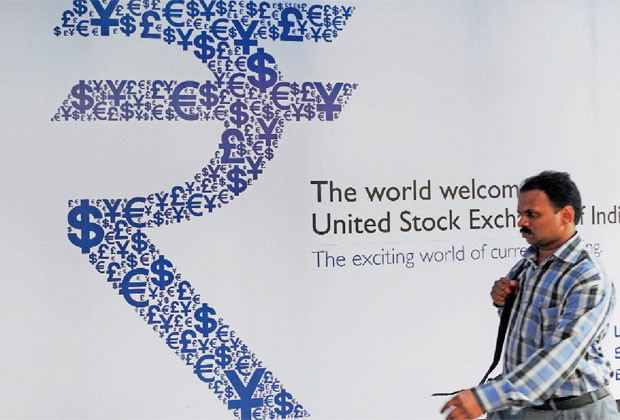
Indian rupee hits all-time low

May 17, 2012

indian_rupee

New Delhi, May 17: The Indian rupee plummeted to an all time low on Wednesday to 54.46 rupees to the dollar, or up to Rs14.81 to the dirham, breaching its previous record low of 54.39 struck on December 15.

Local money exchanges witnessed “higher than normal footfalls” as non residents rushed to remit money as the rupee’s value against the dollar-pegged UAE currency declined to over 20 per cent during the past 12 months.

The Reserve Bank of India said it was closely observing the rupee’s movement and will act if needed.

Although the immediate trigger for the rupee plunge was a sudden surge in demand for dollar amid deepening uncertainty over the eurozone debt crisis, analysts blamed it on India’s deteriorating macro-economic conditions, most importantly its twin financial setbacks — current account defcit and the fiscal deficit that are among the highest among emerging Asian economies.

“In the backdrop of the Greek crisis, fiscal deficit and policy paralysis, the currency looks weaker, and could remain so for few days to come, if not more,” said Y. Sudhir Kumar Shetty, chief operating officer, Global Operations, UAE Exchange. Remittances, especially big-ticket transactions, where people send money for investments or savings, are on the rise, which is a natural outcome of currency weakening, said Shetty.

“But blue collar remittances, which are usually sent for family maintenance, maintain a steady level irrespective of the currency movements, which is discernible now. Reserve Bank of India hasn’t taken any significant corrective measures, which indicates that the currency could weaken further,” he said.

Sajith Kumar P K, director and CEO of JRG International Brokerage, said the chances are high that the rupee touch 57 to 58 levels to the dollar in the medium- to long-term basis if the prevailing situation continues. Next support levels are 55.80, 57.80 and resistance levels are 54.40, 52.20.

Kumar said urgent action from policy makers are needed at this juncture to stop a further steep fall of the currency.

“While more steps are needed to restore the confidence level of foreign institutional investors, policy makers should initiate more avenues for foreign direct investments to strengthen the rupee,” he said.

Some analysts suggest that it was time that the rupee is allowed to depreciate and left to find its own level that could slow imports and help raise exports.

“The pressure on the rupee has been mostly due to inadequate dollar supplies to meet India’s rising import bill. About 20 per cent of it is to fund its crude oil imports. India’s weak fundamentals, aggravated by imprudent subsidies, are getting increasingly exposed at a time when unfriendly tax proposals keep at bay foreign investors,” one analyst said.

India government’s lack of determination to push ahead with policy reforms had been a further deterrent to foreign investments into the country, analysts said. “The need of the hour are sound fundamentals to attract capital inflows that are needed to fund the current-account shortfall,” they said.

Foreign portfolio investors have started going slow on investments into the country. In April, they pulled out close to $1 billion from the Indian markets. On the other hand, the country’s import bill has risen due to high crude and commodity prices amid a slower growth in exports.

According to ING Vysya Bank Ltd, India’s economic fundamentals are pressuring the currency more than global factors. The trade deficit swelled to a record $184.9 billion in the year ended March 31 and industrial output shrank 3.5 per cent in March from a year earlier, government figures showed this month. Standard & Poor’s cut the outlook on the nation’s BBB- sovereign debt rating to negative on April 25.

Comments

Add new comment

  • Coastaldigest.com reserves the right to delete or block any comments.
  • Coastaldigset.com is not responsible for its readers’ comments.
  • Comments that are abusive, incendiary or irrelevant are strictly prohibited.
  • Please use a genuine email ID and provide your name to avoid reject.
News Network
May 5,2020

New Delhi, May 5: India registered the biggest jump in numbers of COVID-19 cases and deaths, with 3,900 new cases and 195 deaths being reported in the last 24 hours, according to the Ministry of Health and Family Welfare on Tuesday.

"3,900 COVID-19 cases and 195 deaths have been reported in the last 24 hours, the largest spike till now in both," according to the Ministry of Health and Family Welfare.

The total number of confirmed coronavirus cases in India reached 46,433, including 1,568 deaths, according to the Union Ministry of Health and Family Welfare on Tuesday.

According to the latest update by the MoHFW, 12,727 patients in the country have been cured and discharged, or have migrated, as of today morning. At present, there are 32,138 active cases in the country.

Maharashtra with 14,541 cases is the worst-affected state by the disease, while Gujarat with 5,804 cases is second on the list.

Comments

Add new comment

  • Coastaldigest.com reserves the right to delete or block any comments.
  • Coastaldigset.com is not responsible for its readers’ comments.
  • Comments that are abusive, incendiary or irrelevant are strictly prohibited.
  • Please use a genuine email ID and provide your name to avoid reject.
News Network
March 6,2020

Mumbai, Mar 6: Harried Yes Bank depositors rushed to ATMs to withdraw cash but faced multitude of problems including closed down machines and long queues, after the RBI placed the bank under a moratorium, capping maximum withdrawals at Rs 50,000 per account for a month.

Aggravating the problems of depositors were difficulties accessing the internet banking channel, which ensured that they can't transfer the funds online as well. At an ATM in south Mumbai's Horniman Circle, with the RBI headquarters overlooking it, the shutters were pulled down.

The guard on duty said the machine was non-operational before he reported to work late in the evening and he was ordered to shut it after 2200 hrs. In the residential area of suburban Chembur, one ATM was dispensing cash but had a long queue of anxious depositors.

One man said it was still possible to withdraw up to Rs 50,000 in multiple transactions from the machine.

However, another machine nearby had run dry within minutes of the RBI announcement, a woman said.

The regulatory actions, undertaken by the RBI and the government, came hours after finance ministry sources confirmed that SBI was directed to bail out the troubled lender.

For the next month, Yes Bank will be led by the RBI-appointed administrator Prashant Kumar, an ex-chief financial officer of SBI.

Comments

Add new comment

  • Coastaldigest.com reserves the right to delete or block any comments.
  • Coastaldigset.com is not responsible for its readers’ comments.
  • Comments that are abusive, incendiary or irrelevant are strictly prohibited.
  • Please use a genuine email ID and provide your name to avoid reject.
News Network
February 19,2020

London, Feb 19: Indian universities had a good performance year within the emerging economies of the world as a record 11 made it to the top 100 Times Higher Education's (THE) Emerging Economies University Rankings 2020.

Only China has more universities than India in the top 100 at 30 from a total of 47 countries and territories included in the analysis released in London on Tuesday evening.

A total of 56 Indian universities appear in the full ranking of a total of 533 universities across emerging economies of the world.

The Indian Institute of Science (IISc), ranked 16th, is India’s top-ranked institution followed by the Indian Institute of Technologies (IITs).

"There has long been a debate about the success of Indian universities in world rankings, and for too long they have been seen as underperforming on the global stage," notes Phil Baty, Chief Knowledge Officer for the THE.

"The Emerging Economies University Rankings 2020 suggests that real progress is being made by a number of institutions in a number of metrics across our robust methodology, and could mark an exciting turning point for Indian higher education, enabled in part by the Institutes of Eminence scheme," he said.

The Indian government’s Institutes of Eminence scheme was established in 2017 and one of its participating universities, Amrita Vishwa Vidyapeetham, has entered the top 100 for the first time, moving up a huge 51 places from joint 141st in 2019.

The other universities included in the Institutes of Eminence scheme that appear in the top 100 mark the biggest improvers in the ranking with IIT Kharagpur moving up 23 places to 32nd, IIT Delhi improving by 28 places to joint 38th and IIT Madras climbing 12 places to joint 63rd.

The Institutes of Eminence scheme provides participating universities with government funding and greater autonomy with the aim of moving them into the top 100 of the world university rankings, including Times Higher Education’s World University Ranking, over time.

The expectation is that this will be achieved through a number of changes including an increase in foreign students and staff, offering online courses and encouraging academic collaboration with other top universities around the world.

This year marks only the second time that 11 Indian institutions have held top 100 positions since the ranking began in 2014, when much fewer universities took part in the ranking globally.

Comments

Add new comment

  • Coastaldigest.com reserves the right to delete or block any comments.
  • Coastaldigset.com is not responsible for its readers’ comments.
  • Comments that are abusive, incendiary or irrelevant are strictly prohibited.
  • Please use a genuine email ID and provide your name to avoid reject.