An Open Letter to Mamata Banerjee from the student she branded a 'Maoist'

May 20, 2012

taniya_mamata

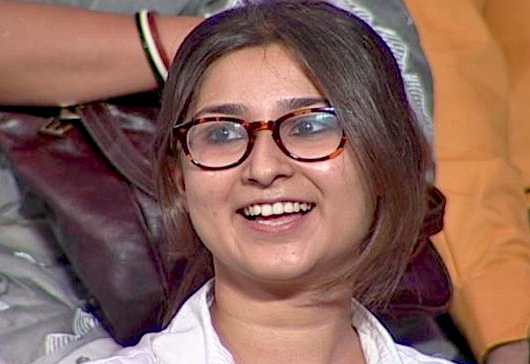
New Delhi, May 20: On Friday, West Bengal Chief Minister Mamata Banerjee called Presidency University student Taniya Bhardwaj a CPI(M) cadre and a Maoist for asking a question about the conduct of senior state ministers and officials over crimes against women.

The question was asked at an open house session with the Chief Minister, conducted by CNN-IBN to mark one year of the Trinamool Congress's coming to power in West Bengal.

An angry Banerjee castigated the audience for asking 'CPI(M) questions' and 'Maoist questions' and stormed out, refusing to participate further. Taniya Bhardwaj writes an open letter to Mamata Banerjee.

Dear 'Simple Man',

On being asked a simple question, you acquired a complicated avatar. We all went to the CNN-IBN question-answer session on Friday, May 18, at the Town Hall expecting to hear some heated exchanges, but it got too hot to handle.

You, the most important person in West Bengal, labelled me and the rest of the audience 'Maoist and CPM cadres'. What exactly did we do to deserve this honour? We asked you questions. I asked you whether affiliates of your party, specifically minister Madan Mitra and MP Arabul Islam, who wield power, should act, or should have acted, more responsibly.

Like many others, I was also greatly disturbed when Madan Mitra pronounced his own judgement on a rape victim before the police were done investigating. This woman, whose character was assassinated, is an Anglo-Indian, a member of the minority community. Thus, if we were to even forget about sensitivity, the question of political correctness still hangs over his conduct.

A few months ago, this very same man had misbehaved with policemen who had stopped his car on the Eastern Metropolitan Bypass as part of its routine. As for the Arabul Islam case, it is still making headlines.

I asked you something that had been on the minds of most people around me, people who voted for 'paribartan' (change). Is this what we expect of our leaders? The ones who set examples and whom people follow. This is all that I wanted to know. What I got to know, instead, is that in West Bengal, asking a question can be the equivalent of being a Maoist.

'Simple man', you claimed with pride on stage that you're not a feminist.

That proclamation did not surprise us, especially after the Katwa and Park Street cases. You also spoke of democracy. The answers you gave to the questions you took before mine were sprinkled with words like ‘people’, 'democracy', and 'Bengal'.

But one of the most important features of a true democracy, which I have learnt as a student of political science, is freedom of expression. This freedom is the one that allows an individual to express oneself, to not have to mince words out of fear of authority. It involves enjoying a chuckle or two at cartoon about important public figures.

Sadly, there seems to be a gradual failure in this aspect of the democratic machinery in the state. And just like I won’t become a Maoist simply because you called me one, the state too won’t epitomize democracy unless it is truly so in all spheres. All said and done, what you did was in haste and it made me the centre of attention. And as you stomped off in fury, you automatically assumed the role of the spoilsport.

It would have been so much more ‘simple’ had you just answered my question, or even said “No comments” and moved on. The question became so important because you chose to make it important.

You have spoken of 'brain drain' so many times. I hold offers from the University College, London and the School of Oriental and African Studies to study development and administration. I too will probably leave, and now you know the reason why. Had you stayed on, it would have been fun. And you would have honestly been 'a Chief Minister with a difference'. The role of your office as Chief Minister is to aggregate interest – you should at the least have heard us all out.

"Nearly all men can stand adversity, but if you want to test a man's character, give him power". So said Abraham Lincoln.

Love

A Simple Woman – Taniya Bhardwaj

Comments

Add new comment

  • Coastaldigest.com reserves the right to delete or block any comments.
  • Coastaldigset.com is not responsible for its readers’ comments.
  • Comments that are abusive, incendiary or irrelevant are strictly prohibited.
  • Please use a genuine email ID and provide your name to avoid reject.
News Network
January 18,2020

Jan 18: Days after the arrest of Deputy SP Davinder Singh along with two Hizbul Mujahideen terrorists, Shiv Sena on Saturday questioned the role of police in the Kashmir Valley.

"Cross border infiltration is ongoing in Kashmir. But the police machinery is being used to help the terrorists in Kashmir to safely cross the border (to Pakistan) and a President's medal awarded Deputy SP was arrested for doing so. In Kashmir (it seems), the government is using the police for some other purposes, what will the country's Home Ministry say if somebody has a doubt in connection with the Pulwama attacks," Sena mouthpiece, Saamna, read.

This was in reference to the incident in which Jammu and Kashmir police intercepted a vehicle on Sunday and arrested DySP Davinder Singh along with two top Hizbul Mujahideen terrorists, who were travelling together.

The Sena mouthpiece asserted that the impact and acceptance of the Centre removing Article 370 should be visible "through the people" during the upcoming Republic Day celebrations.

"Jammu and Kashmir is now a Union Territory. It is being ruled by the Centre through President's Rule. The government had removed Article 370 in a historic decision...The joy and excitement in the people over the removal of 370 should be visible in the Republic Day celebrations this time. The tricolour should be seen flying over all houses in Kashmir, it is the least that can be expected," it added.

The Sena mouthpiece further said that with the arrest of terrorists in the recent days, it hoped that "Republic Day will be celebrated safely in Delhi, Jammu and Kashmir".

Comments

Add new comment

  • Coastaldigest.com reserves the right to delete or block any comments.
  • Coastaldigset.com is not responsible for its readers’ comments.
  • Comments that are abusive, incendiary or irrelevant are strictly prohibited.
  • Please use a genuine email ID and provide your name to avoid reject.
Agencies
August 3,2020

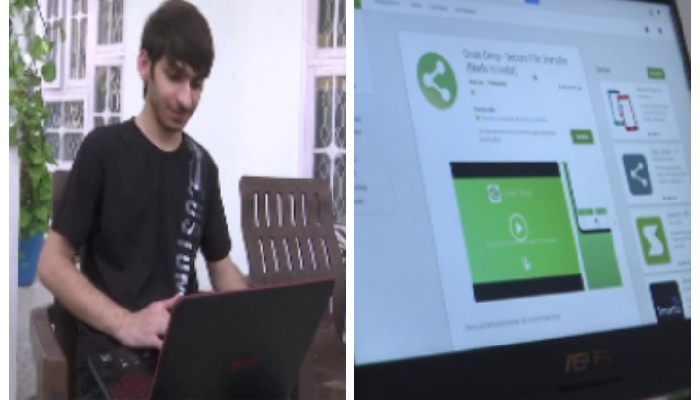
Rajouri, Aug 3: Ashfaq Mehmood Choudhary, a 17-year-old boy from Chattyear of Jammu and Kashmir's Rajouri district, has developed a file-sharing app 'Dodo Drop' which would enable users to share audios, videos, images, and texts between two devices without Internet access.

While speaking to media persons, Ashfaq Mehmood said that the 'Dodo Drop' application is an alternative to the Chinese 'SHAREit' app. "The Indian government has banned several Chinese apps due to data breaching, and among those apps was SHAREit which was used for sharing files.

Users faced a lot of problems due to the ban, and so I decided to make this file-sharing app. With 'Dodo Drop', users can share audios, videos, images, and even texts," he said.

Ashfaq said that it took him four weeks to develop the application, and it was launched on August 1 this year. The 'Dodo Drop' application has a transfer rate of up to 480 mbps, which is faster than the SHAREit app and is "quite easy" to use.

"Users can transfer data comprising photos, videos, audios, apps, texts, etc. between two devices with no Internet access. The transfers are fully encrypted and secure," he added.

"Our Prime Minister has always asserted the need for decreasing the dependency on foreign products and apps and to focus on the development of India-based apps. I tried to be part of the initiative of 'Aatmanirbhar Bharat' by developing an India-based file-sharing app. I want to develop global-standard apps for India," he added.

"We support and cooperate with him. He generates his own income by working on some projects and utilises it. We will continue to support him," said Parvez Ahmed Choudhary, Ashfaq's father.

In July, the Ministry of Electronics and Information Technology (MEITY) banned 47 apps, which were variants and cloned copies of the 59 apps banned earlier in June. These banned clones included SHAREit Lite, Tiktok Lite, Helo Lite, BIGO LIVE Lite, and VFY Lite.

The 59 apps had been banned by the Centre in June in view of the information available that they were engaged in activities which were "prejudicial to sovereignty and integrity and defence" of the country.

Almost all the apps banned had some preferential Chinese interest and the majority had parent Chinese companies.

The ban came amid border tensions with China in the Eastern Ladakh region.

Comments

Add new comment

  • Coastaldigest.com reserves the right to delete or block any comments.
  • Coastaldigset.com is not responsible for its readers’ comments.
  • Comments that are abusive, incendiary or irrelevant are strictly prohibited.
  • Please use a genuine email ID and provide your name to avoid reject.
Agencies
July 6,2020

New Delhi, Jul 6: The Indian Academy of Sciences, a Bengaluru-based body of scientists, has said the Indian Council for Medical Research's (ICMR) target to launch a coronavirus vaccine by August 15 is "unfeasible" and "unrealistic".

The IASc said while there is an unquestioned urgent need, vaccine development for use in humans requires scientifically executed clinical trials in a phased manner.

While administrative approvals can be expedited, the "scientific processes of experimentation and data collection have a natural time span that cannot be hastened without compromising standards of scientific rigour", the IASc said in a statement.

In its statement, the IASc referred to the ICMR's letter which states that "it is envisaged to launch the vaccine for public health use latest by 15th August 2020 after completion of all clinical trials".

The ICMR and Bharat Biotech India Limited, a private pharmaceutical company, are jointly developing the vaccine against the novel coronavirus -- SARS-CoV-2.

The IASc welcomes the exciting development of a candidate vaccine and wishes that the vaccine is quickly made available for public use, the statement said.

"However, as a body of scientists including many who are engaged in vaccine development IASc strongly believes that the announced timeline is unfeasible. This timeline has raised unrealistic hope and expectations in the minds of our citizens," it said.

Aiming to launch an indigenous COVID-19 vaccine by August 15, the ICMR had written to select medical institutions and hospitals to fast-track clinical trial approvals for the vaccine candidate, COVAXIN.

Experts have also cautioned against rushing the process for developing a COVID-19 vaccine and stressed that it is not in accordance with the globally accepted norms to fast-track vaccine development for diseases of pandemic potential.

The IASc said trials for a vaccine involve evaluation of safety (Phase 1 trial), efficacy and side effects at different dose levels (Phase 2 trial), and confirmation of safety and efficacy in thousands of healthy people (Phase 3 trial) before its release for public use.

Clinical trials for a candidate vaccine require participation of healthy human volunteers. Therefore, many ethical and regulatory approvals need to be obtained prior to the initiation of the trials, it added.

The IASc said the immune responses usually take several weeks to develop and relevant data should not be collected earlier.

"Moreover, data collected in one phase must be adequately analysed before the next phase can be initiated. If the data of any phase are unacceptable then the clinical trial is required to be immediately aborted," it said.

For example, if the data collected from Phase 1 of the clinical trial show that the vaccine is not adequately safe, then Phase 2 cannot be initiated and the candidate vaccine must be discarded.

For these reasons, the Indian Academy of Sciences believes that the announced timeline is "unreasonable and without precedent", the statement said.

"The Academy strongly believes that any hasty solution that may compromise rigorous scientific processes and standards will likely have long-term adverse impacts of unforeseen magnitude on citizens of India," it said.

Comments

Add new comment

  • Coastaldigest.com reserves the right to delete or block any comments.
  • Coastaldigset.com is not responsible for its readers’ comments.
  • Comments that are abusive, incendiary or irrelevant are strictly prohibited.
  • Please use a genuine email ID and provide your name to avoid reject.