


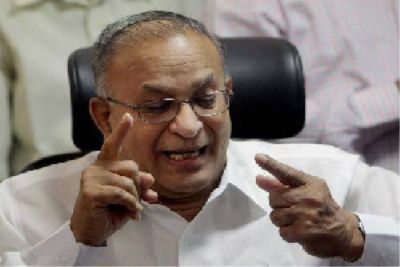
Increase duty on diesel cars up to Rs 2.5 lakh: Jaipal Reddy

June 13, 2012

Jaipal-Reddy

New Delhi, June 13: If the government accepts oil minister S Jaipal Reddy's proposal, the price of small diesel cars could soon rise by Rs 1.7 lakh while medium-to-large guzzlers could become costlier by Rs 2.55 lakh a piece.

The proposal to impose additional excise duty on diesel cars is bound to trigger protests from automakers, who have seen sales growing at the slowest pace in seven months in May. Domestic car sales declined 24% in May compared to the year-ago period due to high fuel prices and interest rates.

The proposal drew a thumbs down from analysts and private players, who described it as an excuse to avoid fuel pricing reforms. "From the RBI to C Rangarajan, head of the PM's Economic Advisory Council, everyone has recommended deregulation of fuel prices. If you can't do that for political reasons, at least fix subsidy on diesel and then let the market determine the pump price. Taxing vehicles would serve hardly any purpose," said an industry analyst requesting anonymity.

But Reddy has his arguments for seeking taxing diesel vehicles that are outpacing petrol car sales. In a June 7 letter to finance minister Pranab Mukherjee, the oil minister gave three key reasons for his proposal aimed at arresting a ballooning fuel subsidy bill.

Reddy pointed out that the proposed additional excise duties are equivalent to the minimum benefit that a diesel car owner derives from the fuel's price differential with petrol — at current prices — over a 10-year assumed life of a vehicle. Petrol in Delhi costs Rs 71.16 a litre against Rs 40.91 for diesel.

Reddy's arithmetic goes like this: he first calculates the total distance a vehicle is expected to clock in its 10-year life span, assuming an annual run of 18,000km. Then, he works out the fuel costs by taking a median mileage of 18km to a litre for small cars and 12km for medium/large vehicles. For good measure, he shaves off 10% of the total cost to level.

According to Reddy's calculation, the additional excise duty amounts to asking the diesel car buyer to pay upfront the price differential with petrol that he or she would enjoy later. A petrol car owner, in contrast, shells out every time at the pump.

Reddy also pointed out the adverse impact of increased diesel car sales on the government's earnings. Petrol attracts an excise duty of Rs 14.78 per litre against Rs 2.06 a litre for diesel. So each time a buyer opts for a diesel car instead of petrol and visits a petrol pump, the government loses Rs 12.72 in excise duty on litre of diesel. Together with the Rs 12.53 a litre subsidy on diesel, the actual price differential with petrol at Delhi works out to Rs 25.75 a litre.

To drive home the enormity of the situation arising out of this increasing dieselization, Reddy says diesel consumption rose by 7.6% in 2011-12 against 6.2% in 2010-11. In contrast, growth in petrol consumption fell from 10.7% in 2010-11 to 5.6% in 2011-12.

The Kirit Parikh Committee on fuel pricing reforms had recommended an additional excise duty of Rs 80,000 in February 2010 when duty difference on petrol and diesel was Rs 9.75 a litre and under-recovery on petrol was more at Rs 3.97 a litre than Rs 2 on diesel.

Comments

Add new comment

  • Coastaldigest.com reserves the right to delete or block any comments.
  • Coastaldigset.com is not responsible for its readers’ comments.
  • Comments that are abusive, incendiary or irrelevant are strictly prohibited.
  • Please use a genuine email ID and provide your name to avoid reject.
News Network
May 18,2020

May 18: The Central Board of Secondary Education (CBSE) on Monday announced the date sheet for the pending class 10 and 12 board exams, which will now be held from July 1 to 15.

The exams were postponed due to the nationwide lockdown imposed on March 25 to contain the spread of COVID-19.

The Class 10 board exams are pending only in the North East Delhi.

"The Class 10 exams will be staggered on four dates, starting July 1. The first paper will be Social Science, while the next day students will be required to appear for the Science exam,” said Sanyam Bhardwaj, the Controller of Examination, CBSE.

“On July 10, exams will be conducted for both courses of Hindi and on July 15 for both courses of English," he said.

On health guidelines for students, Bhardwaj said that they will be required to carry their own sanitiser bottles and wear masks to examination centres.

"Parents will have to ensure that their ward is not sick and candidates will have to strictly follow physical-distancing norms," he said.

For Class 12, the Home Science exam will be held on July 1, followed by both courses of Hindi the next day.

The Class 12 Business Studies exam has been scheduled for July 9, followed by Biotechnology on July 10 and Geography on July 11.

Comments

Add new comment

  • Coastaldigest.com reserves the right to delete or block any comments.
  • Coastaldigset.com is not responsible for its readers’ comments.
  • Comments that are abusive, incendiary or irrelevant are strictly prohibited.
  • Please use a genuine email ID and provide your name to avoid reject.
Agencies
January 14,2020

Microsoft's Indian-origin CEO Satya Nadella on Monday voiced concern over the contentious Citizenship Amendment Act (CAA), saying what is happening is "sad" and he would love to see a Bangladeshi immigrant create the next unicorn in India.

His comments came while speaking to editors at a Microsoft event in Manhattan where he was asked about the contentious issue of CAA which grants citizenship to persecuted non-Muslim minorities from Pakistan, Bangladesh and Afghanistan.

"I think what is happening is sad... It's just bad.... I would love to see a Bangladeshi immigrant who comes to India and creates the next unicorn in India or becomes the next CEO of Infosys," Nadella was quoted as saying by Ben Smith, the Editor-in-Chief of New York-based BuzzFeed News.

In a statement issued by Microsoft India, Nadella said: "Every country will and should define its borders, protect national security and set immigration policy accordingly. And in democracies, that is something that the people and their governments will debate and define within those bounds.

"I’m shaped by my Indian heritage, growing up in a multicultural India and my immigrant experience in the United States. My hope is for an India where an immigrant can aspire to found a prosperous start-up or lead a multinational corporation benefitting Indian society and the economy at large".

The Centre last week issued a gazette notification announcing that the CAA has come into effect from January 10, 2020.

The CAA was passed by Parliament on December 11.

According to the legislation, members of Hindu, Sikh, Buddhist, Jain, Parsi and Christian communities who have come from Pakistan, Bangladesh and Afghanistan till December 31, 2014, due to religious persecution will not be treated as illegal immigrants but given Indian citizenship.

There have been widespread protests against the Act in different parts of the country.

In Uttar Pradesh, at least 19 persons were killed in anti-CAA protests.

Comments

Add new comment

  • Coastaldigest.com reserves the right to delete or block any comments.
  • Coastaldigset.com is not responsible for its readers’ comments.
  • Comments that are abusive, incendiary or irrelevant are strictly prohibited.
  • Please use a genuine email ID and provide your name to avoid reject.
News Network
July 16,2020

New Delhi, Jul 16: With India's economic growth sputtering, the Reserve Bank of India was expected to maintain a rate-cutting cycle, but an uptick in near-term inflation could give the central bank's Monetary Policy Committee reason to pause for now.

Having cut its key lending rate by an aggressive 115 basis points (bps) in 2020, on top of 135 bps cuts in 2019, the RBI so far has had little success in spurring credit growth amid varying degrees of lockdowns across India.

Some economists and market insiders argue it may be prudent for the MPC, the policy committee, to hold its fire when it meets early next month.

"It's probably too early to administer a demand stimulus. The RBI still has room to cut rates, but we probably want to be more cautious of the timing," said Venkat Pasupuleti, portfolio manager at Dalton Investments.

"Maybe they should wait a quarter to see how things pan out once the lockdown situation is eased further."

Market participants have factored in at least a 25 bps rate cut by the MPC on August 6 while analysts are predicting a total 50-75 bps cuts over the rest of the fiscal year that runs to March 31.

The spike in the retail inflation rate above the RBI's mandated 2%-4% target range is another reason for the central bank to take a breather, analysts say.

Annual retail inflation rose to 6.09% in June, compared to 5.84% in March and sharply above a 5.30% median forecast in a Reuters poll of economists.

Rahul Bajoria, an economist at Barclays, said the spike in both consumer and wholesale prices "could lead to a tempering in enthusiasm for material front-loaded policy support from here on."

Almost all economists however agreed the RBI cannot move away from its accommodative stance or call an end to the rate cutting cycle just yet.

India's economy grew at 3.1% in the March quarter - an eight year low - and some economists have predicted a contraction of more than 20% in the June quarter and a contraction of up to 5% in the fiscal year.

"Even in the event of a pause, we think the RBI and MPC would want to hold out the promise of more cuts," said A. Prasanna, economist with ICICI Securities.

RBI Governor Shaktikanta Das said in a recent speech the need of the hour is to restore confidence, preserve financial stability, revive growth and recover stronger, suggesting inflation concerns are unlikely to deter the downward trajectory for rates too soon.

"The August policy decision would boil down to a judgment call over whether RBI can maintain easy monetary and financial conditions without the aid of a token rate cut," Prasanna said. 

Comments

Add new comment

  • Coastaldigest.com reserves the right to delete or block any comments.
  • Coastaldigset.com is not responsible for its readers’ comments.
  • Comments that are abusive, incendiary or irrelevant are strictly prohibited.
  • Please use a genuine email ID and provide your name to avoid reject.