



India's street children bank on the future

July 6, 2012
street_child

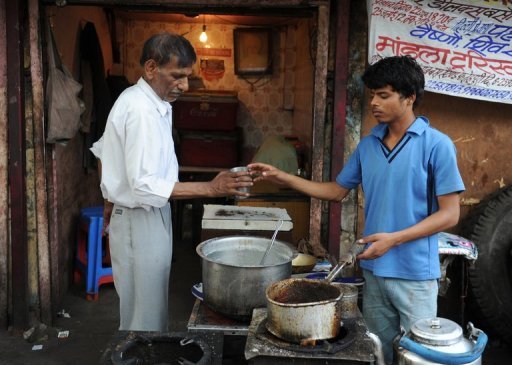
New Delhi, July 6: Ram Singh, 17, earns just one dollar from the 100 cups of tea he makes every day outside Delhi railway station, but each evening, after packing up, he goes to the bank and deposits nearly half of it.

Singh holds an account at a special bank, run for — and mostly by — Indian street children, that keeps what little money they have safe and seeks to instill the idea that savings, however meagre, are important.

Just one among millions of street children who rely on menial jobs for survival, Singh is determined to make his work pay some sort of future dividend.

“I’m smart, but that alone isn’t enough to start a business.

“I save money everyday, hoping to start something of my own. Someday soon,” he said as he served glasses of India’s ubiquitous, spicy milk tea in sweltering heat at a stall near the teeming train station.

The Children’s Development Khazana (treasure chest) opened its first office in New Delhi 2001 and has since spread across the country and overseas with 300 affiliated branches in India, Nepal, Bangladesh, Afghanistan, Sri Lanka and Kyrgyzstan.

Delhi counts 12 branches with around 1,000 child clients aged between nine and 17.

The brightly painted metal cubicles which serve as teller counters are located in shelters that provide children with free meals and sleeping mats, as well as school classes.

The branches are run almost entirely by and for the children, with account holders electing two volunteer managers from the group every six months.

“Children who make money by begging or selling drugs are not allowed to open an account. This bank is only for children who believe in hard work,” said Karan, a 14-year-old “manager”.

During the day, Karan earns a pittance washing up at wedding banquets or other events. In the evening, he sits at his desk to collect money from his friends, update their pass books and close the bank.

“Some account holders want to withdraw their money. I ask them why and give it to them if other children approve. Everyone earns five per cent interest on their savings.”

An adult staff member is always present to collect the takings at the end of each day, depositing the cash in a nationalised bank to earn the interest component.

Sharon Jacob, who works for the rights group Butterflies that set up the bank, said it aimed to give the children a genuine stake in their own future.

“They work in shops as hawkers or porters but they never had a safe place to keep their money. They were always cheated of it or somebody also stole their money,” Jacob said.

“So this is a place where they could keep their money safely and they are also taught life skills, how to manage their finances. They are taught budgeting, they are taught democratic participation,” Jacob said.

Child labour is officially illegal in India but millions of boys and girls have no choice but to earn a living to support themselves or help their families.

Many move to the cities from rural areas, seeking an escape from grinding poverty or abusive homes.

“I ran away from home at the age of 11 after my father beat me for stealing a kitchen appliance,” said Samir who works in a sweatshop.

“For days I slept on a railway platform. I was beaten by the police and even harassed by the drug peddlers. I wanted to go back home but was ashamed of myself.”

Now 14, Samir lives in the children’s shelter and holds an account in the bank.

“I have saved 4,000 rupees (Dh257) in the last seven months. It’s a good feeling to have some money. I will buy a shirt and a watch for my father and send it to him to seek his apology.”

“He might forgive me and ask me to be with him at home.”


Comments

Add new comment

  • Coastaldigest.com reserves the right to delete or block any comments.
  • Coastaldigset.com is not responsible for its readers’ comments.
  • Comments that are abusive, incendiary or irrelevant are strictly prohibited.
  • Please use a genuine email ID and provide your name to avoid reject.
News Network
March 9,2020

New Delhi, Mar 9: A war of words broke out between the BJP and the Congress on Sunday over the Yes Bank crisis with the ruling party seeking to link it with the Gandhi family, while the opposition wondered if the prime minister and finance minister were "complicit" as the bank's loan book grew manifold.

Posting on Twitter a clip of a news channel report that Rana Kapoor, the arrested Yes Bank founder, had bought a painting from Congress leader Priyanka Gandhi Vadra, BJP's information and technology wing in-charge Amit Malviya alleged that every financial crime in India has "deep links" with the Gandhis.

The Congress dismissed the charge "fake" and called it a "diversionary" tactic.

It said Priyanka Gandhi had sold an M F Hussain painting of her father Rajiv Gandhi to Kapoor for Rs 2 crore, and the entire amount was disclosed in her income tax return of 2010.

Malviya tweeted, "Every financial crime in India has deep link with the Gandhis. Mallya used to send flight upgrade tickets to Sonia Gandhi. Had access to MMS (Manmohan Singh) and PC (P Chidambaram). Is absconding. Rahul inaugurated Nirav Modi’s bridal jewellery collection, he defaulted. Rana bought Priyanka Vadra’s paintings."

Congress' chief spokesperson Randeep Surjewala asked how does an M F Hussain painting of Rajiv Gandhi sold 10 years ago by Priyanka Gandhi to Yes Bank owner Rana Kapoor and disclosed in her tax returns connect with unprecedented giving of loans of Rs 2,00,000 crore in five years of the Modi government.

"More so, when (Kapoor's) proximity to BJP leaders is well known," he said.

Rubbishing the BJP's allegation, Congress spokesperson Abhishek Manu Singhvi at a press conference said it was a "diversionary" tactic by the government.

He noted that the bank's loan book rose from Rs 55,633 crore in March 2014, the year Narendra Modi became prime minister, to Rs 2,41,499 crore in March 2019.

"Why did the loan book rise by 100 per cent in two years after demonetisation i.e from Rs 98,210 cr in March 2016 to Rs 2,03,534 ar in March 2018? Were PM and FM sleeping, ignorant or complicit?" he asked.

The entire amount Priyanka Gandhi had received was in cheque and was fully disclosed in the income tax return, Singhvi said.

Surjewala, taking to Twitter, said instead of diverting from the real issue of people's money sinking into a bad bank, should not the government answer questions like how did loans given by Yes Bank rise from Rs 55,633 crore in March 2014 to Rs 2,41,499 crore in March 2019, an increase of almost Rs 2,00,000 crore in fiver years of the Modi government.

Why did the loans given by Yes Bank rise by a whopping 100 per cent in just two years after demonetisation, he asked.

Surjewala also questioned why did the prime minister address a conference sponsored by Yes Bank on March 6 despite the RBI moratorium.

"Why did the Haryana BJP government deposit over Rs 1,000 crore in Yes Bank a month ago, knowing that it was sinking? Is this figure Rs 3,000 cr? Did Fadnavis government in Maharashtra make similar deposits?" Surjewala asked.

"Of course, the government's media proxies won't dare to ask these questions. But the nation wants to know!" he said in a series of tweets.

Kapoor, 62, was arrested by the Enforcement Directorate in Mumbai after charges of alleged financial irregularities and mismanagement in the bank's operations surfaced and the RBI and Union government initiated action to control its affairs.

Comments

Add new comment

  • Coastaldigest.com reserves the right to delete or block any comments.
  • Coastaldigset.com is not responsible for its readers’ comments.
  • Comments that are abusive, incendiary or irrelevant are strictly prohibited.
  • Please use a genuine email ID and provide your name to avoid reject.
News Network
June 6,2020

United Nations, Jun 6: The COVID-19 pandemic, which has presented challenges for several nations, could be an “opportunity” for India to speed up the health insurance scheme Ayushman Bharat, especially with a focus on primary healthcare, WHO chief Tedros Adhanom Ghebreyesus has said.

WHO Director-General Ghebreyesus was responding to a question on the COVID-19 situation in India, where the number of coronavirus cases are increasing rapidly. India went past Italy on Friday to become the sixth worst-hit nation by the COVID-19 pandemic.

India saw a record single-day jump of 9,887 coronavirus cases and 294 deaths on Saturday, pushing the nationwide infection tally to 2,36,657 and the death toll to 6,642, according to the health ministry.

"Of course COVID is very unfortunate and it's challenging for many nations but we need to look for opportunities too. For instance for India, this could be an opportunity to speed up Ayushman Bharat, especially with a focus on primary health care. I know there is a very strong commitment from the government to speed up the implementation of Ayushman Bharat and with primary healthcare and community engagement, I think we can really turn the tide,” Ghebreyesus said during a press briefing in Geneva on Friday.

Ayushman Bharat is the world’s largest health insurance scheme and was launched by the Narendra Modi government in 2018. Last month, Modi had said that the number of people who have benefited from the scheme crossed the one crore-mark.

The scheme aims to cover more than 500 million beneficiaries and provide coverage of Rs 500,000 per family per year.

Referring to the Ayushman Bharat scheme, Ghebreyesus added that “using and speeding up what has started could actually help in India and that's what WHO was very appreciative by the way when Ayushman Bharat started. And this could be a very good opportunity actually to test that and speed up and use it to really fight this pandemic.”

Comments

Add new comment

  • Coastaldigest.com reserves the right to delete or block any comments.
  • Coastaldigset.com is not responsible for its readers’ comments.
  • Comments that are abusive, incendiary or irrelevant are strictly prohibited.
  • Please use a genuine email ID and provide your name to avoid reject.
News Network
February 21,2020

Washington, Feb 21: Days ahead of his India visit, US President Donald Trump on Thursday said the two countries could make a "tremendous" trade deal.

"We're going to India, and we may make a tremendous deal there," Trump said in his commencement address at the Hope for Prisoners Graduation Ceremony in Las Vegas.

Trump, accompanied by First Lady Melania Trump, is scheduled to travel to Ahmedabad, Agra and New Delhi on February 24 and 25.

Ahead of the visit, there have been talks about India and the United States agreeing on a trade package as a precursor to a major trade deal.

During his commencement address, Trump indicated that the talks on this might slowdown if he did not get a good deal.

"Maybe we'll slow down. We'll do it after the election. I think that could happen too. So, we'll see what happens," he said.

"But we're only making deals if they're good deals because we're putting America first. Whether people like it or not, we're putting America first," Trump said.

Bilateral India-US trade in goods and services is about three per cent of the US' world trade.

In a recent report, the Congressional Research Service (CRS) said the trading relationship is more consequential for India -- in 2018 the United States was its second largest goods export market (16.0 per cent share) after the European Union (EU, 17.8 per cent), and third largest goods import supplier (6.3 per cent) after China (14.6 per cent) and the EU 28 (10.2 per cent).

"The Trump Administration takes issue with the US trade deficit with India, and has criticised India for a range of 'unfair' trading practices," the CRS said.

"Indian Prime Minister Modi's first term fell short of many observers' expectations, as India did not move forward with anticipated market opening reforms, and instead increased tariffs and trade restrictions," it said.

"Modi's strong electoral mandate may embolden the Indian government to press ahead with its reform agenda with greater vigour. Slowing economic growth in India raises concerns about its business environment," CRS said.

As per a fact sheet issued by the Council on Foreign Relations (CFR), trade in goods and services between the two countries from 1999 to 2018 surged from $16 billion to $142 billion.

India is now the United States' eighth-largest trading partner in goods and services and is among the world's largest economies.

India's trade with the United States now resembles, in terms of volume, the US' trade with South Korea ($167 billion in 2018) or France ($129 billion), said Alyssa Ayres from CFR.

"The United States for two years now has set out in stone pretty clearly the things that they wanted to see to try to get an agreement, and it's basically then on India's doorstep on whether they want to take those steps," Rick Rossow, Wadhwani Chair in US-India Policy Studies at the Center for Strategic and International Studies think-tank told reporters during a conference call.

"The list of US asks has been pretty static all throughout. Not to say that any of these things are easy for India to do, but the United States to my knowledge didn't change the goalposts just because we now consider India to be a middle-income country. The things that we wanted to see happen to get this trade agreement have been pretty static all throughout, no matter how difficult they are," he said in response to a question.

Comments

Add new comment

  • Coastaldigest.com reserves the right to delete or block any comments.
  • Coastaldigset.com is not responsible for its readers’ comments.
  • Comments that are abusive, incendiary or irrelevant are strictly prohibited.
  • Please use a genuine email ID and provide your name to avoid reject.