



India's street children bank on the future

July 6, 2012
street_child

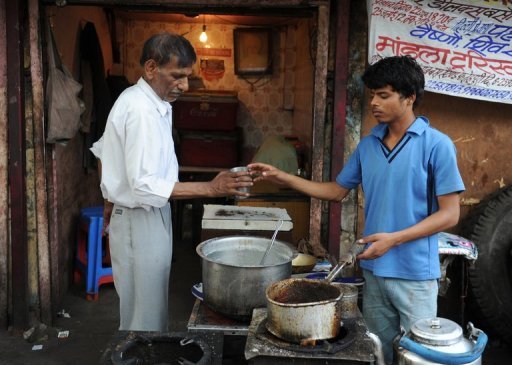
New Delhi, July 6: Ram Singh, 17, earns just one dollar from the 100 cups of tea he makes every day outside Delhi railway station, but each evening, after packing up, he goes to the bank and deposits nearly half of it.

Singh holds an account at a special bank, run for — and mostly by — Indian street children, that keeps what little money they have safe and seeks to instill the idea that savings, however meagre, are important.

Just one among millions of street children who rely on menial jobs for survival, Singh is determined to make his work pay some sort of future dividend.

“I’m smart, but that alone isn’t enough to start a business.

“I save money everyday, hoping to start something of my own. Someday soon,” he said as he served glasses of India’s ubiquitous, spicy milk tea in sweltering heat at a stall near the teeming train station.

The Children’s Development Khazana (treasure chest) opened its first office in New Delhi 2001 and has since spread across the country and overseas with 300 affiliated branches in India, Nepal, Bangladesh, Afghanistan, Sri Lanka and Kyrgyzstan.

Delhi counts 12 branches with around 1,000 child clients aged between nine and 17.

The brightly painted metal cubicles which serve as teller counters are located in shelters that provide children with free meals and sleeping mats, as well as school classes.

The branches are run almost entirely by and for the children, with account holders electing two volunteer managers from the group every six months.

“Children who make money by begging or selling drugs are not allowed to open an account. This bank is only for children who believe in hard work,” said Karan, a 14-year-old “manager”.

During the day, Karan earns a pittance washing up at wedding banquets or other events. In the evening, he sits at his desk to collect money from his friends, update their pass books and close the bank.

“Some account holders want to withdraw their money. I ask them why and give it to them if other children approve. Everyone earns five per cent interest on their savings.”

An adult staff member is always present to collect the takings at the end of each day, depositing the cash in a nationalised bank to earn the interest component.

Sharon Jacob, who works for the rights group Butterflies that set up the bank, said it aimed to give the children a genuine stake in their own future.

“They work in shops as hawkers or porters but they never had a safe place to keep their money. They were always cheated of it or somebody also stole their money,” Jacob said.

“So this is a place where they could keep their money safely and they are also taught life skills, how to manage their finances. They are taught budgeting, they are taught democratic participation,” Jacob said.

Child labour is officially illegal in India but millions of boys and girls have no choice but to earn a living to support themselves or help their families.

Many move to the cities from rural areas, seeking an escape from grinding poverty or abusive homes.

“I ran away from home at the age of 11 after my father beat me for stealing a kitchen appliance,” said Samir who works in a sweatshop.

“For days I slept on a railway platform. I was beaten by the police and even harassed by the drug peddlers. I wanted to go back home but was ashamed of myself.”

Now 14, Samir lives in the children’s shelter and holds an account in the bank.

“I have saved 4,000 rupees (Dh257) in the last seven months. It’s a good feeling to have some money. I will buy a shirt and a watch for my father and send it to him to seek his apology.”

“He might forgive me and ask me to be with him at home.”


Comments

Add new comment

  • Coastaldigest.com reserves the right to delete or block any comments.
  • Coastaldigset.com is not responsible for its readers’ comments.
  • Comments that are abusive, incendiary or irrelevant are strictly prohibited.
  • Please use a genuine email ID and provide your name to avoid reject.
News Network
May 20,2020

May 20: Prime Minister K P Sharma Oli on Tuesday asserted that Lipulekh, Kalapani and Limpiyadhura belong to Nepal and vowed to "reclaim" them from India through political and diplomatic efforts, as his Cabinet endorsed a new political map showing the three areas as Nepalese territory.

Addressing Parliament, Oli said the territories belong to Nepal “but India has made it a disputed area by keeping its Army there”. “Nepalis were blocked from going there after India stationed its Army,” he said.

“India has deployed its troops in Kalapani since 1962 and our rulers in the past hesitated to raise the issue,” he said, asserting, “We will reclaim and get them back.”

The prime minister asserted that the Nepal government will make political and diplomatic efforts to reclaim the territory.

Oli also expressed the hope that India will “follow the path of truth, shown by Satya Meva Jayate, which is mentioned in the Ashoka Chakra, the national symbol of India”.

The prime minister’s remarks came a day after the Cabinet headed by him endorsed a new political map showing Lipulekh, Kalapani and Limpiyadhura under Nepal’s territory.

Foreign Minister Pradeep Kumar Gyawali said the official map of Nepal will soon be made public by the Ministry of Land Management. The move announced by Gyawali came weeks after he said that efforts were on to resolve the border issue with India through diplomatic initiatives.

Nepal''s ruling Nepal Communist Party lawmakers have also tabled a special resolution in Parliament demanding return of Kalapani, Limpiyadhura and Lipulekh to Nepal.

The Lipulekh pass is a far western point near Kalapani, a disputed border area between Nepal and India. Both India and Nepal claim Kalapani as an integral part of their territory - India as part of Uttarakhand’s Pithoragarh district and Nepal as part of Dharchula district.

Gyawali last week summoned the Indian Ambassador Vinay Mohan Kwatra and handed over a diplomatic note to him to protest against the construction of a key road connecting the Lipulekh pass with Dharchula in Uttarakhand.

India has said that the recently-inaugurated road section in Pithoragarh district in Uttarakhand lies completely within its territory. Indian Army chief Gen MM Naravane last week said that there were reasons to believe that Nepal objected to India''s newly-inaugurated road linking Lipulekh Pass with Dharchula in Uttarakhand at the behest of "someone else", in an apparent reference to a possible role by China on the matter.

He said there was no dispute whatsoever between India and Nepal in the area and road laid was very much within the Indian side.

The 80-KM-long strategically crucial road at a height of 17,000 KM along the border with China in Uttarakhand was thrown open by Defence Minister Rajnath Singh earlier this month.

Nepal has raised objection to the inauguration of the road, saying the "unilateral act" was against the understanding reached between the two countries on resolving the border issues. China on Tuesday said the Kalapani border issue is between India and Nepal as it hoped that the two neighbours could refrain from "unilateral actions" and properly resolve their disputes through friendly consultations.

After the endorsement of Nepal’s new map senior ruling party leader and member of Nepal Communist Party Standing Committee Ganesh Shah said the new move may escalate unnecessary tension between Nepal and India at a time when the country is fighting the coronavirus.

"The Nepal government should soon start a dialogue with India to resolve the matter through political and diplomatic moves," he said.

The new map includes 335-km land area including Limpiyadhura in the Nepalese territory.

The new map was drawn on the basis of the Sugauli Treaty of 1816 signed between Nepal and then the British India government and other relevant documents, which suggests Limpiyadhura, from where the Kali river originated, is Nepal''s border with India, The Kathmandu Post quoted an official at the Ministry of Land Reform and Management as saying.

India and Nepal are at a row after the Indian side issued a new political map incorporating Kalapani and Lipulekh on its side of the border in October last year.

The tension further escalated after India inaugurated the road link connecting Kailash Mansarovar, a holy pilgrimage site situated at Tibet, China, that passes through the territory belonging to Nepal.

Comments

Add new comment

  • Coastaldigest.com reserves the right to delete or block any comments.
  • Coastaldigset.com is not responsible for its readers’ comments.
  • Comments that are abusive, incendiary or irrelevant are strictly prohibited.
  • Please use a genuine email ID and provide your name to avoid reject.
The wire
May 20,2020

Bhopal, May 20: Two months after Deepak Bundele, an advocate and former journalist, was brutally assaulted by the Madhya Pradesh’s Betul Police on March 23, an Assistant Sub-Inspector of Kotwali Police Station in Betul district, BS Patel, approached the victim to record his statement. However, he allegedly tried to convince Bundele to withdraw the case saying that the cops had mistaken him for a Muslim since he has a long beard and assaulted him. But, the cop added, they were ashamed of the incident after they came to know that they had beaten their ‘Hindu brother’.
Bundele was on his way to the government hospital for diabetes treatment, a day before the countrywide lockdown was announced, when the assault occurred. Miffed with the incident and after the district police denied to register the case, he wrote to the State Human Rights Commission; Chief Justice of Madhya Pradesh High Court; Chief Minister Shivraj Singh Chouhan; Vivek Johri, Director General of Police, Madhya Pradesh; and SP Betul to register an FIR against the police officials and take punitive action against them.
In the wake of COVID-19 pandemic outbreak, section 144 had been imposed in Betul district and public movement was restricted when the incident had occurred. 
Talking to Bundele, ASI Patel had said, “We seek an apology on behalf of those officials [who assaulted Bundele]. We are truly embarrassed because of the incident. If you want, I can bring those officials and make them apologise in person to you. They mistook you as a Muslim and assaulted you, since you had a long beard. And the man (who assaulted you) is a kattar (staunch) Hindu…In Hindu-Muslim riots whenever a Muslim is arrested, they beat them up brutally, always,” the police official can be heard saying in an audio recording shared by the victim.
In the 14 minutes long audio, he further said, “I request to you to withdraw the complaint. Please agree to our request; understand that we are living in Gandhi’s country; we are all Gandhi’s children…I have at least 50 friends from your caste.”
The cop continued, “All those people are ashamed that they did something like this to a Hindu brother without knowing his identity. We do not have any enmity against you. Whenever there is a Hindu-Muslim riot, police always supports the Hindus; even Muslims know this. But whatever happened with you was because of ignorance. For that, I have no words.” 
Refuting ASI Patel’s claim, Bundele claimed that there was no Hindu-Muslim riot that day, and asked whether he was beaten for being wrongly identified as a Muslim. The police officials agreed, and said: “Yes, exactly.”
“When I constantly declined to withdraw the compliant, he indirectly threatened me saying, ‘Agree to our request, else you and your advocate brother will face consequences’,” Bundele claimed. 
When contacted Betul SP DS Bhadoriya said, “I’m not aware of this audio clip. I will taken strict action, if I receive any such complain.”
Bundele said that he has written to the DGP and other senior police officials with details about the incident.   
THE ASSAULT
On March 23 evening, when Bundele was on his way to a hospital for the treatment, Betul Police allegedly thrashed him. The 32-year-old advocate had worked as a journalist for various dailies in Madhya Pradesh’s state capital for a decade. He moved to Betul in 2017 and started practising in the district court with his brother. “I have been a patient of diabetes and blood pressure for the last 15 years. On March 23, since I was not feeling well, I decided to visit the hospital and get some medicines. But I was stopped by the police midway,” Bundele had said. 
Even though the advocate, who sports a beard, said that he explained to police personnel that he had to get his medicines but one of them slapped him without trying to listen to what he was saying. “When I protested and said that police have no right to beat the public, they got anxious and within no time, many police officials came and started beating me up with sticks,” he added. 
"I need constant medication and lifesaving medicines to survive and I told the policemen everything while they were assaulting me. But, they kept hitting me, even after I fell,” he said, adding, "I bled for almost a 2-3 days after the incident.”
Bundele, sustained multiple injuries and his ear bled for almost two days after the incident, but, Betul police denied to file an FIR in the incident.
‘WILL MOVE TO THE HIGH COURT’
“Even after two months of the incident, no FIR has been registered and it seems that police is trying to sweep the matter under the carpet,” Bundele said, adding, “I have talked to the Supreme Court’s veteran advocate Vivek Tankha and Etasham Hashmi and will take this matter to the court.”
He also raised serious concerns about the communal angle of the incident, saying, “It’s a matter of grave concern that the police is turning communal and targeting a particular community.”

Source: https://www.google.com/amp/s/m.thewire.in/article/communalism/madhya-pr…

Comments

Add new comment

  • Coastaldigest.com reserves the right to delete or block any comments.
  • Coastaldigset.com is not responsible for its readers’ comments.
  • Comments that are abusive, incendiary or irrelevant are strictly prohibited.
  • Please use a genuine email ID and provide your name to avoid reject.
News Network
April 28,2020

New Delhi, Apr 28: With 1,594 new cases of COVID-19 reported in the last 24 hours and 51 deaths, India's total count of coronavirus cases surged to 29,974, said the Union Ministry of Health and Family Welfare on Tuesday.

The total cases are inclusive of 7,026 cured and discharged patients, one migrated and 937 deaths.

At present, there are 22,010 active COVID-19 cases in the country.

Addressing a press conference here, Lav Agarwal, Joint Secretary, Union Health and Family Welfare Ministry, said that in the last 28 days, 17 districts have had no new Covid-19 cases. "This means we need to maintain constant vigil," he added.

Comments

Add new comment

  • Coastaldigest.com reserves the right to delete or block any comments.
  • Coastaldigset.com is not responsible for its readers’ comments.
  • Comments that are abusive, incendiary or irrelevant are strictly prohibited.
  • Please use a genuine email ID and provide your name to avoid reject.