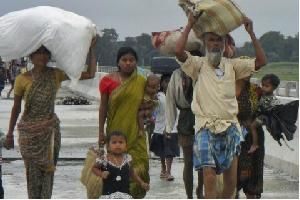
58,000 Bangladeshis went missing in India in 3 years

August 15, 2012

bangla

New Delhi, August 15: Actual figures of illegal immigrants from Bangladesh are a political hot potato. But, official data revealed a disturbing trend, where over 58,000 Bangladeshi citizens came to India and became traceless in the past three years. Bangladeshis were also found to be the worst offenders among foreigners as far as overstaying in India was concerned. Data, shared by the government in Lok Sabha on Tuesday, showed that as many as 82,585 Bangladeshis did not voluntarily return to their country between January 2009, and December 2011.

Though they all had visited India using their valid travel documents, they chose not to go back. Alarmed over their overstay, the government machineries did swing into action. But, only 23,653 out of total 82,585 Bangladeshi citizens could be traced and deported, leaving the whereabouts of 58,932 of them unknown.

The figure assumes significance amid debate over status of illegal Bangladeshi immigrants in the backdrop of the recent violence in Assam, where 77 people were killed in ethnic clashes between Bodo tribals and Muslims. In a written response to a Parliament question, the home ministry disclosed that 21,274 Bangladeshi nationals did not return to their country last year as compared to 28,667 in 2010 and 32,644 in 2009. Deportation figures revealed that 6,761 were sent back in 2011 as against 6,290 in 2010 and 10,602 in 2009.


Comments

Add new comment

  • Coastaldigest.com reserves the right to delete or block any comments.
  • Coastaldigset.com is not responsible for its readers’ comments.
  • Comments that are abusive, incendiary or irrelevant are strictly prohibited.
  • Please use a genuine email ID and provide your name to avoid reject.
News Network
June 24,2020

New Delhi, Jun 24: With the highest single-day spike of 15,968 cases and 465 deaths in the last 24 hours, India's COVID-19 count reached 4,56,183 on Wednesday.

According to the latest update by the Union Ministry of Health and Family Welfare (MoHFW), 14,476 deaths have been recorded due to the infection so far in the country.

The count includes 1,83,022 active cases, and 2,58,685 cured/discharged/migrated patients.

Maharashtra with 1,39,010 confirmed cases remains the worst-affected by the infection so far in the country. The state's count includes 62,848 active, 69,631 cured, discharged patients while 6,531 deaths have been reported due to the infection so far.

Meanwhile, the national capital's confirmed coronavirus cases reached 66,602.

2,301 deaths have been reported in Delhi due to the infection so far.

Tamil Nadu has reported 64,603 cases so far with the death toll reaching 833.

Comments

Add new comment

  • Coastaldigest.com reserves the right to delete or block any comments.
  • Coastaldigset.com is not responsible for its readers’ comments.
  • Comments that are abusive, incendiary or irrelevant are strictly prohibited.
  • Please use a genuine email ID and provide your name to avoid reject.
News Network
March 7,2020

New Delhi, Mar 7: No country in the world says everybody is welcome, External Affairs Minister S Jaishankar said on Saturday, hitting out at those criticising India over the Citizenship (Amendment) Act.

Jaishankar criticised the United Nations Human Rights Council (UNHRC) for its criticism on the situation in Jammu and Kashmir, saying its director had been wrong previously too and one should look at the UN body's past record on handling the Kashmir issue.

"We have tried to reduce the number of stateless people through this legislation. That should be appreciated," he said when asked about the CAA at the ET Global Business Summit. "We have done it in a way that we do not create a bigger problem for ourselves."

"Everybody, when they look at citizenship, have a context and has a criterion. Show me a country in the world which says everybody in the world is welcome. Nobody says that," the minister said.

The external affairs minister said moving out of the Regional Comprehensive Economic Partnership (RCEP) was in the interest of India's business.

Asked about the UNHRC director not agreeing with India on the Kashmir issue, Jaishankar said: "UNHRC director has been wrong before.

"UNHRC skirts around cross-border terrorism as if it has nothing to do with country next door. Please understand where they are coming from; look at UNHRC's record how they handled Kashmir issue in past," he added.

Comments

Add new comment

  • Coastaldigest.com reserves the right to delete or block any comments.
  • Coastaldigset.com is not responsible for its readers’ comments.
  • Comments that are abusive, incendiary or irrelevant are strictly prohibited.
  • Please use a genuine email ID and provide your name to avoid reject.
News Network
February 24,2020

New Delhi, Feb 24: They hail from vastly different backgrounds — Donald Trump is the son of a property tycoon while Narendra Modi is a descendant of a poor tea-seller.

Yet the two teetotallers, loved by right-wing nationalists in their home countries, share striking similarities that have seen them forge a close personal bond, analysts say.

Ahead of the American leader's first official visit to India, which begins in Modi's home state of Gujarat on Monday, the world's biggest democracy has gone out of its way to showcase the chemistry between them.

In Gujarat's capital Ahmedabad, large billboards with the words "two dynamic personalities, one momentous occasion" and "two strong nations, one great friendship" have gone up across the city.

"There's a lot that Trump and Modi share in common, and not surprisingly these convergences have translated into a warm chemistry between the two," Michael Kugelman of the Washington-based Wilson Center said.

"Personality politics are a major part of international diplomacy today. The idea of closed-door dialogue between top leaders has often taken a backseat to very public and spectacle-laden summitry."

Since assuming the top political office in their respective countries — Modi in 2014 and Trump in 2017 — the two men have been regularly compared to each other.

Trump, 73, and Modi, 69, both command crowds of adoring flag-waving supporters at rallies. A virtual cult of personality has emerged around them, with their faces and names at the centre of their political parties' campaigns.

A focus of Trump's administration has been his crackdown on migrants, including a travel ban that affects several Muslim-majority nations, among others, while critics charge that Modi has sought to differentiate Muslims from other immigrants through a contentious citizenship law that has sparked protests.

Both promote their countries' nationalist and trade protectionist movements — Trump with his "America First" clarion call and Modi with his "Make in India" mantra.

And while they head the world's largest democracies, critics have described the pair as part of a global club of strongmen that includes Russia's Vladimir Putin and Brazil's Jair Bolsonaro.

"There are many qualities that Trump and Modi share — a love for political grandstanding and an unshakable conviction that they can achieve the best solutions or deals," former Indian diplomat Rakesh Sood said.

Modi and Trump have sought to use their friendship to forge closer bonds between the two nations, even as they grapple with ongoing tensions over trade and defence.

Despite sharing many similarities in style and substance, analysts say there are some notable differences between the pair.

Modi is an insider who rose through the ranks of the Bharatiya Janata Party after starting out as a cadre in Rashtriya Swayamsevak Sangh.

Trump is a businessman and a political outsider who has in some sense taken over the Republican Party.

"Modi is a more conventional leader than is Trump in that he hasn't sought to revolutionise the office he holds in the way that Trump has," said Kugelman, a longtime observer of South Asian politics.

He added that genuine personal connections between leaders of both countries have helped to grow the partnership.

"George Bush and Manmohan Singh, Barack Obama and Singh, Obama and Modi, now Modi and Trump — there has been a strong chemistry in all these pairings that has clearly helped the relationship move forward," he added.

Trump has also stood by the Indian leader during controversial decisions, including his revocation of autonomy for Kashmir and his order for jets to enter Pakistani territory following a suicide bombing.

Analysts said the leaders would use the visit to bolster their image with voters.

A mega "Namaste Trump" rally in Ahmedabad on Monday will be modelled after the "Howdy, Modi" Houston extravaganza last year when the Indian leader visited the US and the two leaders appeared before tens of thousands of Indian-Americans at a football stadium.

"The success of this visit... will have a positive impact on his (Trump's) re-election campaign and the people of Indian origin who are voters in the US — a majority of them are from Gujarat," former Indian diplomat Surendra Kumar said.

"On the Indian side, the fact that Prime Minister Modi... (shares) such warmth, bonhomie and informality with the most powerful man on Earth adds to his stature... as well as with hardcore supporters."


Comments

Add new comment

  • Coastaldigest.com reserves the right to delete or block any comments.
  • Coastaldigset.com is not responsible for its readers’ comments.
  • Comments that are abusive, incendiary or irrelevant are strictly prohibited.
  • Please use a genuine email ID and provide your name to avoid reject.