


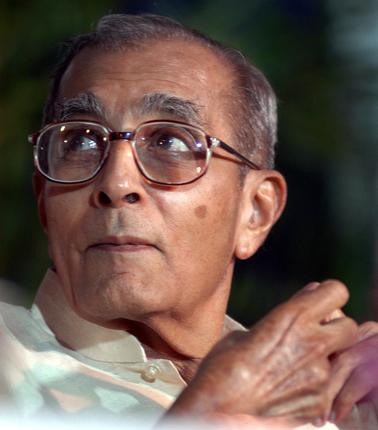
G. Kasturi, moderniser of The Hindu, passes away

[email protected] (The Hindu)
September 21, 2012
G._KasturiChennai, September 21: We record with profound regret and grief the passing of G. Kasturi, former Editor of The Hindu and former Managing Director of Kasturi and Sons Limited, the proprietors of The Hindu Group publications. He presided over, and led from the front, the newspaper’s rapid expansion and innovative modernisation and growth on the editorial-technology-logistics fronts through the 1960s and on to the cusp of the 1990s.

The end came peacefully at 2 a.m. on Friday, September 21, at his home on Kasturi Ranga Road here. Alert and active till almost the very end, he was surrounded by loved ones. He was 87.

He is survived by his wife Kamala Kasturi, sons K. Balaji and K. Venugopal, daughter Lakshmi Srinath, five granddaughters and two great grandchildren. Mr. Balaji, Mr. Venugopal and Ms. Srinath, are whole-time Directors of Kasturi and Sons Limited.

The news was received with a sense of disbelief and anguish at The Hindu’s offices in Chennai as well as in other centres.

Son of Kasturi Gopalan, who was the second of S. Kasturiranga Iyengar’s two sons, Mr. Kasturi was Editor of The Hindu from September 1965 to January 1991 — for more than 25 years. It was the longest tenure for an Editor of the newspaper, which, as on September 20, 2012, is 134 years old. (Kasturi Srinivasan was the Editor from 1934 to 1959).

Born on December 17, 1924, he had his school and college education in Madras. After acquiring an M.A. degree from Madras University creditably, he joined the organisation in 1944. In 1959, he was designated Joint Editor.

The Hindu was his life, says N. Ram

In a tribute, N. Ram, former Editor-in-Chief of The Hindu and other group publications and Director of Kasturi & Sons Limited, said:

“My uncle, Shri G. Kasturi was a major figure in the post-independence history of Indian journalism and the newspaper industry. Along with his uncle, Shri Kasturi Srinivasan, under whom he trained as a newspaperman, he was the longest serving Editor of The Hindu. Earlier and more clearly and determinedly than most of his media contemporaries and fellow Editors, he saw the need for the newspaper industry and journalism to embrace new and state-of-the-art technology and adapt it to our conditions while preserving the core values of journalism. Many a leap in newspaper technology – offset printing, facsimile transmission of whole newspaper pages, photocomposition, full-page pagination, colour scanning – found its first Indian champion in my uncle, who was always hands-on, side by side with the technical experts. He was enthusiastic about internet journalism and digital technology and almost till the end was regularly on his iMac working on page design and photographs and savouring the best of international newspaper websites. He believed that Indian newspapers had to raise their game in terms of production values and must not take their readers for granted. Significantly, he lived to see the 134th anniversary of the founding of The Hindu on September 20 and passed away a couple of hours into September 21. The Hindu was his life.”


Comments

Add new comment

  • Coastaldigest.com reserves the right to delete or block any comments.
  • Coastaldigset.com is not responsible for its readers’ comments.
  • Comments that are abusive, incendiary or irrelevant are strictly prohibited.
  • Please use a genuine email ID and provide your name to avoid reject.
News Network
April 19,2020

New Delhi, Apr 19: With 1,334 fresh cases of coronavirus reported in the last 24 hours, the total number of confirmed cases of COVID-19 in India has reached 15,712 including 507 deaths, said Lav Aggarwal, Joint Secretary, Health and Family Welfare, here on Sunday.

As many as 2,231 people have recovered from the disease so far, said Aggarwal during the daily media briefing on the coronavirus. "This equals 14.1 per cent of the total cases," he added.

"A total of 15,712 confirmed cases have been reported in India including 507 deaths and 2,231 people, who were COVID-19 positive, have recovered. Out of the total deaths, 27 deaths have been reported in the last 24 hours," said Aggarwal.

The Joint Secretary said that no new case was reported in Mahe in Puducherry and Karnataka's Kodagu in the last 28 days.

"A total of 54 other districts beside these two in 23 States/Union Territories did not report any cases in the last 14 days," he said.

He informed that there are 755 dedicated COVID-19 hospitals and 1,389 dedicated health care centres in the country, which takes the total dedicated facilities where severe or critical patients can be treated to 2,144.

Comments

Add new comment

  • Coastaldigest.com reserves the right to delete or block any comments.
  • Coastaldigset.com is not responsible for its readers’ comments.
  • Comments that are abusive, incendiary or irrelevant are strictly prohibited.
  • Please use a genuine email ID and provide your name to avoid reject.
News Network
April 23,2020

Washington, Apr 23: Air pollution over northern India has plummeted to a 20-year-low for this time of the year, according to satellite data published by US space agency National Aeronautics and Space Administration (NASA).
The US space agency's satellite sensors observed aerosol levels at a 20-year low post the countrywide lockdown, implemented to slow the spread of the novel coronavirus.

"We knew we would see changes in atmospheric composition in many places during the lockdown," said Pawan Gupta, a Universities Space Research Association (USRA) scientist at NASA''s Marshall Space Flight Center. "But I have never seen aerosol values so low in the Indo-Gangetic Plain at this time of year," added Mr Gupta.

Acting Assistant Secretary of State for South and Central Asia Alice G Wells tweeted, "These images from NASA were taken each spring starting in 2016 and show a 20-year low in airborne particle levels over India. When India and the world are ready to work and travel again, let's not forget that collaborative action can result in cleaner air."

The data published with maps show aerosol optical depth (AOD) in 2020 compared to the average for 2016-2019. Aerosol optical depth is a measure of how light is absorbed or reflected by airborne particles as it travels through the atmosphere.

If aerosols are concentrated near the surface, an optical depth of 1 or above indicates very hazy conditions. An optical depth, or thickness, of less than 0.1 over the entire atmospheric vertical column is considered "clean." The data were retrieved by the Moderate Resolution Imaging Spectroradiometer (MODIS) on NASA's Terra satellite.

In the first few days of the lockdown, it was difficult to observe a change in the pollution signature. "We saw an aerosol decrease in the first week of the shutdown, but that was due to a combination of rain and the lockdown," said Mr Gupta.

Around March 27, heavy rain poured over vast areas of northern India and helped clear the air of aerosols. Aerosol concentrations usually increase again after such heavy precipitation.

"After the rainfall, I was really impressed that aerosol levels did not go up and return to normal. We saw a gradual decrease and things have been staying at the level we might expect without anthropogenic emissions," Mr Gupta said.

On March 25, the Indian government placed its 1.3 billion citizens under a strict lockdown to reduce the spread of COVID-19. The countrywide mandate decreased activity at factories and severely reduced car, bus, truck and airplane traffic. Every year, aerosols from anthropogenic (human-made) sources contribute to unhealthy levels of air pollution in many Indian cities.

Aerosols are tiny solid and liquid particles suspended in the air that reduce visibility and can damage the human lungs and heart.

In southern India though, the story is a little hazier. Satellite data show aerosol levels have not yet decreased to the same extent. In fact, levels seem to be slightly higher than in the past four years. The reasons are unclear but could be related to recent weather patterns, agricultural fires, winds or other factors.

"This a model scientific experiment," Robert Levy, program leader for NASA's MODIS aerosol products, said about the lockdown and its effects on pollution.

"We have a unique opportunity to learn how the atmosphere reacts to sharp and sudden reductions in emissions from certain sectors. This can help us separate how natural and human sources of aerosols affect the atmosphere," Mr Levy added.

Comments

Add new comment

  • Coastaldigest.com reserves the right to delete or block any comments.
  • Coastaldigset.com is not responsible for its readers’ comments.
  • Comments that are abusive, incendiary or irrelevant are strictly prohibited.
  • Please use a genuine email ID and provide your name to avoid reject.
News Network
February 16,2020

New Delhi, Feb 16: RSS chief Mohan Bhagwat on Saturday said everyone is unhappy in the society and constantly agitating notwithstanding a "many-fold rise" in materialistic comforts and pleasures.

Addressing a gathering of Sangh workers and intellectuals here in Gujarat, Mr Bhagwat also said that even political parties who are not in power are also agitating.

"Inspite of increase in comforts and materialistic pleasures, everyone is unhappy and is staging agitations. Be it owner or servant, a party in opposition, the common man students, teachers, everyone is unhappy and dissatisfied," the Rashtriya Swayamsewak Sangh (RSS) chief said.

He was speaking on the topic "India's Role in the Present World Context".

Mr Bhagwat further said that bigotry, violence and terrorism are on the rise in the present world.

"India has to give 'dharma'  (wisdom) to the world so that knowledge spreads but humans do not become robotic. We have always talked about the concept of global family but not global market," he said.

The lecture was organised by "Madhav Smruti Nyas", an organisation backed by the RSS.

"To think that we are living in a better world is a half truth. Facilities are not evenly distributed. Rule of Jungle is prevailing. A capable person is crushing the weak to climb up. Knowledge is used more for the destruction of the world," the Sangh chief said.

Mr Bhagwat said people are also misusing social media by spreading "false information" to create controversies.

He also stated that trying to put "everyone into one uniform" is also a form of bigotry.

"US and Russia are super powers. China would become a super power too. Now, what super power nations did to others? They just took control of other countries for their own selfish agenda. These super powers gave it back only when they were asked to do so. Otherwise, they never gave anything to others," said Mr Bhagwat.

Comments

Add new comment

  • Coastaldigest.com reserves the right to delete or block any comments.
  • Coastaldigset.com is not responsible for its readers’ comments.
  • Comments that are abusive, incendiary or irrelevant are strictly prohibited.
  • Please use a genuine email ID and provide your name to avoid reject.