



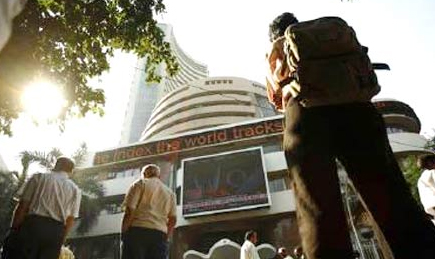
Indian stock market slips below trillion-dollar mark, rupee at record low

August 6, 2013

Indian_stockMumbai, Aug 6: Indian stock market slipped below the trillion-dollar level in terms of total valuation of all listed companies on Tuesday morning, as downward pressure continued on rupee and share prices.

Rupee touched its all-time low level of Rs 61.51 against the US dollar in early trade and the stock market also lost further ground with a fall of over one per cent in the benchmark Sensex.

As a result, the total market capitalisation of all listed stocks in the country fell to nearly USD 992 billion (close to Rs 60.9 lakh crore), pushing India out of the elite global league of markets having a trillion-dollar valuation.

The BSE benchmark Sensex tumbled by more than 200 points in the late morning trade on fresh selling mainly in realty, metal, consumer durable, banking and captial goods sectors.

Indian stock market has been holding to the trillion-dollar level by a wafer-thin margin for last few days amid continuing weakness in stocks and rupee values.

At the end of Monday's trade, the total valuation of all listed stocks in India stood at Rs 61,55,448.63 crore (USD 1.011 trillion), while it had touched a low of USD 1.004 trillion last week.

With India out of this league, only 13 stock markets across the world currently enjoy a trillion-dollar status, led by the US (an estimated USD 20 trillion).

Other members of this elite club are - UK, Japan, China, Canada, Hong Kong, Germany, France, Switzerland, Australia, South Korea, Nordic region and Brazil.

While markets like Russia, Spain and South Africa have moved out of this club after enjoying a trillion-dollar status in the past, at least three more markets -- Brazil, South Korea and Nordic region markets -- are maintaining this level with small margins.

India had first entered the trillion-dollar club in June 2007, but moved out in September 2008, amid a global slowdown. It again got back into this elite league in May 2009 and had largely remained there since then, except for some brief periods.

Rather than the fall in share values, the rupee weakness has been the greater force behind the dollar-valuation plunge in the recent months.

Since the beginning of the current fiscal in April 2013, though the rupee valuation of Indian stock market has fallen by only about 4 per cent (from Rs 63.88 lakh crore to Rs 60.90 crore), but its dollar valuation has plunged by about 18 per cent (from USD 1,209 billion to USD 992 billion).

Rupee has depreciated by over 12 per cent during this period.

Comments

Add new comment

  • Coastaldigest.com reserves the right to delete or block any comments.
  • Coastaldigset.com is not responsible for its readers’ comments.
  • Comments that are abusive, incendiary or irrelevant are strictly prohibited.
  • Please use a genuine email ID and provide your name to avoid reject.
Agencies
February 14,2020

Lucknow, Feb 14: Uttar Pradesh doctor Kafeel Khan was on Friday booked under the National Security Act (NSA) over his alleged anti-CAA speech at Aligarh Muslim University on December 12, 2019.

The Uttar Pradesh slapped NSA on Kafeel Khan on Friday even as the doctor waited to be released from jail despite being granted bail on Monday in connection with his alleged inflammatory speech.

SP Crime Dr Arvind said that there were sufficient grounds to book the doctor under NSA.

The suspended pediatrician, Kafeel Khan, was arrested for allegedly delivering a controversial speech during Anti-CAA protests on December 12 at the Aligarh Muslim University or AMU. While he was granted bail on Monday, his family members claimed on Thursday that he was yet to be released.

Dr Kafeel Khan's brother Adeel Ahmed Khan had issued a statement saying that despite being granted bail Mathura jail authorities had not honoured the court's order.

Dr Kafeel Khan was arrested by the UP Special Task Force from Mumbai on January 29 for participating anti-CAA protest at AMU. A case was registered against him at the Civil Lines police station here for promoting enmity between different religions.

After his arrest in Mumbai, Dr Khan was brought to Aligarh, from where he was shifted to the district jail in neighbouring Mathura.

According to police, this was done as a precautionary measure in view of the anti-CAA protests on the AMU campus and at the Eidgah grounds in the old city. Police had said that the Dr Khan's presence in the Aligarh jail could have aggravated the law and order situation in the city.

The doctor was earlier arrested for his alleged role in the death of over 60 children in one week at the BRD Medical College in Gorakhpur in August 2017. Short supply of oxygen at the children's ward was blamed at that time for the deaths.

About two years later, a state government probe cleared Khan of all major charges, prompting him to seek an apology from the Yogi Adityanath government.

Comments

Add new comment

  • Coastaldigest.com reserves the right to delete or block any comments.
  • Coastaldigset.com is not responsible for its readers’ comments.
  • Comments that are abusive, incendiary or irrelevant are strictly prohibited.
  • Please use a genuine email ID and provide your name to avoid reject.
News Network
July 16,2020

New Delhi, Jul 16: With India's economic growth sputtering, the Reserve Bank of India was expected to maintain a rate-cutting cycle, but an uptick in near-term inflation could give the central bank's Monetary Policy Committee reason to pause for now.

Having cut its key lending rate by an aggressive 115 basis points (bps) in 2020, on top of 135 bps cuts in 2019, the RBI so far has had little success in spurring credit growth amid varying degrees of lockdowns across India.

Some economists and market insiders argue it may be prudent for the MPC, the policy committee, to hold its fire when it meets early next month.

"It's probably too early to administer a demand stimulus. The RBI still has room to cut rates, but we probably want to be more cautious of the timing," said Venkat Pasupuleti, portfolio manager at Dalton Investments.

"Maybe they should wait a quarter to see how things pan out once the lockdown situation is eased further."

Market participants have factored in at least a 25 bps rate cut by the MPC on August 6 while analysts are predicting a total 50-75 bps cuts over the rest of the fiscal year that runs to March 31.

The spike in the retail inflation rate above the RBI's mandated 2%-4% target range is another reason for the central bank to take a breather, analysts say.

Annual retail inflation rose to 6.09% in June, compared to 5.84% in March and sharply above a 5.30% median forecast in a Reuters poll of economists.

Rahul Bajoria, an economist at Barclays, said the spike in both consumer and wholesale prices "could lead to a tempering in enthusiasm for material front-loaded policy support from here on."

Almost all economists however agreed the RBI cannot move away from its accommodative stance or call an end to the rate cutting cycle just yet.

India's economy grew at 3.1% in the March quarter - an eight year low - and some economists have predicted a contraction of more than 20% in the June quarter and a contraction of up to 5% in the fiscal year.

"Even in the event of a pause, we think the RBI and MPC would want to hold out the promise of more cuts," said A. Prasanna, economist with ICICI Securities.

RBI Governor Shaktikanta Das said in a recent speech the need of the hour is to restore confidence, preserve financial stability, revive growth and recover stronger, suggesting inflation concerns are unlikely to deter the downward trajectory for rates too soon.

"The August policy decision would boil down to a judgment call over whether RBI can maintain easy monetary and financial conditions without the aid of a token rate cut," Prasanna said. 

Comments

Add new comment

  • Coastaldigest.com reserves the right to delete or block any comments.
  • Coastaldigset.com is not responsible for its readers’ comments.
  • Comments that are abusive, incendiary or irrelevant are strictly prohibited.
  • Please use a genuine email ID and provide your name to avoid reject.
Agencies
August 4,2020

New Delhi, Aug 4: Over 50 per cent of COVID-19 deaths in India have taken place among people aged 60 years and above and 37 per cent deaths have been reported among patients in the age group of 45 to 60 years, Health Ministry said on Tuesday.

Addressing a press conference, Rajesh Bhushan, Secretary, Health Ministry said that 11 per cent COVID-19 deaths took place in the age group of 26 to 44.

The 18 to 25 age group and those below 18 years reported one per cent deaths each.
"Currently, 5,86,298 active COVID-19 cases are in India and over 12 lakh people have recovered.

50 per cent deaths due to COVID19 have taken place among the age group of 60 years or above and 37 per cent deaths took place in the age group between 45 to 60 years," Bhushan said.

"A total of 11 per cent COVID-19 deaths took place in the age group of 26 to 44. Only 1 per cent in 18 to 25 age group and 1 per cent in below the age of 18 years," he added.

Bhushan said that 68 per cent of COVID-19 deaths have been reported among male patients and 32 per cent among female patients which is broadly in line with the global scenario.

The number of recovered COVID-19 patients in India is increasing daily and is now over double the number of active cases.

Bhushan said that the case fatality rate (CFR) is lowest since the first lockdown.

"More than 2 crore COVID-19 tests have been conducted, including more than 6.6 lakh tests in the last 24 hours. Recovered cases are now double of the active cases. 

The case fatality rate (CFR) is lowest since the first lockdown," he said
"This is the first time after the first lockdown that the fatality rate is at the lowest, at 2.10 per cent. The fatality rate has seen a progressive decline and it is continuing, which is a good sign," he added.

According to the World Health Organisation, CFR is a measure of the severity of a disease and is defined as the proportion of reported cases of a specified disease or condition which are fatal within a specified time.

Comments

Add new comment

  • Coastaldigest.com reserves the right to delete or block any comments.
  • Coastaldigset.com is not responsible for its readers’ comments.
  • Comments that are abusive, incendiary or irrelevant are strictly prohibited.
  • Please use a genuine email ID and provide your name to avoid reject.